From Ambewela to Ragala: Exploring the Hill Country Dairy Belt and Its Colonial Roots
From Ambewela to Ragala: Exploring the Hill Country Dairy Belt and Its Colonial Roots | The central highlands of Sri Lanka are often celebrated for misty valleys, tea blankets, and cool mountain air. Yet tucked within this landscape lies another heritage—quiet, pastoral, and shaped as much by colonial-era ambition as by the region’s natural abundance. The stretch from Ambewela to Ragala, sometimes called Sri Lanka’s “Dairy Belt”, is a living record of how the island’s uplands became a centre of livestock farming, milk production, and experimental agriculture long before the modern dairy industry emerged.
This article traces that evolution: how geography shaped the region, how colonial influence transformed its purpose, and how today’s dairy farms, grasslands, and communities continue a legacy that began nearly 150 years ago.
The Highlands That Became a Natural Dairy Zone
Ambewela, Pattipola, and Ragala sit more than 6,000 feet above sea level, forming one of the coldest and most temperate climates in Sri Lanka. Unlike the steamy lowlands, these uplands remain cool year-round, with temperatures often dipping below 10°C at dawn. For grazing animals, especially European cattle breeds, such conditions are ideal.
Long before colonisation, the upper hills supported montane forests and open grasslands (patnas). These grasslands proved particularly suitable for livestock. After the British arrived in the 19th century, they quickly recognised the region’s potential—not just for tea, which became the backbone of the plantation economy, but also for dairy farming.
The climate, altitude, and vegetation created a “natural laboratory” for cattle rearing and milk production. This environmental advantage laid the foundation for what would later become Sri Lanka’s most prominent dairy corridor.
The Colonial Experiments That Shaped Ambewela
Under British rule, the highlands became the site of several agricultural experiments. While tea and cinchona dominated commercial interests, the administration also explored dairy farming as part of a broader effort to diversify upland agriculture. By the late 1800s, Ambewela was earmarked as a zone where European cattle could thrive.
Early colonial planters introduced Ayrshire and Friesian breeds—cows known for high milk yields in cold climates. The intention was twofold: supply milk and butter to plantation communities, and test whether dairy could become a viable export industry.
Infrastructure soon followed. Access roads cut through forests. Grasslands were expanded. Livestock stations were established at key points between Ambewela and Ragala. These developments transformed the highlands from untouched montane ecosystems into organised farmlands, shaping the visual identity of the region.
Though commercial dairy exports never matched the profitability of tea, the colonial foundations firmly positioned Ambewela as the central dairy heartland of the island.
From Estate Livestock to National Supply: Post-Independence Growth
After 1948, Sri Lanka inherited both the opportunities and limitations of the colonial dairy system. While large plantations continued to use cattle for estate needs, successive governments sought to scale up dairy production as part of national food security.
The Livestock Development Board (LDB) took over many of the colonial farms, modernising infrastructure and expanding herds. More scientific breeding programmes emerged. Artificial insemination techniques improved livestock genetics. Veterinary services extended deeper into rural communities, enabling smallholder farmers to participate in the sector.
Ambewela, in particular, became the flagship dairy farm of the highlands—earning nicknames such as “Little New Zealand” due to its temperate environment and structured grazing lands.
Ragala, less commercialised but equally fertile, developed a mix of estate-led and village-level dairy initiatives, contributing to a more distributed dairy economy across the region.
Life in the Dairy Belt: Communities, Culture, and Daily Rhythms
Beyond historical and economic forces, the dairy belt is also defined by the people who live and work across its slopes. For generations, dairy farming has shaped village life in Ambewela, Boralanda, Ohiya, Uvaparanagama, and Ragala.
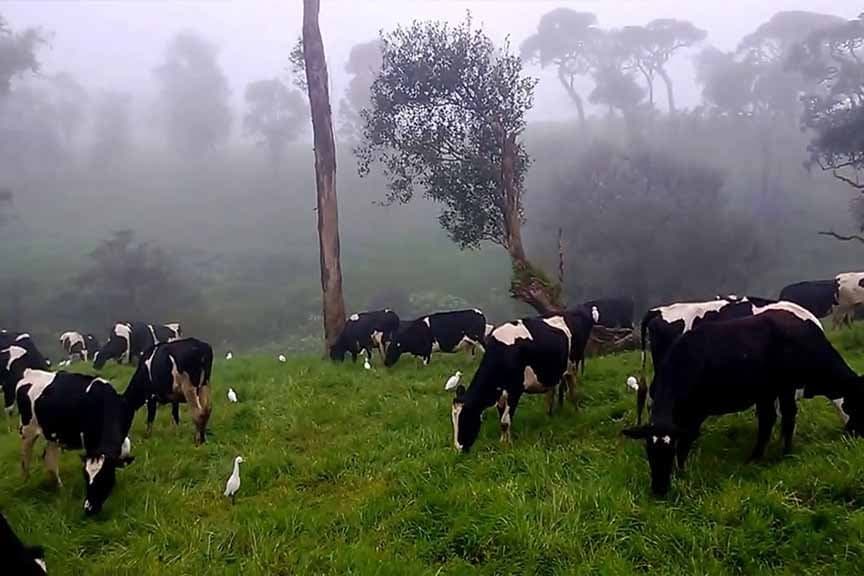
Daily routines revolve around milking schedules, grass cutting, feeding, and maintaining cattle sheds. The early morning fog and cold winds become part of life for farmers who rise before sunrise to gather milk for collection centres.
Smallholder dairy farmers form the backbone of local supply chains. While commercial estates contribute significantly, it is often the villagers—managing one to five cows each—who sustain daily milk production. Cooperative societies, milk chilling centres, and local transport networks support this decentralised system.
Culturally, dairy has influenced everything from household diets to local trade patterns. Fresh milk, curd, and butter are staples in many hill-country homes. In parts of Ragala and Walapane, dairy-linked income supports schooling, small businesses, and community development.
Grasslands, Wildlife, and Environmental Concerns
The transformation of Ambewela and Ragala into dairy zones also carries an environmental backdrop. Large swathes of the highlands that were once pristine montane forest became patna grasslands, partly shaped by livestock grazing and estate expansion.
These grasslands now support a delicate ecological balance. They host herds of sambar, birds of prey, montane flora, and rare amphibians. At the same time, overgrazing, invasive plants, and changing climate patterns pose challenges to long-term sustainability.
Some conservationists argue that the dairy belt must adopt rotational grazing, controlled herd sizes, and better land management to protect biodiversity. Others point out that the region’s grasslands—though altered by humans—have developed into unique ecosystems with their own ecological value.
Balancing dairy production with environmental stewardship remains an evolving conversation.
The Modern Dairy Landscape: What Ambewela and Ragala Mean Today
Today, Ambewela stands as a symbol of Sri Lanka’s modern dairy aspirations. Large-scale farms showcase high-yielding cattle, mechanised milking systems, and improved feed management. Visitors often see neatly divided paddocks, clean barns, and cows grazing against dramatic misty backdrops.
Ragala, meanwhile, offers a more community-centred model. Smaller farms, dispersed across rolling hills, contribute steadily to the region’s collective output. The emphasis here is on local livelihoods, cooperative marketing, and complementing agriculture with dairy as a secondary income stream.
Together, these areas illustrate two parallel narratives:
- Commercial dairy production shaped by historical investment.
- Grassroots dairy culture sustained by rural families and tradition.
Both play essential roles in shaping Sri Lanka’s dairy future.
Click on here “Galle’s Military Past: How the Fort Shaped Trade, Power, and People”
Why the Hill Country Dairy Belt Still Matters
From colonial beginnings to modern realities, the Ambewela–Ragala corridor represents more than just milk production. It reflects:
• the fusion of foreign influence with local adaptation
• the resilience of hill-country communities
• the environmental value of highland grasslands
• the economic importance of domestic milk supply
• the possibility of expanding dairy self-sufficiency in Sri Lanka
As the nation continues to debate import dependency, nutrition standards, and agricultural reform, the lessons from the dairy belt remain relevant. The region shows what is possible when climate, community, and careful planning intersect.
A Living Heritage
The story of Ambewela to Ragala is not simply a chapter of colonial history. It is an ongoing narrative where past decisions shape present landscapes, and where modern aspirations build on foundations laid more than a century ago.
Mist, cattle, grasslands, and quiet mountain roads continue to define this highland dairy belt. But beneath the calm surface lies a dynamic system—one that bridges colonial heritage with contemporary challenges, and tradition with innovation.
The dairy belt endures, feeding both the nation’s households and its historical imagination.