The story of Ceylon in World War One is rarely told today. Yet in the corridors of some of Sri Lanka’s oldest schools, memorials still bear the names of former pupils who left the island to fight in France, Belgium and other distant battlefields between 1914 and 1918.
They were young men who had grown up in colonial Ceylon, attended school in Colombo and elsewhere, played cricket, and expected to pursue ordinary careers. Some were already working when war broke out in Europe in August 1914. Others were studying overseas.
Within a few years, their names would appear in military records from France, Belgium, Gallipoli and the Middle East.
Some returned to Ceylon after the war. Others were buried thousands of miles from home.
The First World War is usually remembered through the experiences of Britain, France, Australia, New Zealand and Canada. Far less is said about the men from Ceylon who served in the conflict, or the island’s wider contribution to the British imperial war effort.
Yet the records are there, particularly in the archives of our older schools, military histories and the memorials that have survived for more than a century.
Ceylon in World War One: Life in 1914
Colombo was already a busy commercial city when war broke out.
Steamships arrived regularly at its harbour, electric trams carried passengers through the streets, and the mercantile establishments of the Fort maintained close connections with London and other trading centres.
Along Galle Face, people gathered in the evenings to enjoy the sea breeze. Churches held their Sunday services, schools followed their established routines, and newspapers brought reports of events taking place overseas.
Further inland, the tea plantations of the central highlands formed an important part of the island’s economy. Trains carried passengers and produce between the hill country and Colombo, while the rubber and coconut industries continued to expand.
Ceylon was a British Crown Colony, administered within an imperial system that connected the island to Britain politically, commercially and militarily.
When Britain declared war on Germany in August 1914, Ceylon was drawn into the conflict.
The war initially appeared distant from everyday life on the island. But as the fighting spread and volunteers began leaving for overseas service, its effects became increasingly visible.
Newspapers reported developments in Europe, military units were mobilised, and families began receiving letters from men serving abroad.
From Ceylon’s Schools to the Battlefields
One of the clearest records of Ceylonese participation in the First World War can be found in the history of S. Thomas’ College.
The College was still located at Mutwal when the war began. Its move to Mount Lavinia took place in January 1918, while fighting continued in Europe.
A historical compilation records 86 Old Thomians who volunteered for service during the Great War. The College’s commemorative records have helped preserve their names and the history of their participation.
These were not simply supporters of the war effort. Some served in combat formations and fought on the Western Front.
Among the best-known was Second Lieutenant Basil Arthur Horsfall, a former S. Thomas’ College cricketer who served in the British Army.
Horsfall was awarded the Victoria Cross for exceptional gallantry during fighting in France in March 1918. He was killed in action during the engagement.
His journey from the cricket grounds of Ceylon to the Western Front is one of the better-documented examples of an Old Thomian’s military service.
S. Thomas’ was not alone in sending former pupils to the war.
Royal College, Trinity College and Kingswood College also had Old Boys who volunteered for military service. Historical research has brought together records of volunteers from these institutions, including men from Ceylon’s Sinhalese, Tamil, Burgher, Malay and European communities.
The records demonstrate that the island’s military contribution extended beyond the European planting community and British residents.
Ceylonese men themselves enlisted, fought and died during the conflict.
The school memorials remain important sources for understanding this part of the island’s history. They provide names and connections that might otherwise have disappeared from public memory.
The Volunteers Who Left Ceylon
Ceylon had a tradition of volunteer military service before the First World War.
The Ceylon Light Infantry Volunteers, Ceylon Artillery Volunteers and other formations eventually became part of the Ceylon Defence Force, established in 1910.
When war began, the Defence Force was mobilised for local duties, including the protection of important installations and communications.
Some volunteers subsequently travelled overseas, while other men connected with Ceylon enlisted independently in British military formations.
The circumstances of their enlistment varied.
Some had been educated in Britain and joined military units there. Others left Ceylon specifically to volunteer. Their opportunities were influenced by the racial and administrative distinctions of the colonial period.
Military service was not organised through a single Ceylonese expeditionary force. Instead, volunteers from the island served in different units and theatres of war.
This helps explain why their histories are scattered across British military records, school archives and family collections.
The Ceylon Planters’ Rifle Corps at Gallipoli
One of the best-known volunteer formations associated with Ceylon was the Ceylon Planters’ Rifle Corps.
Established in Kandy in 1900, the Corps was composed principally of European tea and rubber planters.
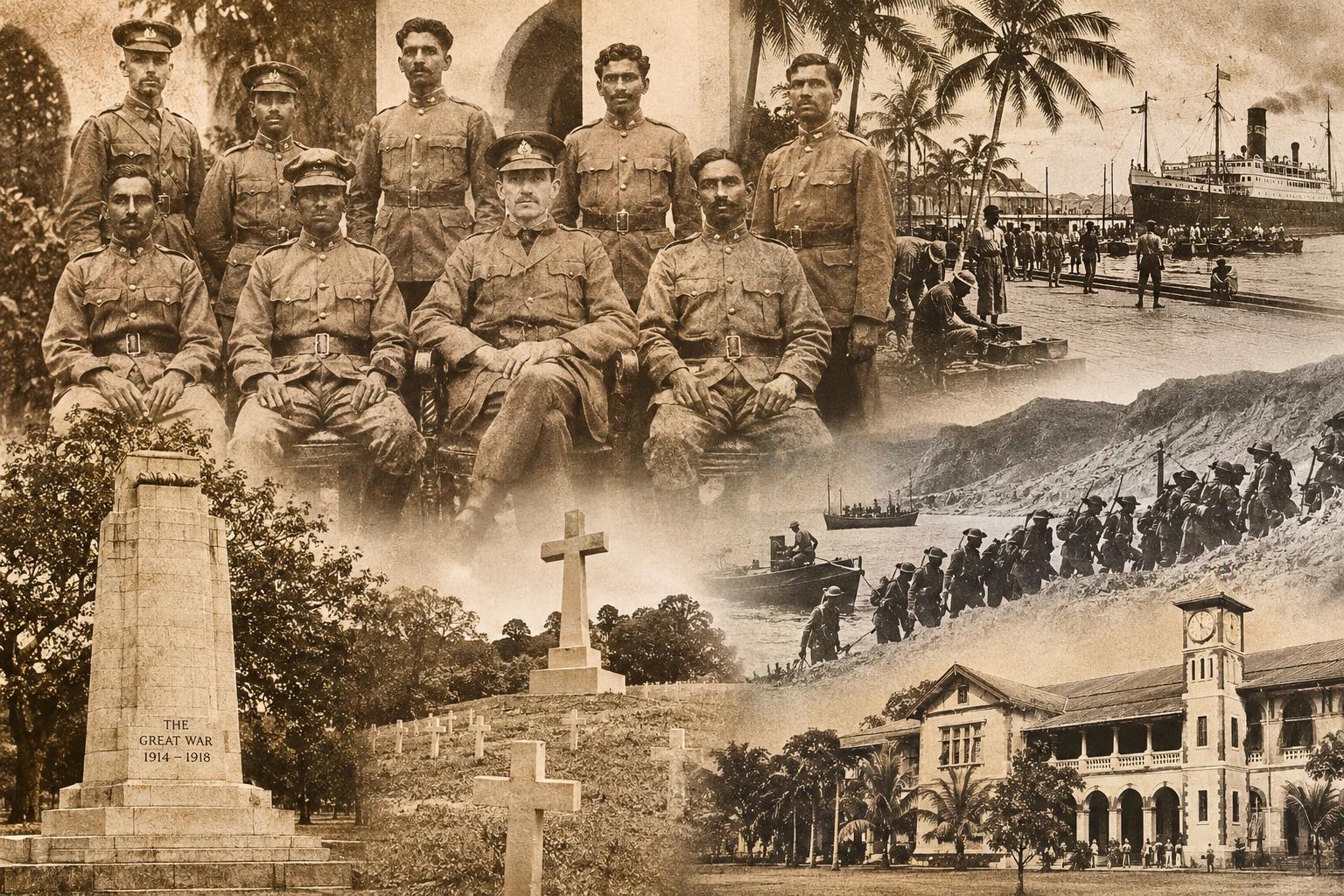
In October 1914, approximately 230 officers and men departed for Egypt.
Members of the Corps were subsequently attached to Australian and New Zealand forces and served during the Gallipoli campaign of 1915.
Gallipoli was an attempt by the Allied powers to secure the Dardanelles and establish a sea route to Russia. The campaign became a prolonged and costly military operation.
Members of the Ceylon Planters’ Rifle Corps carried out escort, guard and other duties, including responsibilities associated with the headquarters of Lieutenant General William Birdwood, commander of the ANZAC forces.
Their service placed them within one of the war’s most difficult campaigns.
Three members of the Corps are buried at Beach Cemetery on the Gallipoli Peninsula.
The involvement of the Ceylon Planters’ Rifle Corps is particularly well documented, partly because of its association with Australian and New Zealand military history.
However, its predominantly European membership should be distinguished from the wider participation of Ceylonese volunteers who enlisted in other formations.
Both form part of the island’s wartime record.
Ceylonese Soldiers on the Western Front
The Western Front became the principal theatre of fighting between Germany and the Allied forces in Western Europe.
For much of the war, armies occupied extensive trench systems across France and Belgium.
Conditions were severe. Soldiers faced artillery bombardment, machine-gun fire, disease, cold weather and prolonged periods in difficult defensive positions.
Men from Ceylon who served in British military formations encountered these conditions alongside soldiers from Britain and other parts of the Empire.
Basil Arthur Horsfall’s service in France provides one documented example, but the historical records of Ceylonese volunteers include others who served overseas in combat roles.
Their experiences differed according to their regiments, duties and the campaigns in which they participated.
Some were infantrymen. Others held commissions or served in specialist units.
Not every soldier’s career was extensively documented, and many records provide only basic information about enlistment, rank, unit and casualty status.
Nevertheless, these records establish that Ceylonese participation in the First World War included direct combat service.
It was not confined to local defence or logistical support.
The Ceylon Sanitary Corps in Mesopotamia
Another contribution came from the Ceylon Sanitary Corps, whose personnel served in Mesopotamia, covering much of present-day Iraq.
The Mesopotamian campaign presented serious difficulties for British and imperial forces.
Extreme heat, poor sanitation, contaminated water and infectious diseases were major threats to military operations.
Sanitary personnel played an essential role in maintaining camp hygiene, improving water safety and reducing the spread of disease.
Their work included disinfection, waste management and other public-health measures required in military environments.
These duties rarely attracted the publicity associated with infantry battles, but they were important to the effectiveness of military operations.
The Ceylon Sanitary Corps provides an example of the specialised services undertaken by personnel from the island.
Its history also broadens our understanding of what wartime service involved.
The First World War depended on medical, engineering, transport, supply and sanitation services as well as combat units.
Colombo Harbour and the Island’s Strategic Importance
Ceylon’s geographical position made it important to British maritime communications.
Colombo harbour was a major stopping point on the Indian Ocean shipping routes linking Europe with India, Southeast Asia and Australia.
During the war, maintaining the movement of ships, supplies and communications across these routes was a significant imperial concern.
The island’s military authorities therefore had responsibilities beyond recruiting volunteers for overseas service.
Local defence arrangements included guarding important installations, maintaining security and protecting communications.
Ceylon’s commercial economy was also closely connected to the wartime imperial economy.
Tea, rubber and coconut products were among its principal exports.
Rubber had particular industrial importance as motor transport and mechanical equipment became increasingly significant in modern warfare.
Plantation workers, railway employees, dockworkers and others involved in the movement of goods contributed to an economic system that supported imperial trade and supply networks.
Their circumstances differed considerably from those of military volunteers, and many worked within colonial structures over which they exercised little control.
Nevertheless, the island’s wartime experience cannot be understood solely through military enlistment.
Its ports, industries and civilian workforce were also part of the wider picture.
News from the Front
For families in Ceylon with relatives serving overseas, newspapers and letters were the principal sources of information.
The Ceylonese press carried reports of battles, military developments and the experiences of local volunteers.
Letters from servicemen sometimes appeared in newspapers, providing readers with accounts of conditions overseas.
The arrival of personal correspondence was particularly important at a time when international communication depended largely on postal services.
Letters could take weeks to reach Ceylon, and interruptions were inevitable during wartime.
A family might learn about a major battle through the newspaper before receiving any personal news from a relative serving in the area.
Some households preserved photographs, letters and military documents long after the war.
These private collections are valuable historical sources today, particularly where official records are incomplete.
They also help explain how a conflict fought largely overseas became part of the everyday experience of families in colonial Ceylon.
Ceylon and the Wider British Empire
The First World War drew soldiers and resources from across the British Empire.
India supplied more than a million soldiers and support personnel for overseas service.
Australia and New Zealand sent forces to Gallipoli, the Western Front and other theatres.
Canadian troops fought in major campaigns in France and Belgium, while South African forces served in Africa and Europe.
Soldiers and labourers from the Caribbean and African colonies also contributed to military operations and logistical support.
Ceylon’s contribution was considerably smaller than that of India or the self-governing Dominions, but it formed part of this extensive imperial mobilisation.
The political circumstances of these territories were not identical.
Canada, Australia and New Zealand were self-governing Dominions, while Ceylon remained a Crown Colony.
The modern Commonwealth did not yet exist in its present form.
Military recruitment and service were also shaped by colonial racial distinctions, different legal arrangements and unequal political rights.
For this reason, it is important not to treat all imperial wartime participation as a single experience.
Ceylonese volunteers served for different reasons and under different circumstances.
Their service nevertheless connected the island to a conflict that involved people from across the world.
Remembering Those Who Did Not Return
The First World War ended with the Armistice of 11 November 1918.
The conclusion of fighting on the Western Front was followed by the return of surviving servicemen to their homes and civilian occupations.
For some Ceylonese volunteers, this meant resuming careers and family life that had been interrupted by military service.
Others had been killed during the conflict or died from illness and other causes associated with wartime conditions.
Their names were subsequently preserved in military records, war cemeteries and memorials.
Colombo’s Cenotaph, now located near the Public Library in Viharamahadevi Park, remains one of the island’s principal monuments commemorating those who died in the two world wars.
The memorials maintained by schools provide another important record.
At S. Thomas’ College, the names of former pupils who served in the Great War remain part of the institution’s commemorative history.
Royal College, Trinity College and Kingswood College also preserve connections to former pupils who participated in the conflict.
These records are particularly valuable because they link military service to the educational and social history of Ceylon.
They identify men who had grown up on the island before entering military service overseas.
They also provide starting points for further research into individual lives, regiments and wartime experiences.
The War and the Ceylon That Followed
The end of the First World War did not bring an immediate transformation of Ceylon’s political position.
The island remained a British Crown Colony, although the following decades saw increasing demands for constitutional reform and greater political representation.
The war formed part of the wider changes affecting the British Empire during the early twentieth century.
For returning servicemen, however, the immediate concern was often the resumption of civilian life.
Some returned to employment in government service, commerce, plantations and other occupations.
Others continued their lives overseas.
Their experiences gradually became part of family histories, school traditions and veterans’ commemorations.
As Ceylon moved towards independence in 1948, the First World War became associated with an earlier period of colonial history.
Unlike Australia and New Zealand, where Gallipoli became central to national remembrance, Ceylon did not develop an equally prominent public tradition around its First World War volunteers.
The surviving memorials and historical records therefore remain especially important.
They preserve a chapter of the island’s history that is easily overlooked.
A Part of Old Ceylon Worth Remembering
Much of the nostalgia surrounding old Ceylon centres on familiar subjects: the streets of Colombo, the railway journeys, plantation life, schools, churches, old houses and the everyday routines of another generation.
The First World War belongs to that history as well.
It affected young men who had grown up in those surroundings and subsequently found themselves serving in military formations thousands of miles away.
Some fought in France and Belgium. Others served at Gallipoli or in Mesopotamia. Still others remained in Ceylon, carrying out local defence duties or contributing through the island’s commercial and transport infrastructure.
Their experiences were varied, and the surviving records do not always provide complete accounts of their service.
But the names preserved by S. Thomas’ College and other schools establish an important connection between Ceylon and the battlefields of the Great War.
They remind us that the island’s contribution was not limited to economic support or the activities of European volunteer formations.
Ceylonese men also fought.
More than a century later, their service remains part of the history of the country we know today.
And perhaps the next time we pass an old school memorial or come across a faded photograph of a young man in military uniform, we might look a little more closely.
There may be a story of Ceylon and the Great War waiting to be rediscovered.
Historical references and acknowledgements
This article draws on published historical accounts of Ceylon’s involvement in the First World War, including records of the Sri Lanka Army, New Zealand’s Ministry for Culture and Heritage, British government historical material and research into volunteers from Ceylon’s schools.
Particular acknowledgement is due to the commemorative records of S. Thomas’ College, Royal College, Trinity College and Kingswood College, which preserve valuable information about former pupils who served during the war.
Further reading
- World War I – Volunteers from Ceylon: Royal, S. Thomas’, Kingswood and Trinity College
- Ceylon Planters’ Rifle Corps at Gallipoli – NZ History
- Ceylon’s Role at Gallipoli – British FCDO
- Sri Lanka Army – History
Historical note: The article distinguishes documented military service from broader historical context. The figure of 86 Old Thomian volunteers is attributed to a published historical compilation and is not a casualty figure.
Visit us: https://trippingsrilanka.com/