The Men Who Pulled Colombo: The Forgotten Rickshaw Pullers of Old Ceylon
They waited outside grand hotels, ran through Colombo’s busy streets and carried passengers who seldom gave their hard work a second thought. This is the story of the men behind Ceylon’s hand-pulled rickshaws.
The Men Outside the Grand Oriental Hotel
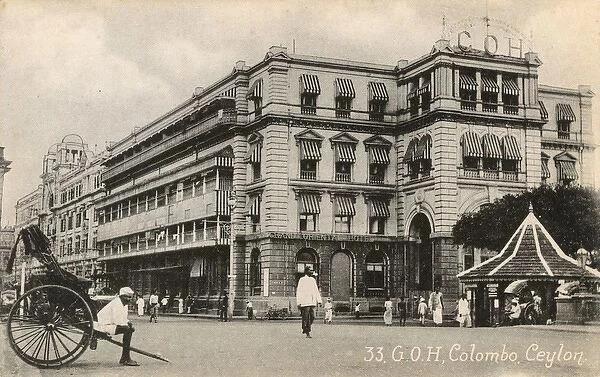
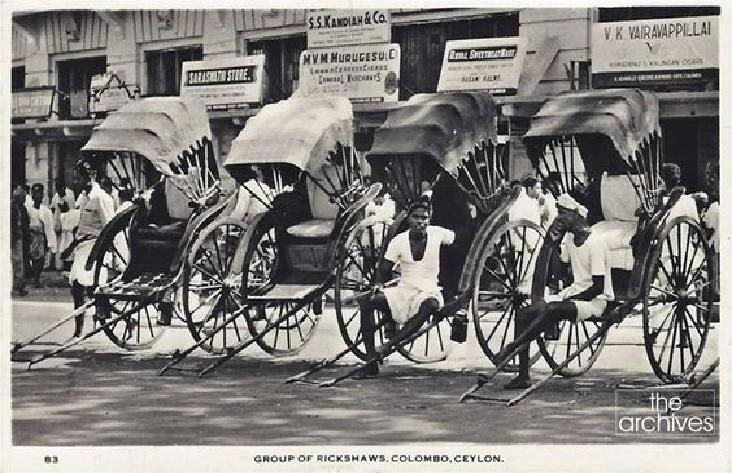
Outside the Grand Oriental Hotel in Colombo Fort, several hand-pulled rickshaws stand in a row, their large spoked wheels casting shadows across the road. Men dressed in white move between the vehicles, while others wait near the hotel’s entrance. The street beyond is busy with people attending to their daily affairs, and the building itself presents the familiar imposing appearance of one of colonial Colombo’s best-known hotels.
The old postcard carries a French caption, Pousse-Pousses devant l’Oriental-Hôtel, meaning rickshaws outside the Oriental Hotel. It is the kind of image that immediately brings back an older Colombo, with its impressive buildings, wide streets, horse-drawn vehicles and pedestrians dressed in the fashions of another time. At first glance, it is easy to admire the architecture and the quieter appearance of the street.
But the rickshaws deserve a closer look. Every one of those small carriages needed a man to pull it, and while a passenger sat comfortably under the folding hood, the man in front had to walk or run, carrying the weight of the vehicle and its occupant. For years, this was an accepted form of transport in Colombo, as familiar to many residents and visitors as hiring a taxi would later become.
A Man and His Rickshaw
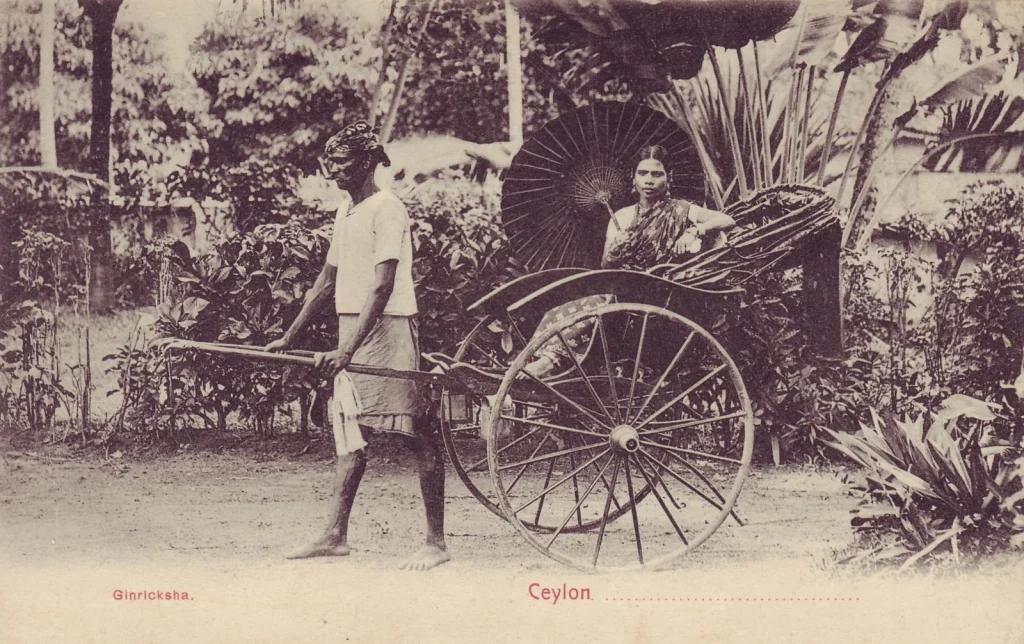
According to historical accounts, hand-pulled rickshaws were introduced to Ceylon in 1883, when Whittall & Co. imported an early example. By the following decade, they had become a familiar means of transport in Colombo and other towns. They were particularly useful for relatively short journeys, offering passengers an alternative to walking or hiring a larger horse-drawn carriage.
The vehicle itself was straightforward in design. Two large wheels supported a small carriage fitted with a cushioned passenger seat and, usually, a folding hood to provide shade. Two long shafts extended from the front, allowing the puller to position himself between them, lift the carriage and begin moving. Once the passenger was seated, the puller had to maintain the vehicle’s balance while making his way along the road.
It was much harder work than the appearance of the carriage might suggest. The puller had to negotiate corners, avoid carts and other traffic, and pay attention to uneven road surfaces. Any incline made the task more demanding, particularly when carrying a heavier passenger, and some rickshaws reportedly required a second man to help push from behind. Historical descriptions also indicate that fares were often calculated according to the duration of the journey rather than the distance travelled.
For the passenger, the rickshaw offered convenience. For the man pulling it, each journey involved considerable physical effort, often in the heat of the tropical afternoon. The ability to keep working throughout the day depended upon strength, endurance and the prospect of securing enough fares to make the labour worthwhile.
A photograph preserved by Royal Museums Greenwich, dated 7 October 1919, shows five British sailors seated in rickshaws in Kandy, with five Sri Lankan pullers standing in front of them. The image is a useful reminder that this was not a form of transport confined to Colombo. Rickshaws were familiar in other Ceylonese towns as well, particularly where visitors and residents needed transport over shorter distances.
Waiting for a Fare Outside the Hotel
The Grand Oriental Hotel occupied an important place in the life of colonial Colombo. Situated close to the harbour, it was associated with the world of steamship passengers, merchants, officials and visitors arriving in Ceylon. For a traveller unfamiliar with the city, the hotel provided a convenient point from which to begin exploring Colombo or conducting business in the Fort and Pettah districts.
For a rickshaw puller, the entrance to such an establishment offered the possibility of work. Hotel guests might need transport to nearby shops, banks, offices or other parts of the city. Some may have wished to see Colombo without walking long distances in the heat, while others needed a practical means of reaching their next appointment.
The men waiting outside the hotel would have depended upon passengers choosing to hire them. There may have been quiet periods between fares, when the pullers rested beside their vehicles and watched people coming and going through the entrance. Competition for customers would have been another part of the occupation, since a traveller could select one carriage rather than another or decide that the journey was short enough to walk.
We know nothing of the individual men in this postcard. Some may have worked regularly outside the hotel, while others may have been waiting there only that day. We cannot say how long they had been standing beside their vehicles, what they earned or how many journeys they had already completed.
The postcard tells us much more about the building than it does about the workers. The hotel was important enough to be identified in the caption, but the men who made the rickshaws useful remained anonymous. They were part of the scene rather than the reason the photograph was taken.
The Other Side of Colonial Colombo
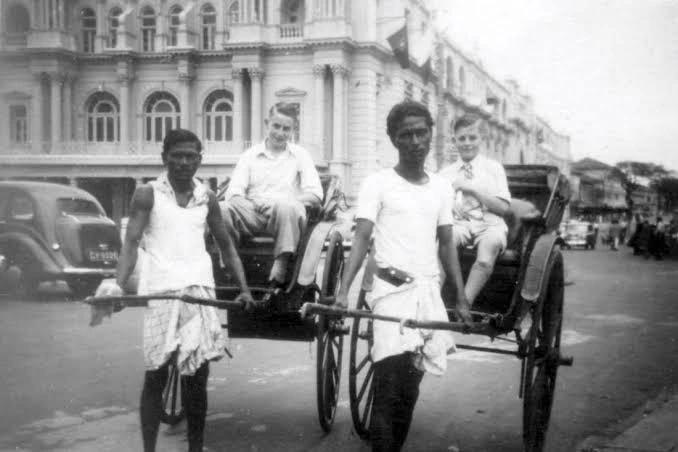
When people remember British Ceylon, the conversation often turns to the grand hotels, clubs, department stores and impressive buildings of Colombo Fort. Old photographs certainly show a city with a distinctive architectural character, and many of those buildings remain interesting today. Yet the comfortable lives enjoyed by some residents and visitors depended upon the work of others whose circumstances were quite different.
The hand-pulled rickshaw was a particularly visible example of this contrast. One person sat while another walked or ran, and the passenger could remain sheltered while the puller faced the heat, rain and difficulties of the road. The journey might have been a pleasant convenience for the person being carried, but it required considerable strength and endurance from the man responsible for moving the carriage.
Rickshaw pulling was a physically demanding occupation, and historical accounts describe the difficult working conditions faced by those who performed it. Royal Museums Greenwich, in discussing photographs of rickshaw transport, has drawn attention to the toll such labour could take on the men involved. Long hours, repeated journeys and the need to earn a living through physical effort made it a hard way to support oneself.
These conditions were not necessarily questioned by everyone who used rickshaws during the colonial period. The vehicles were simply regarded as another form of paid transport, available to those who could afford the fare. Today, the idea of hiring a man to pull us through Colombo’s streets seems difficult to imagine, but at the time a row of rickshaws outside a hotel was an ordinary sight.
The postcard therefore records more than an interesting form of transport. It also shows the unequal physical demands upon which part of colonial urban life depended.
Knowing Colombo One Street at a Time
A man who spent years pulling rickshaws through Colombo would have developed an intimate knowledge of the city. He would have known the roads connecting the harbour, hotels, business establishments and shopping streets, as well as the places where customers were most likely to require transport. He would also have learnt which routes involved difficult climbs, uneven surfaces or particularly heavy traffic.
The Fort and Pettah districts were among the busiest parts of colonial Colombo. Shipping offices, banks, trading houses, shops and warehouses brought people into the area throughout the day, creating a steady need for movement between different establishments. A rickshaw puller waiting near the Grand Oriental Hotel was therefore close to an important centre of commercial activity.
The work would have involved more than simply knowing the streets. Pullers needed to understand the habits of passengers, judge how long a journey might take and decide where to wait for their next fare. A busy morning might be followed by a long afternoon with few customers, while changes in weather could make the work considerably harder.
There was also the constant physical strain of the job. Walking or running through the city while balancing a loaded carriage required experience, particularly on roads shared with carts, carriages, pedestrians and eventually motor vehicles. For the men who performed this work, Colombo’s streets were not merely familiar landmarks but the places where they earned their living.
When the Rickshaw Pullers Began to Disappear
Hand-pulled rickshaws continued to be used long after motor vehicles began appearing on Ceylon’s roads. They remained part of the transport landscape during the early and middle decades of the twentieth century, although their numbers gradually declined as motorcars, buses and other forms of transport became more common.
An old photographic account records that hand-pulled rickshaws were still being used by tourists in 1952 and that they had largely disappeared from Colombo by the late 1960s. The transition did not happen at once. Older forms of transport often remained in use for years after newer vehicles became available, particularly when they continued to serve a practical purpose.
An interesting exception has been recorded in Gampaha. A hand-pulled rickshaw reportedly continued to carry mailbags between the Gampaha railway station and the local post office until 1972. The vehicle was later preserved at the Gampaha Main Post Office, providing a rare reminder of a form of transport that had almost entirely disappeared from everyday life.
By the 1960s and 1970s, Colombo’s streets were becoming increasingly dominated by motor vehicles. The hand-pulled rickshaw could no longer compete with the speed and convenience of newer transport, and the occupation gradually vanished. One generation remembered seeing the men at work, while the next grew up in a Colombo where they were no longer part of the streetscape.
There was no grand occasion marking the end of the rickshaw puller’s working life in the city. The vehicles simply became less common until their absence was no longer noticed.
A Reminder at the Grand Oriental Hotel
The Grand Oriental Hotel remains one of the familiar historic landmarks of Colombo Fort, and a statue associated with the hotel provides a reminder of the rickshaws that once waited outside. It depicts a puller drawing a carriage occupied by a colonial passenger, recalling a form of transport that was once part of the city’s everyday life.
The sculpture is interesting because it shows not only the vehicle but also the physical relationship between the passenger and the man who moved it. The seated traveller occupies the carriage, while the puller provides the effort required to carry him through the streets. What once appeared to be an ordinary arrangement now offers an uncomfortable reminder of the differences between the lives of those who travelled in comfort and those who worked to provide it.
For anyone familiar with the old postcard, the connection is striking. The hotel has survived, but the rickshaws that once stood outside its entrance are long gone. The men who earned their living there are remembered mainly through old photographs, postcards, historical accounts and representations of the vehicles they pulled.
The statue, like the photograph, cannot tell us the personal stories of those men. It can, however, remind us that the history of Colombo’s grand buildings includes the working people who helped make the city function.
Remembering the Men, Not Just the Rickshaws
It is tempting to look at an old photograph of Colombo and imagine that life must have been better in those days. The streets appear less crowded, the buildings have an architectural elegance that many people admire, and the absence of modern traffic creates an impression of a quieter city. But the appearance of a street in a photograph tells us very little about the lives of everyone who used it.
For the rickshaw puller, those same streets meant long hours on his feet, heavy work and uncertain earnings. He might have passed the most impressive buildings in Colombo every day without ever entering them as a guest. His knowledge of the city came from working through its roads, waiting for fares and carrying passengers who could afford to hire his services.
At the end of the day, he returned home like thousands of other working men whose names seldom appeared in newspapers or official records. He may have had a family depending upon his earnings, responsibilities beyond his work and hopes that the next day would bring enough customers. These ordinary details of his life were not the concerns of the postcard photographer.
That is what makes the old photograph worth examining again. The Grand Oriental Hotel and the unusual vehicles are certainly interesting, but the men waiting beside those rickshaws deserve just as much attention. Their labour belonged to a period when human effort was still an essential part of urban passenger transport.
We cannot identify the pullers in the photograph, and we do not know what became of them. Yet their presence reminds us that behind the impressive streets and buildings of Old Colombo were thousands of ordinary people whose work helped keep the city moving.
For a brief moment, more than a century later, the postcard allows us to remember that they were there.
Visit us:https://trippingsrilanka.com/stories