The Grand Orient Hotel Is Ceylon s First Palace of Hospitality
How Colombo’s legendary hotel became the social heart of colonial Ceylon
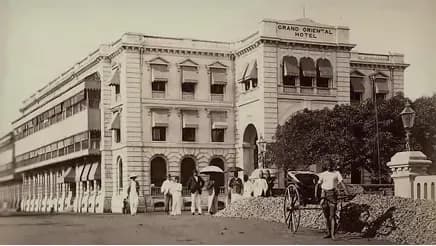
Before the Galle Face Hotel became the name every travel writer reached for, before the hill-country bungalows and the planter’s club drew the eye of every arriving ship passenger, there was one address in Colombo’s Fort district that set the tone for an entire era. The Grand Orient Hotel its name alone a declaration of ambition stood at the corner of York Street and the Colombo waterfront as both a physical gateway and a social institution for all who arrived in colonial Ceylon.
To step off the mail steamer at the Colombo harbour in the early years of the twentieth century was to enter a world of humid heat, jangling rickshaws, the smell of cloves and cinnamon floating up from the godowns along the quay, and the immediate, reassuring sight of the Grand Orient’s colonnaded facade. For British officials, planters heading upcountry, merchants in the spice trade, and the occasional literary traveller, the hotel was the first solid ground after weeks at sea.
Click on here “A Coronation-Era Moment at Sea Women, Service, and Silent Careers Behind a Historic Photograph”
Origins and the Colonial Vision
The Grand Orient’s origins belong to the confident mid-Victorian era when Colombo was being remade as the administrative and commercial capital of a prized Crown Colony. The hotel took shape along York Street, the city’s principal commercial artery, in a building that drew on the colonial Italianate style fashionable across British Asia wide verandahs, high ceilings, louvred shutters angled to catch every available breeze from the ocean. The architecture was practical and aspirational in equal measure: practical because the tropics demanded shade and ventilation, aspirational because every colonial enterprise believed it was building something permanent.
The hotel’s name itself carried meaning. The ‘Orient’ was not merely geography it was a romantic promise, the word that the Victorian imagination attached to everything east of Suez that was warm, strange, and profitable. The ‘Grand’ was the assertion that this was no ordinary staging post but a destination in its own right, the equal of anything a traveller might have known in Bombay or Calcutta.
The Social Machinery of the Fort
What made the Grand Orient more than just a place to sleep was its position at the centre of Colombo’s colonial social machinery. The hotel’s bar and dining room were the informal parliament of the Fort district, the place where the day’s commercial transactions were sealed over a gin pahit and the evening’s news was exchanged over a long table dinner. Ceylon in the early 1900s ran on personal connection the planting community, the merchant houses, the civil service, and the military all overlapped in the drawing rooms and dining halls of the city’s principal hotels, and the Grand Orient sat at the top of this hierarchy.
The hotel welcomed the full cast of the colonial world: the newly arrived cadet from the Ceylon Civil Service, still pale and slightly dazed from the voyage; the veteran tea planter descending from Dimbula or Nuwara Eliya for his annual visit to the city; the Colombo Chetty trader who moved easily between the European world of the Fort and the layered communities of the Pettah; the occasional maharajah or Kandyan noble making a formal call on the Governor. The Grand Orient was one of the few spaces in colonial Colombo where these worlds brushed against each other with something approaching civility.
The Rituals of the Day
Life at the Grand Orient followed the disciplined rhythms that the British imposed wherever they settled. Breakfast was served early, before the heat of the day became punishing eggs, kedgeree, cold meats, and strong Ceylon tea poured from silver pots. The hotel’s kitchens managed the colonial trick of producing approximations of English food in tropical conditions: roast beef appeared at Sunday tiffin, Madeira cake with afternoon tea, and devilled kidneys at supper.
But what the Grand Orient served alongside its food was something more valuable: information. The hotel’s front hall, where guests collected their letters and cables, was a kind of intelligence exchange for the whole of the commercial colony. News of the tea market at Mincing Lane in London, reports of monsoon failure in the hill country, the arrival of a new Superintendent of the Agricultural Department all of this moved through the Grand Orient’s lobby before it reached the morning papers.
The Planter’s City Stop
For the planting community of the hill country, the Grand Orient held a particular significance. The journey from Nuwara Eliya or Haputale to Colombo was an expedition a day by train through the mountain passes and the lowland plains, arriving at Colombo Fort station in the late afternoon. The planter’s ritual was well-established: check in at the Grand Orient, draw a bath, change into town clothes, and then emerge into the evening air of York Street to conduct business, meet the agent, visit the tailor, and attend to all the commercial and social obligations that the isolation of the estate had deferred.
The hotel was thus a decompression chamber between two very different worlds: the self-contained, often lonely life of the up-country estate, and the buzzing commercial port city with its ships, its clubs, and its constant traffic of humanity from four continents.
Decline and What Remains
The rise of the Galle Face Hotel, opened in 1864 on the seafront to the south of the Fort, gradually drew away the leisure trade that the Grand Orient had claimed. The Galle Face had the ocean, the evening breeze, and the romance of its garden promenade advantages that no amount of colonial prestige in the Fort district could overcome. By the early decades of the twentieth century, the Grand Orient had settled into a more commercial role, its rooms filling with traders and travelling salesmen rather than Governors and literary figures.
The building itself has had a complicated later life, as have most of the great colonial structures of Colombo’s Fort. Some walls survive in altered form, absorbed into later constructions; the street grid that gave the Grand Orient its address the corner of York Street, the proximity to the harbour remains the skeleton of what is now a very different city.
What does remain, unchanged by time, is the idea the hotel embodied. Colombo has always been a city of arrivals, a place where the world’s trade routes converged and where the first impression mattered enormously. The Grand Orient understood this. It stood on the quayside and offered the arriving world its best face: cool rooms, cold drinks, and the assurance that whatever you had come to Ceylon to find, this was the right place to begin looking.