The Pioneer of Tea: James Taylor and the Birth of Sri Lanka’s Golden Leaf
The Pioneer of Tea: James Taylor and the Birth of Sri Lanka’s Golden Leaf | In the misty highlands of central Sri Lanka, where emerald hills roll like waves under a tropical sun, a humble Scotsman named James Taylor planted the seeds of an industry that would transform a nation. Often called the “Father of Ceylon Tea,” Taylor arrived on the island in 1852 as a 17-year-old adventurer, little knowing he would spark a revolution that turned coffee blight into tea triumph.
His story is not one of grand empires or royal decrees, but of quiet persistence, hands-on experimentation, and a deep love for the land that became his home. Today, Sri Lanka’s tea—known worldwide for its bright, brisk flavor—owes its origins to this unassuming pioneer, whose legacy brews in every cup.
Arrival in a Coffee Kingdom
James Taylor was born in 1835 in the rugged Mosspark area of Aberdeenshire, Scotland, to a family of modest means. His father, a wheelwright, instilled in him a strong work ethic, but young James dreamed beyond the crofts. At age 16, he set sail for Ceylon (as Sri Lanka was then called under British rule), joining the influx of Scots seeking fortune in the colony’s booming coffee plantations.
Ceylon in the mid-19th century was a coffee powerhouse. Introduced by the Dutch and expanded by the British after they seized control in 1796, coffee estates carpeted the island’s central highlands. By the 1840s, exports soared, attracting European planters who cleared vast tracts of jungle to cultivate the crop. Taylor landed in Colombo and headed straight to the up-country, apprenticed to a coffee estate in the Kandy district. He learned the ropes quickly: supervising laborers, managing harvests, and navigating the challenges of monsoon rains and steep terrain.
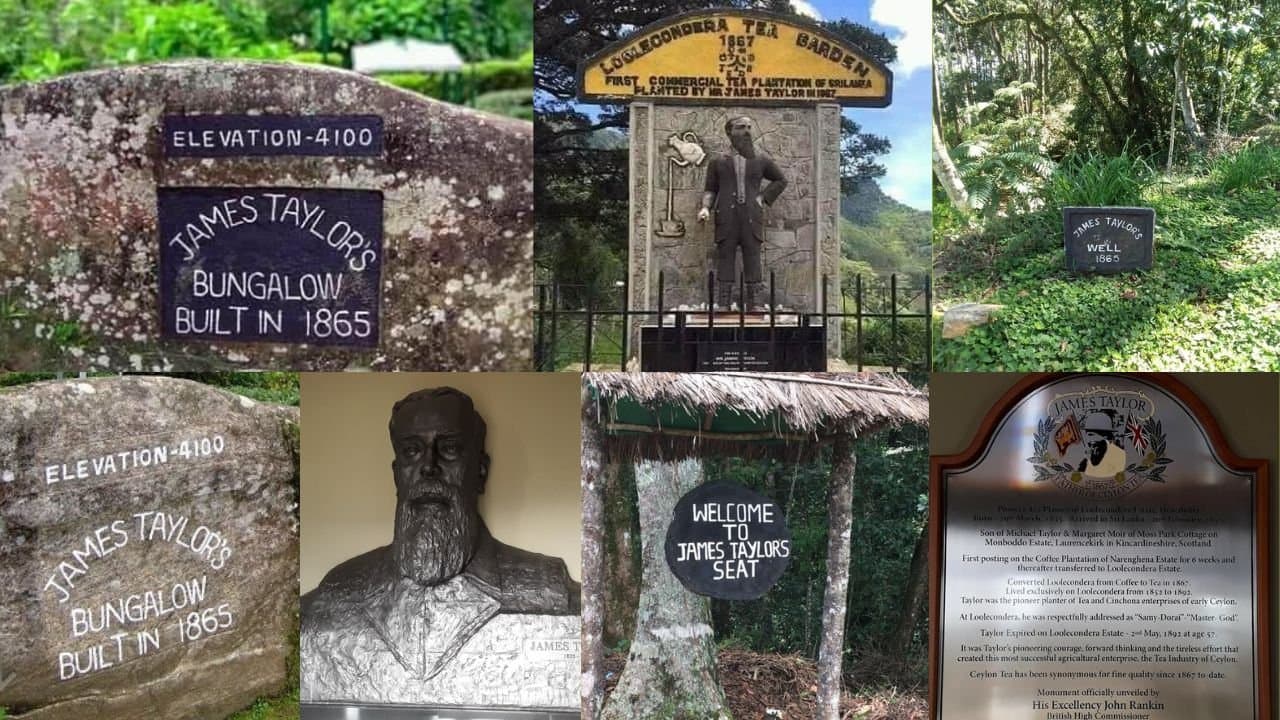
For nearly two decades, Taylor thrived in this world. By 1866, at age 31, he was appointed superintendent of Loolecondera Estate in the Hewaheta region, southeast of Kandy. The estate spanned 1,100 acres, mostly under coffee, with a workforce of Tamil laborers from southern India. Taylor lived simply in a bungalow overlooking the plantations, rising before dawn to oversee operations.
He was known for his fairness—paying workers promptly and providing basic amenities—and his innovative spirit. He experimented with machinery, like a water-powered pulping mill he designed to process coffee beans more efficiently.
But storm clouds were gathering. In the late 1860s, a microscopic fungus called Hemileia vastatrix—coffee leaf rust—began ravaging plantations across Asia. First spotted in Ceylon in 1869, it spread like wildfire, defoliating bushes and slashing yields by up to 90%. Planters watched in horror as their livelihoods withered. By 1875, coffee production had plummeted from 100 million pounds annually to a fraction. Estates were abandoned, workers fled, and the colonial economy teetered. It was in this crisis that Taylor saw opportunity.
Click on here “EAST COAST ESCAPE: WHY TRINCOMALEE IS THE MALDIVES OF SRI LANKA”
From Coffee Blight to Tea Experiment
The idea of tea wasn’t new to Ceylon. The British had introduced Camellia sinensis seeds from Assam, India, in the 1830s for botanical gardens, and small experimental plots existed. But coffee’s dominance had sidelined it. As rust decimated his crops, Taylor received a packet of Assam tea seeds from the Peradeniya Botanical Gardens in 1867. Intrigued, he cleared 19 acres of Loolecondera—land previously under coffee—and planted them.
Taylor approached tea with the meticulous care of a scientist and the grit of a farmer. He studied tea cultivation manuals from India and China but adapted them to Ceylon’s unique conditions: higher elevations (3,000–6,000 feet), ample rainfall (over 100 inches annually), and acidic red soils. His first harvest in 1872 yielded just a few pounds, rolled by hand on a bungalow veranda using a simple table. He fired the leaves in a clay chulah (stove) borrowed from local kitchens, then packed the crude black tea into tins.
Word spread. In 1873, Taylor sent 23 pounds to the London Tea Auction, where it fetched decent prices. Encouraged, he expanded plantings, building a small factory in 1875 with basic rollers and withering trays. He trained workers in plucking “two leaves and a bud”—the tender shoots that yield the finest tea—and emphasized quality over quantity. Unlike India’s large-scale operations, Taylor’s methods were artisanal: no chemicals, natural shading from jungle trees, and fermentation timed by feel.
By the 1880s, as coffee estates collapsed en masse, planters turned to Taylor for advice. He shared seedlings freely, demonstrating pruning techniques and soil management. His success proved tea could thrive where coffee failed—rust didn’t affect it, and the plant’s perennial nature promised steady income. The colonial government took notice, offering subsidies and importing more seeds.
From Loolecondra’s humble plots, tea estates mushroomed across the Nuwara Eliya, Dimbula, and Uva districts.
Building an Industry Amid Challenges
Taylor’s life was no idyll. The highlands were harsh: leeches in the undergrowth, malaria outbreaks, and isolation from European society. He never married, pouring his energy into the estate. Visitors described him as a wiry, bearded man in khaki shorts, pipe in hand, trudging through mud with laborers. He spoke fluent Sinhala and Tamil, earning respect from locals who called him “Thaylor Aiyah” (Mr. Taylor).
Challenges abounded. Early tea faced skepticism—buyers preferred established Indian or Chinese varieties. Transport was rudimentary: leaves hauled by bullock cart to Colombo, then shipped to London. Labor shortages led to importing more Indian Tamils, creating a plantation workforce that endures today. Taylor navigated strikes and supply issues, once improvising a ropeway to move tea across ravines.
Yet innovation defined him. In 1880, he installed Ceylon’s first multi-level tea factory at Loolecondera, with withering lofts, rolling machines, and drying ovens. He experimented with green tea and even a “Taylor’s Patent” fermentation process. By 1890, Ceylon exported over 20 million pounds of tea annually, surpassing coffee’s peak. Taylor’s estate alone produced 5,000 pounds yearly.
His influence extended beyond Loolecondera. He mentored young planters, like Thomas Lipton, who visited in 1890 and later built a global brand on Ceylon tea. The Ceylon Tea Traders Association formed in 1894, standardizing grades like Orange Pekoe (from “pekho,” meaning fine downy leaves).
Click on here “KALPITIYA DIARIES: KITESURFING, DOLPHINS, AND DESERTED BEACHES”
Legacy in Every Brew
James Taylor died on April 29, 1892, at age 57, from dysentery contracted in the hills. He was buried on Loolecondera, his grave overlooking the plantations he pioneered. In his will, he left the estate to his workers’ welfare fund—a testament to his character.
Taylor’s impact reshaped Sri Lanka. Tea became the economic backbone: by 1900, 400,000 acres were under cultivation, employing 300,000 workers. It fueled infrastructure—railways snaking through hills, roads connecting estates. Post-independence in 1948, nationalized plantations sustained the economy; today, tea generates $1.5 billion annually, with Sri Lanka the world’s fourth-largest producer.
Culturally, tea wove into the fabric of life. “Ceylon Tea” became a premium label, its high-grown varieties prized for aroma and color. Festivals like the Nuwara Eliya Season celebrate the harvest, and factories welcome tourists to witness plucking and processing.
Taylor’s story humanizes this legacy. He wasn’t a tycoon but a hands-on visionary who turned disaster into delight. As one contemporary wrote, “He found coffee dying and left tea living.” Visit Loolecondera today—now a museum—and you’ll see his bungalow, original machinery, and fields of bushy tea plants. Sip a cup of pure Ceylon black tea, and taste the pioneer’s perseverance.
In an era of corporate giants, Taylor reminds us that industries are built by individuals with dirt under their nails and dreams in their hearts. From a Scottish lad to Sri Lanka’s tea titan, his journey brews eternal.
Click on here “KANDY TO KATARAGAMA: EXPLORING SRI LANKA’S SACRED PILGRIMAGE TRAILS”