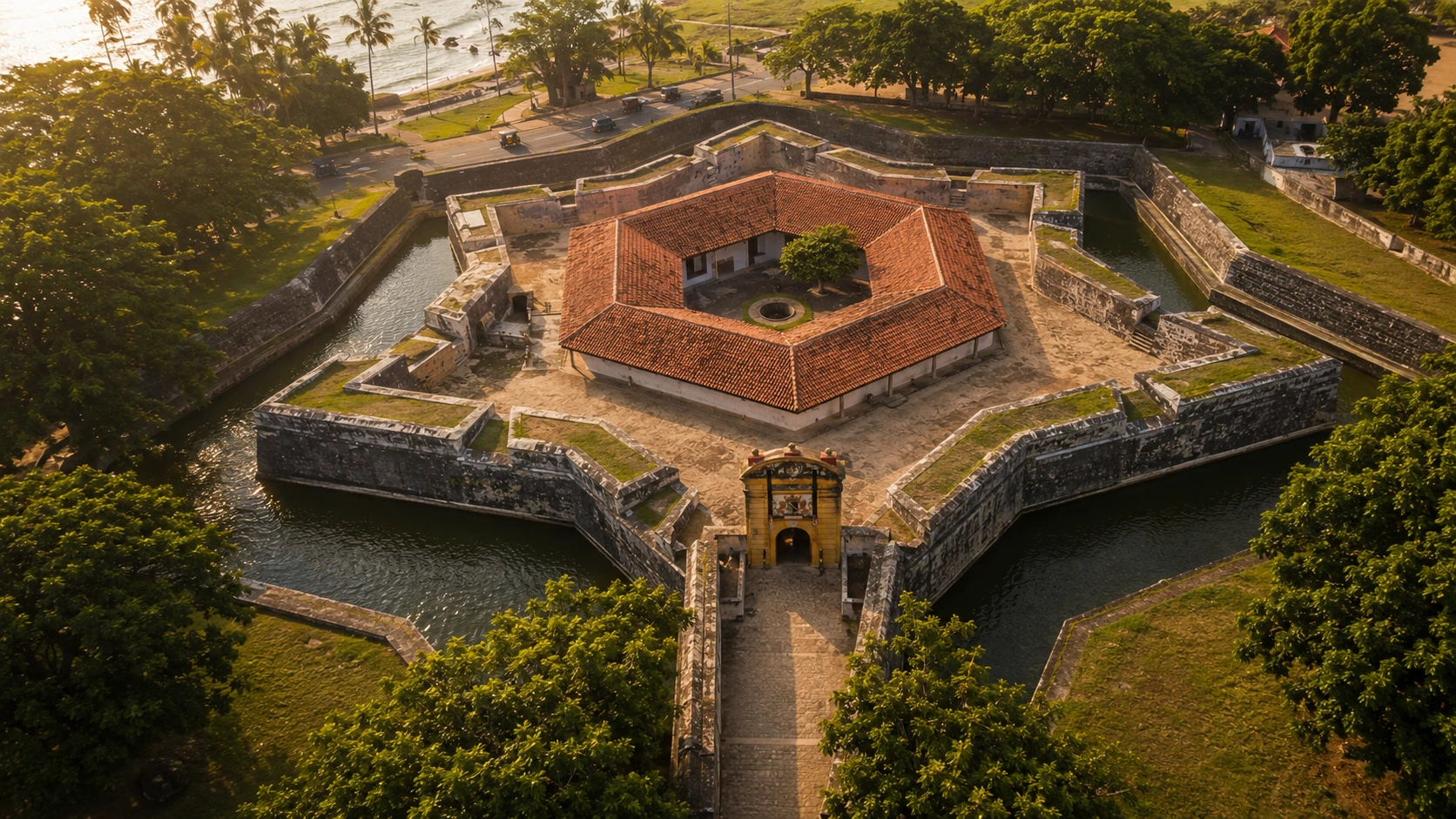
The history of Dutch Ceylon is usually told through forts, cinnamon, governors, ships, and war. But that version leaves out one of the most important forces in colonial society: women. In the period of Dutch East India Company rule in coastal Ceylon, roughly from the mid-seventeenth century until 1796, women were not just background figures in a male mercantile empire. They shaped households, inheritance, religion, language, race-making, social mobility, and the everyday texture of life in Colombo, Galle, Jaffna, Matara, and other VOC-controlled spaces.
To talk about “the women of the Dutch East India Company in Ceylon” is really to talk about several overlapping groups: European Dutch women, Eurasian and Burgher women, Sinhalese and Tamil women drawn into colonial legal systems, enslaved women in domestic households, and women whose marriages, labour, sexuality, and children became part of the machinery of empire. The VOC was a trading corporation, but in Ceylon it functioned like a state. That meant women’s lives were shaped not only by commerce, but by law, church discipline, household hierarchy, and colonial bureaucracy.
Click on here “The Sacred City Under the Empire Kandy and the Temple of the Tooth”
A colony built by men, sustained by women
Like many VOC settlements across Asia, Dutch Ceylon began as a heavily male world. Soldiers, sailors, clerks, merchants, and officials arrived in far greater numbers than European women. That imbalance meant the colony could not reproduce itself through a simple Dutch family model. Instead, VOC society in Ceylon depended on local and mixed households. Scholars note that Dutch settlements across the Indian Ocean were marked by a shortage of European women, which pushed family formation into more complex local arrangements.
This is where women became central. Local women, mestiza women, and women of mixed descent were not marginal to colonial life. They made the colony socially possible. Through marriage, concubinage, domestic labour, childrearing, and kinship networks, they helped create the Indo-European and Burgher families that would later become a distinct community in Sri Lanka. Dutch-speaking or Portuguese-creole-speaking households often rested on women’s work, women’s cultural knowledge, and women’s relationships across ethnic lines. One major study on Dutch Burghers notes that Dutch children often learned creole Portuguese from their mestika mothers and from enslaved women who served as nurses.
Marriage, intimacy, and the politics of respectability
Marriage in Dutch Ceylon was never just personal. It was political. The VOC and the Dutch Reformed Church tried to impose Calvinist ideas of lawful marriage, legitimacy, inheritance, and respectable family life. But they encountered very different local customs, especially among Sinhalese communities, where cohabitation before formal marriage, easier divorce, and plural marital practices were part of existing social worlds. Colonial rule therefore turned marriage into a site of contest.
Women stood at the centre of that contest. A woman’s marital status could affect inheritance rights, the legitimacy of children, church standing, and access to property. Dutch record-keeping tried to classify and regulate relationships that did not fit neat European categories. In practice, however, colonial society remained flexible, improvised, and often contradictory. The Company wanted order, but real life in Ceylon kept producing blended families, informal unions, and cross-cultural households.
At the elite and middling levels of colonial society, women could also become crucial carriers of family strategy. Marriage linked households to office, rank, and patronage. Widows, mothers, and daughters were often involved in preserving family assets and securing children’s futures in an unstable colonial environment. When British power replaced the VOC in Ceylon, many Dutch-oriented families had to decide whether to stay, leave, or adapt. That moment exposed how deeply women were tied to questions of identity, survival, and continuity.
Enslaved women in VOC households
Any honest account of women in Dutch Ceylon has to confront slavery. The VOC traded in enslaved people and used slavery throughout its empire, including in Ceylon. In eighteenth-century Dutch Sri Lanka, enslaved people formed one of the island’s largest and most culturally diverse coerced populations. Enslaved women were especially visible inside households, where they worked as domestic servants, child-minders, wet nurses, cooks, cleaners, and sometimes concubines.
Their labour helped sustain the colonial family itself. Yet the archive often records them only through ownership, punishment, registration, or dispute. Research on VOC Colombo and wider Dutch Sri Lanka shows that household slavery was widespread, and that enslaved women could be deeply embedded in the emotional and economic life of the home while remaining legally unfree and vulnerable to sale, separation, and sexual exploitation.
This is one of the hardest truths in the history of the women of the VOC in Ceylon: some women exercised authority because other women were subordinated beneath them. European and Eurasian mistresses of households could rely on enslaved women’s work. Colonial femininity, respectability, and domestic comfort were often built on coerced female labour. That makes this history not simply a story of women’s resilience, but also a story of hierarchy among women themselves.
Burgher women and the making of a colonial community
One of the most lasting social consequences of Dutch rule in Sri Lanka was the emergence and consolidation of Burgher identity. Women were indispensable to that process. Through intermarriage, motherhood, language transmission, religion, and domestic culture, they helped create the social world from which Burgher families emerged. This was not a simple Dutch transplant. It was a creolised colonial society shaped in kitchens, nurseries, churches, courtrooms, and family networks.
Women in these communities often mediated between worlds. They could move between Dutch legal forms and local custom, between European paternal ancestry and Asian maternal kinship, between Protestant respectability and the realities of colonial pluralism. In that sense, they were not merely “wives of Company men.” They were the social infrastructure of Dutch Ceylon.
Religion, education, and everyday influence
The Dutch also tried to reshape society through the church and schooling. Dutch Reformed institutions, baptismal systems, and schools formed part of the wider colonial project. Historical accounts of the Dutch Church in Ceylon note orphan schools and Dutch schools in Colombo, showing how education, piety, and moral regulation were intertwined. Women, whether as mothers, widows, guardians, or girls within these institutions, were part of that process.
Even when records are thin, the pattern is clear: women were central to how religion entered the home, how children were raised, and how colonial order was normalised at the everyday level.
Why this history still matters
The women of the Dutch East India Company in Ceylon matter because they force us to read colonial history differently. They reveal that empire was not only built through forts and trade monopolies, but through intimacy, domestic labour, family formation, and legal control over women’s bodies and relationships. They also remind us that colonial Ceylon was never socially simple. It was multilingual, mixed, unequal, and deeply entangled.
To recover these women is to recover the hidden architecture of Dutch Ceylon itself. Some were privileged, some were precarious, and many were oppressed. But all were part of the making of a colonial world whose legacies still echo in Sri Lanka’s social history, family names, urban spaces, and memory.