Introduction: A Star Hidden in the South
Matara is often remembered for its beaches, river views, busy town life and southern hospitality. But tucked within this coastal city is one of Sri Lanka’s most unusual colonial monuments: the Matara Star Fort. Unlike the long sea-facing ramparts of Galle Fort or the heavier defensive walls of Matara Fort, this structure is compact, geometric and almost unexpected. Built by the Dutch in the 18th century, the Star Fort stands close to the Nilwala River and was designed as a smaller defensive redoubt to strengthen Matara’s colonial defences.
Its beauty is not loud. There are no grand streets inside it, no massive colonial townscape, no dramatic cliffside setting. Instead, the charm of Matara Star Fort lies in its shape, silence and precision. It is a place where architecture, military anxiety and colonial history meet inside one small, star-shaped space.
Click on here “Colombo Fort: The Colonial Business District That Still Shapes the City”
Why Was the Star Fort Built?
Key points
- Built after weaknesses were exposed in Matara’s Dutch defences
- Connected to the Matara Rebellion and inland threats
- Designed to protect the main Matara Fort
The story of the Star Fort begins with a problem. The Dutch had already established Matara as an important southern stronghold, but the existing fort was vulnerable from the landward side. During the Matara Rebellion around the 1760s, Kandyan-backed forces and local resistance exposed these weaknesses, forcing the Dutch to rethink how Matara should be defended.
The answer was not to build another large fort town, but a compact military outwork. Between 1763 and 1765, under Governor Lubbert Jan Baron Van Eck, the Dutch constructed the Star Fort as a separate defensive post. It was known as Redoute Van Eck, meaning a redoubt or independent defensive outwork connected to the wider protection of Matara.
This gives the fort a different emotional quality from other colonial sites in Sri Lanka. It was not built for elegance first. It was built because the Dutch felt exposed.
The Architecture: Why a Star?
Key points
- Six-pointed star layout
- Designed to allow cannon fire in multiple directions
- Surrounded by a moat and defensive ditch
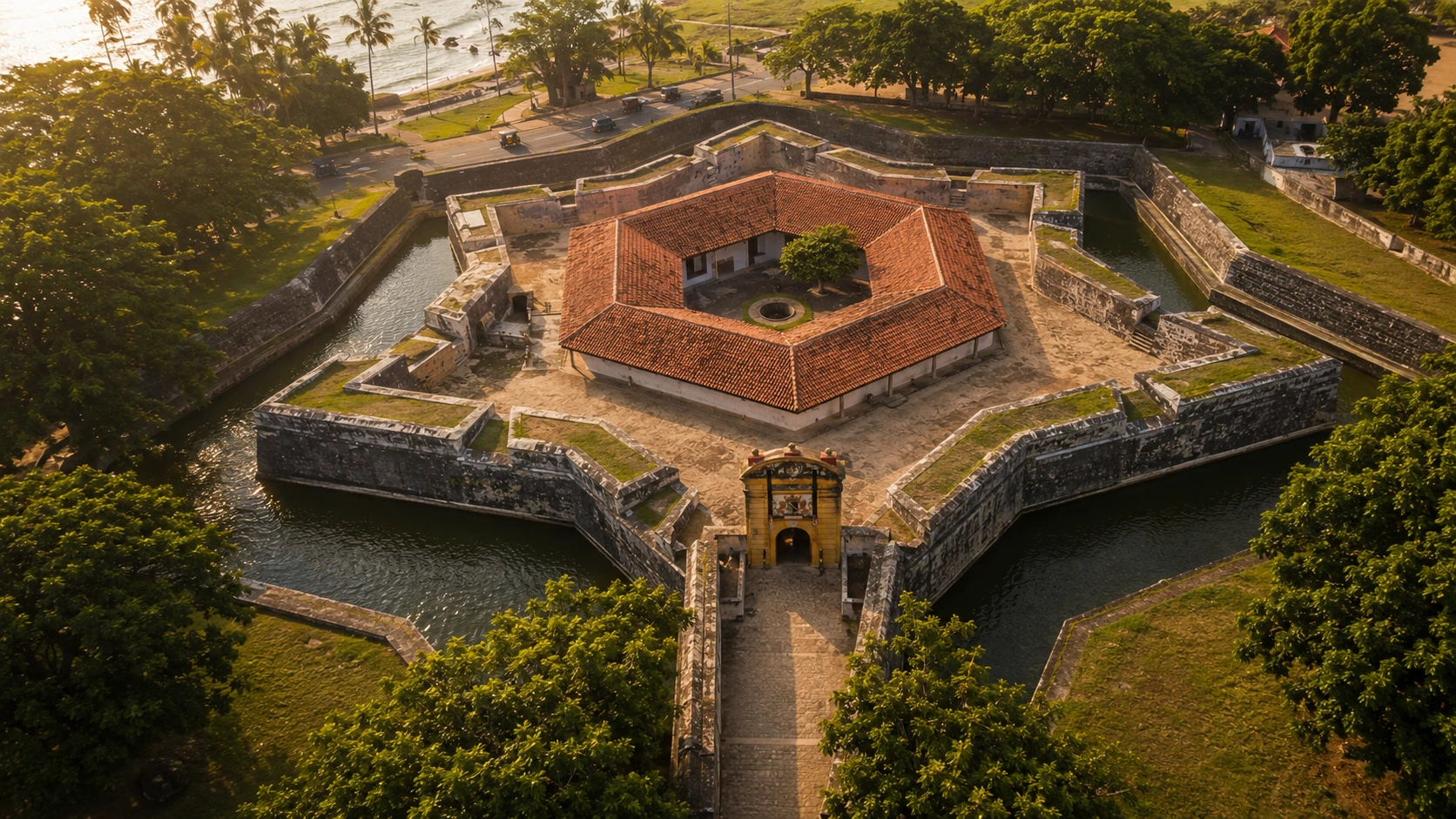
The most striking feature of the Matara Star Fort is, of course, its shape. The fort was built in the form of a six-pointed star, with gun positions arranged to cover approaches from different directions. This type of design allowed defenders to watch and respond to attacks more effectively than a simple square or rectangular layout.
From above, the fort looks almost like a symbol drawn into the earth. But on the ground, the experience is more intimate. You approach through an arched gateway, pass the moat and enter a compact interior where every wall feels purposeful. The defensive geometry is not decorative; it is practical. Every point, turn and angle had a role.
The fort also included a ditch, glacis, drawbridge entrance, gunpowder magazines, barracks, halls and a central well. These features show that the Star Fort was designed to survive pressure, even with a small garrison inside.
The Gateway: Redoute Van Eck
Key points
- Main entrance carries Dutch colonial markings
- VOC emblem and Governor Van Eck’s arms are part of the gateway
- The gate remains one of the most photogenic parts of the fort
The entrance is one of the most memorable parts of the Star Fort. Above the arch, visitors can still see Dutch lettering, colonial symbols and references to Van Eck. The gateway once formed the controlled access point across the moat, and the remains of the drawbridge arrangement still help visitors imagine how the fort functioned when it was active.
This is where the fort feels most cinematic. The warm-toned arch, the old walls and the contained view into the inner courtyard create the sense of stepping through a small but carefully guarded door into colonial Ceylon. It is not as dramatic as Galle Fort’s gates, but it has a quieter mystery.
Inside the Fort: Small, Still and Historical
Key points
- Compact inner courtyard
- Central well and former prison cells
- Now connected to the Matara Star Fort Museum
Inside, the fort is surprisingly small. That is part of its appeal. You do not need hours to walk through it, but you do need time to notice it properly. The central well, old rooms, former prison cells and surrounding walls give the fort an enclosed, almost reflective atmosphere.
Today, the site is associated with the Matara Star Fort Museum, managed under Sri Lanka’s Department of Archaeology. The museum displays archaeological and historical objects from several periods, including prehistoric, Anuradhapura, Polonnaruwa, Kandyan and colonial periods.
For travellers, this makes the fort more than a photo stop. It becomes a small heritage pause inside Matara town — a place where the southern coast’s layered history is visible in one compact setting.
From Dutch Defence to British Administration
Key points
- Dutch control did not last long after construction
- British took possession of Dutch maritime areas in 1796
- The fort later served civil and public functions
One of the ironies of the Star Fort is that it was built as a defensive answer to a real military weakness, yet the Dutch did not use it for very long. In 1796, the British took possession of the maritime provinces, and the fort moved into a new chapter under colonial administration.
Over time, the fort was used for civil purposes, including public administration and later as a public library. Eventually, it came under the Department of Archaeology and was restored to preserve its historic character.
This transformation is part of what makes the Star Fort meaningful. It began as a place of anxiety and defence. Later, it became a place of administration, learning and memory.
Why Travellers Should Visit Matara Star Fort
Key points
- Easy to visit within Matara town
- Ideal for heritage travellers, photographers and colonial history lovers
- Best paired with Matara Fort, Nupe Market and the Nilwala River area
The Star Fort is not a destination that overwhelms you. It rewards slower travel. It is ideal for visitors who enjoy colonial architecture, unusual heritage sites and quiet historic corners that are often missed in fast travel itineraries.
Photographers will enjoy the symmetry, the gate, the old walls and the moat. History lovers will appreciate how the site connects local resistance, Dutch military planning and British colonial transition. Casual travellers will enjoy it as a short but memorable stop while exploring Matara.
The best way to experience it is to connect it with Matara’s wider heritage trail. Visit the old Matara Fort, walk near the Nilwala River, see the town’s colonial street patterns, and then step into the Star Fort to understand why this small structure was so strategically important.
A Beautiful Ending: The Little Fort That Still Watches Matara
The Matara Star Fort is not the largest fort in Sri Lanka. It is not the most famous, and it does not have the busy colonial streets of Galle. But it has something rarer: character.
It stands like a forgotten compass in the heart of Matara, pointing towards a time when rivers, rebellions, trade routes and coastal power shaped the island’s future. Its star-shaped walls remind us that history is not always found in grand monuments. Sometimes, it waits quietly inside a small courtyard, behind an old gateway, beside a river that has seen kingdoms, empires and generations pass by.
For anyone exploring southern Sri Lanka, Matara Star Fort is more than a colonial fortress. It is a beautifully unusual reminder that even the smallest places can hold a powerful story.