The Curious Characters of Old Ceylon: A Forgotten Collection of Drawings from 1893
Old Ceylon caricatures | The Curious Characters of Old Ceylon: A Forgotten Collection of Drawings from 1893
An unusual collection of illustrations from an old book takes us back to a Ceylon of elaborate costumes, colourful personalities and a world that has long since disappeared.
There was a time when the people of Ceylon were as much a curiosity to visiting Europeans as the island’s elephants, tea estates and tropical scenery. Old books were filled with drawings of men in peculiar hats, officials dressed in elaborate robes, merchants, servants and the many colourful characters who were part of everyday life.
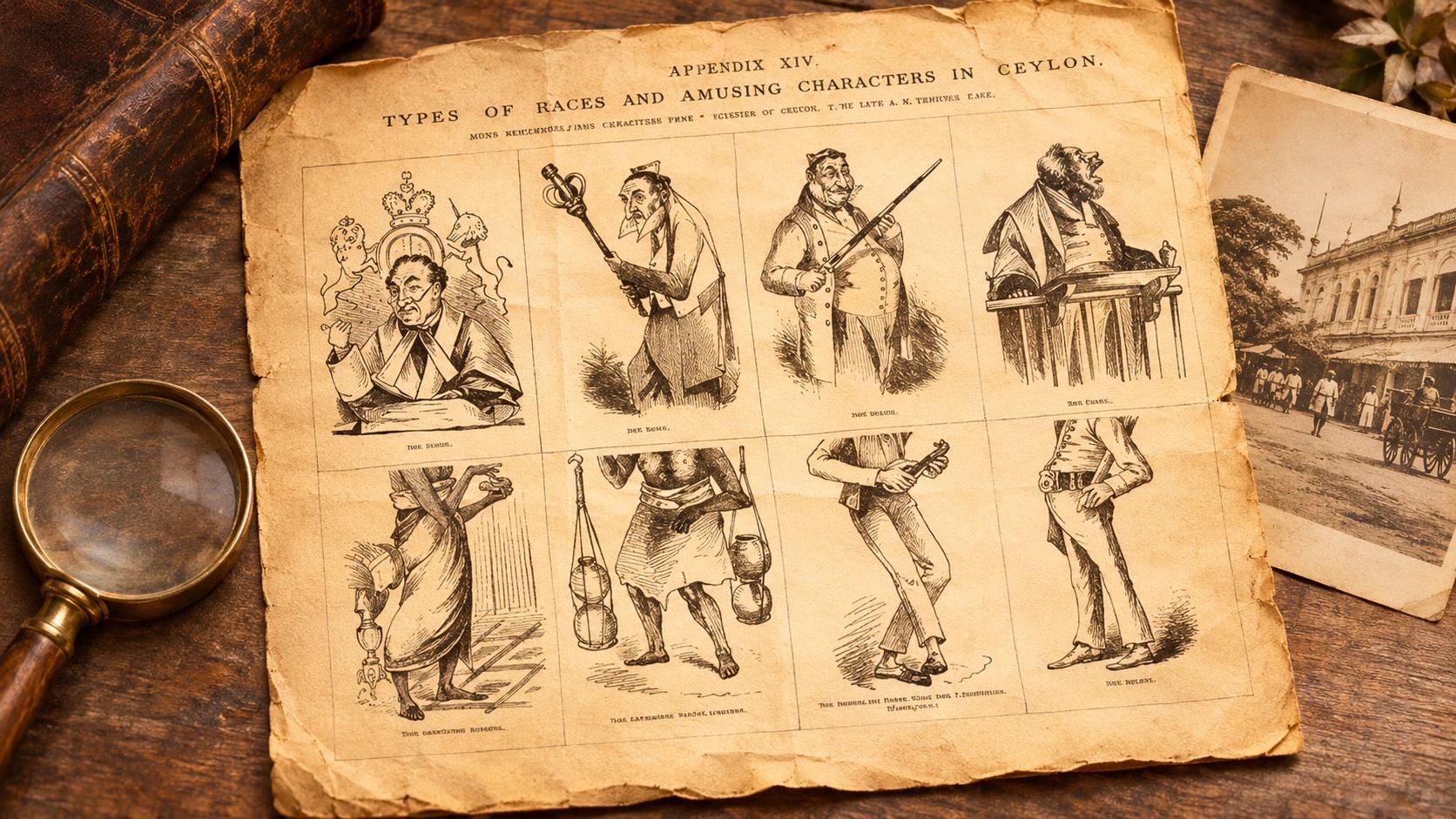
One such collection appeared in an old volume published in 1893. It carried the rather unusual title Types of Races and Amusing Characters in Ceylon.
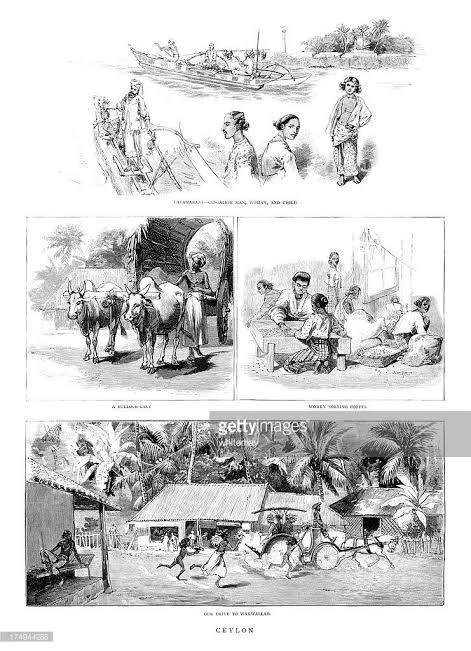
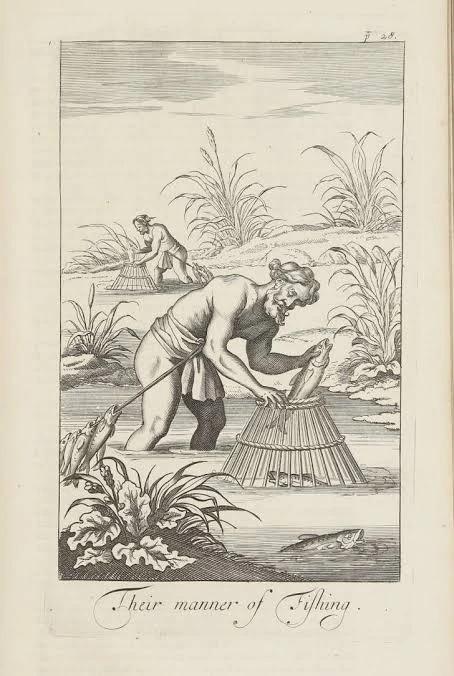
Looking at these drawings today, it is difficult not to smile at some of the exaggerated faces and elaborate costumes. There is something almost theatrical about them. Yet behind the humour is a glimpse of a Ceylon that has long since disappeared, when a man’s clothing could reveal his occupation, his standing in society and sometimes even the part of the island from which he came.
The artist may have intended to amuse his readers, but more than a century later, these little drawings have become something else entirely. They are reminders of the people who once walked the streets of old Colombo, occupied the offices of colonial administration and went about their daily lives in a world very different from ours.
An Old Book and Its Curious Illustrations
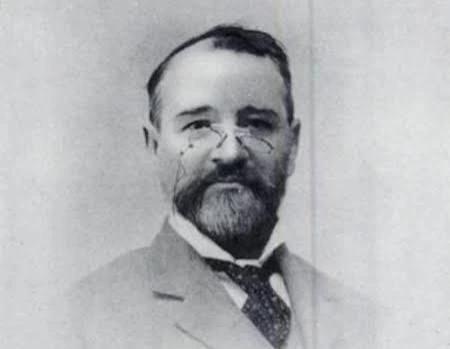
The drawings were reproduced in Ceylon in 1893, a book by John Ferguson, one of the best-known writers and chroniclers of nineteenth-century Ceylon. Ferguson spent many years documenting the island’s development, its plantations, railways, commerce and the changing life of the colony.
His book was a substantial account of Ceylon as it stood towards the end of the Victorian age, when the railway had already climbed into the mountains, the tea industry was becoming firmly established, and Colombo was developing into an important port of the British Empire.
Tucked away among its many pages was this rather curious collection of caricatures, originally drawn from an earlier work, Souvenirs of Ceylon, by A. M. Ferguson.
Unlike the familiar engravings of palm-fringed beaches, elephants crossing rivers or distant mountains, these illustrations were concerned entirely with people.
Each figure seemed to represent a particular character or position in society. There were men in formal coats, others with elaborate headgear, and figures carrying the objects associated with their occupations. Some appeared important and dignified, while others had clearly been drawn with a mischievous sense of humour.
It was a different way of recording the island, one in which the people themselves became the subject of curiosity.
When a Man’s Clothes Told His Story
One of the first things that catches the eye is the clothing.
The Ceylon of the nineteenth century was a place where dress could immediately distinguish a village headman from a merchant, a government official from a labourer, or a Kandyan chief from a gentleman of the maritime provinces.
In the Kandyan districts, the old aristocratic families still preserved much of the ceremonial splendour associated with the former kingdom. The distinctive headgear, flowing garments and carefully arranged folds of cloth were reminders of an earlier age, when the Kandyan court had its own elaborate traditions and customs.
Even after the kingdom passed into British hands in 1815, many of these traditions continued.
A Kandyan chief appearing at an official ceremony would have been quite a sight, dressed in garments that seemed almost impossibly elaborate to the unaccustomed European eye.
Down in the maritime provinces, the Mudaliyars presented a different appearance.
These officials, whose titles and responsibilities had developed through the Portuguese, Dutch and British periods, often dressed in a manner that combined European and local traditions. Their formal coats, ceremonial swords and distinctive hairstyles were familiar sights in colonial society.
To the artist responsible for these illustrations, such costumes offered endless opportunities for exaggeration.
A large coat became even larger. A serious expression became almost comically solemn. An elaborate headpiece was made to look grander still.
But behind the humour lay something that was very real. Clothing was not simply a matter of fashion. It could be a visible declaration of rank, tradition and authority.
The Streets of a Very Different Colombo
It is tempting to imagine the world in which these characters might have been encountered.
Colombo in the late nineteenth century was very different from the crowded modern city we know today, although many of its familiar streets and neighbourhoods were already taking shape.
The Fort was the centre of colonial administration and commercial activity. European merchants went about their business in offices overlooking the harbour, while government officials moved between imposing buildings that represented British authority on the island.
Beyond the Fort lay the Pettah, where another side of Ceylon could be seen.
Its narrow streets were alive with trade. Shopkeepers displayed their goods, merchants negotiated prices, carts carried supplies through the busy thoroughfares, and people from different communities went about their daily business.
There were Sinhalese, Tamils, Muslims, Europeans and members of other communities, each contributing to the commercial and social life of the city.
One could imagine a formally dressed Mudaliyar passing a trader seated outside his shop, while a labourer carrying his load made his way through the street. A government messenger might hurry past, and somewhere nearby a merchant would be counting his day’s takings.
The sounds, languages, clothing and customs of old Colombo would have presented a remarkable mixture to a newcomer.
For the illustrators of the Victorian period, this variety became a source of endless fascination.
Not all of their observations were fair, and many were coloured by the attitudes of colonial society. Yet their drawings have preserved something of the atmosphere of an island where several different worlds met in the same streets.
The Humour of Another Age
There is something distinctly Victorian about the way these characters were drawn.
The faces are exaggerated, the poses sometimes absurd, and the seriousness of certain figures seems deliberately overstated.
Caricature was a popular form of amusement in the nineteenth century. Politicians, judges, military officers and prominent personalities in Britain regularly found themselves depicted with oversized heads, exaggerated expressions or ridiculous costumes.
Ceylon was no exception.
But colonial humour often carried its own prejudices. European artists sometimes portrayed local customs as peculiar simply because they were unfamiliar. The title of this collection, particularly its use of the word “races”, reflects a way of classifying people that belonged to the colonial period.
The individuals represented in these sketches were, of course, far more complex than the drawings suggested.
A Mudaliyar was not merely a man in an elaborate coat, just as a trader or labourer could not be reduced to a particular type of dress or facial expression.
Their lives had families, ambitions, responsibilities and stories that the artist never attempted to tell.
That is perhaps why these illustrations are so interesting today. They show us not only something of nineteenth-century Ceylon, but also how people living in that period looked at one another.
Little Details That Time Has Forgotten
Old illustrations often have a way of preserving details that might otherwise disappear.
A particular style of coat, the arrangement of a headcloth, the manner in which a staff was carried or the shape of a ceremonial accessory may seem insignificant at first.
Yet such details once belonged to the ordinary visual language of everyday life.
People recognised them immediately.
They understood who held authority, who performed a particular occupation, and which traditions were represented by a certain costume.
Today, many of those distinctions have faded from memory.
The ceremonial uniforms of colonial officials have disappeared from everyday life. The elaborate social world of the Mudaliyars and Kandyan headmen has changed beyond recognition. Even the streets where these men once walked have been transformed by successive generations.
Photographs from the period offer us glimpses of this vanished society, but these little drawings provide something different.
They capture not merely appearances but the impressions those appearances made upon an artist more than a century ago.
In their exaggerated way, they remind us that old Ceylon was full of individuals whose dress, manner and position made them instantly recognisable to the people around them.
Old Ceylon caricatures | A Forgotten Page from Old Ceylon
There is a special pleasure in discovering these unusual fragments of the island’s past.
They are not grand historical records of battles, governors or the construction of railways. They do not tell us when a bridge was opened or when a plantation was established.
Instead, they bring us face to face with the sort of people who once formed part of the island’s everyday scenery.
The figures may be exaggerated, and the humour may belong to another age, but the world behind them was real.
Somewhere in the Colombo of the 1800s, men dressed in similar clothes walked along dusty streets, attended official functions, entered government offices, visited markets and returned home at the end of the day.
Their conversations have long since been forgotten. The houses in which many of them lived have disappeared. The customs that shaped their lives have changed, and the titles they carried are now more familiar from history books than from everyday experience.
Yet here they remain, preserved in a few faded drawings on a yellowing page.
Perhaps that is what makes old illustrations so appealing. They allow us to meet, however imperfectly, a few of the people who inhabited the Ceylon our grandparents and great-grandparents might have heard stories about.
And although the artist originally intended these characters to be amusing, their greatest value today lies in something quite different.
They offer a small, curious window into a forgotten social world, reminding us that the story of Old Ceylon was never only about its buildings, railways, plantations and landscapes.
It was also about the people who lived among them.
And sometimes, all that remains of their world is an old drawing, a faded page and a story waiting to be rediscovered.
Visit us: https://trippingsrilanka.com/