Old Colombo Fort | An old photograph of Colombo takes us back to the days of handwritten ledgers, busy shipping offices, covered shopping pavements and streets shaded by enormous trees. Beyond the grand colonial buildings was a city of people going about their daily work.
A Working Morning in Old Colombo
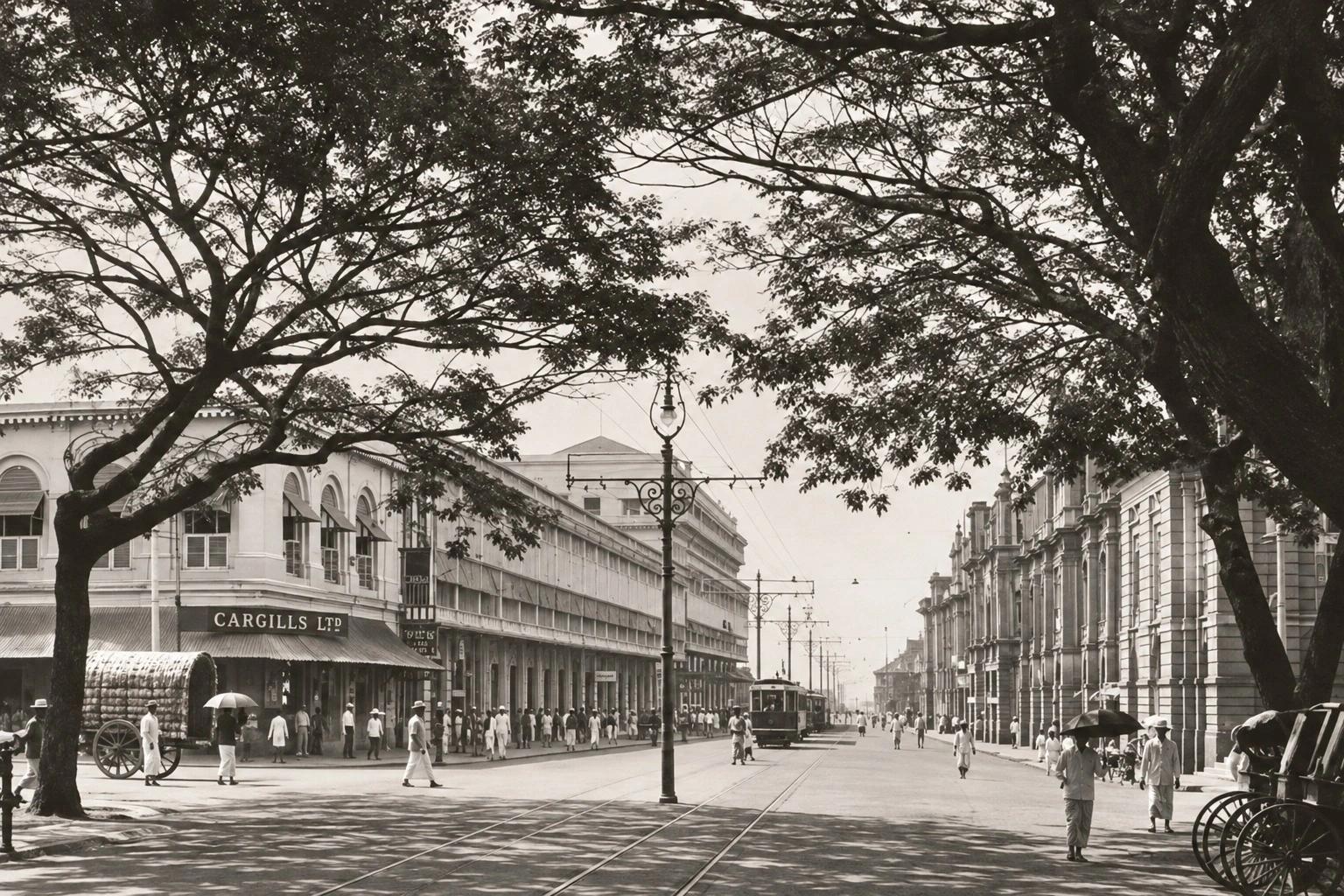
Look at this old photograph of Colombo and imagine arriving there on a weekday morning, more than a hundred years ago. A man carrying an umbrella crosses the road while other pedestrians make their way beneath the shade of enormous trees. The street appears surprisingly open, with tramlines running along the roadway and commercial buildings standing in the background.
Somewhere nearby, shop assistants would have been preparing their counters for customers, clerks arriving at their offices and merchants attending to the day’s business. The photograph cannot tell us exactly what these people were doing, but it captures the surroundings in which much of Colombo’s commercial life took place.
There are no traffic lights, motorcycles weaving through traffic or the long queues of vehicles familiar to anyone travelling through Colombo today. Yet this was certainly not a sleepy town. By the early twentieth century, Colombo was the principal commercial centre of British Ceylon, with a busy harbour, established trading houses, banks and businesses connected with international commerce.
The photograph is interesting because it records a city at work rather than a special occasion. There are no ceremonial decorations or crowds gathered for an important visitor. The people appear to be attending to their own affairs, scarcely aware that the ordinary street around them would one day become a subject of historical interest.
When Colombo Fort Was the Centre of Business
During the early twentieth century, Colombo Fort was the centre of much of Ceylon’s commercial activity. Banks, shipping agencies, trading companies, insurance offices and import businesses occupied buildings that gave the district its distinctive appearance. Some had impressive façades and covered verandahs, while others were more practical commercial premises containing offices, stores and trading rooms.
Inside those buildings, business depended upon paperwork. Before computers, photocopiers and electronic banking, commercial transactions required ledgers, invoices, correspondence and carefully maintained records. Office staff spent much of their time preparing accounts, recording payments, copying letters and checking documents associated with goods arriving at or leaving Colombo Harbour.
A clerk working for a shipping agency might be responsible for entering cargo information into a register or preparing correspondence for an overseas office. A bookkeeper would maintain accounts, while messengers carried documents between businesses, banks and government departments. Typists and office assistants gradually became an established part of commercial life as office equipment and business practices developed.
The work could be repetitive and demanding, particularly when large quantities of information had to be entered by hand. Accuracy mattered because a mistake in a ledger, invoice or shipping document could create difficulties for the people responsible for the transaction.
Although the buildings of Old Colombo often attract our attention, it was the people working inside them who kept the commercial district functioning from one day to the next.
The Harbour That Kept Colombo Busy
Colombo’s working day was closely connected with the harbour. Steamships brought passengers, mail, machinery, manufactured goods and other imports from overseas, while tea, rubber, coconut products and other Ceylonese exports were shipped to international markets.
The arrival of a vessel created work well beyond the harbour itself. Shipping agents needed to attend to documents, merchants expected news of cargo, customs procedures had to be completed and goods were moved towards warehouses and commercial establishments. A delayed shipment or an unexpected arrival could affect the plans of businesses throughout the district.
Much of this work took place in offices located within easy reach of the port. Colombo Fort’s position beside the harbour made it a convenient centre for firms engaged in import and export trade, banking and shipping services.
The city’s commercial activity also extended into Pettah, where warehouses, wholesale traders and smaller businesses handled goods moving through Colombo. Carts and other forms of transport carried merchandise between landing places, stores, shops and customers.
For the office worker seated behind a desk in Fort, the movement of ships could determine the day’s workload. For a labourer unloading cargo or a cart driver transporting goods, the connection was even more immediate. The harbour provided employment for people across many occupations and helped shape the daily rhythm of the city.
The People Behind the Grand Buildings
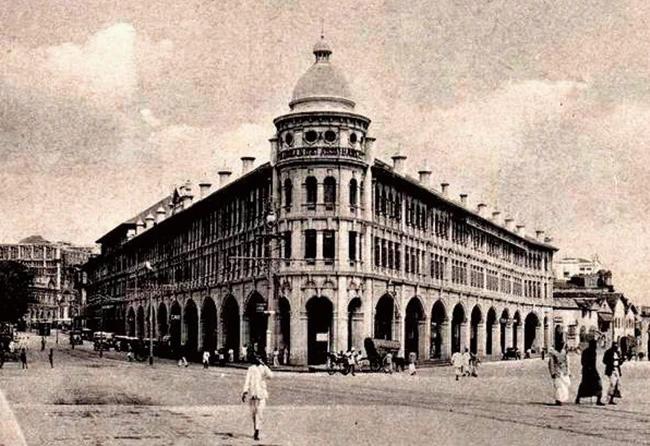
Old photographs of Colombo often draw attention to the architecture. The elegant windows, long verandahs, ornamental columns and substantial commercial buildings are certainly worth studying. They remind us of a period when the Fort was developing into an important centre of colonial administration and international trade.
But behind those façades were people whose working lives were very different from one another. European merchants and managers occupied influential positions in many commercial firms, while Ceylonese clerks, accountants, typists and other employees carried out much of the daily administrative work.
The city also depended upon port workers, labourers, shop assistants, cart drivers, cleaners and messengers. Their work was essential to the functioning of businesses whose names became familiar throughout Ceylon, even though the people themselves seldom appeared in newspaper reports or company histories.
Colonial commercial society had clear hierarchies. Senior positions in many European-owned businesses were not equally accessible to people of different backgrounds, and the conditions experienced by a manager were very different from those of a labourer working in the harbour.
Nevertheless, all these occupations formed part of the same commercial system. A messenger carrying documents between two offices contributed to the working life of Fort just as surely as the manager who signed the correspondence. The photograph allows us to consider the streets shared by people whose occupations, incomes and opportunities differed considerably.
When Shopping in Fort Was an Outing
Fort was not simply a district of banks, offices and shipping companies. It was also a place where people came to shop, sometimes travelling considerable distances to visit particular establishments.
Names such as Cargills, Millers and Colombo Apothecaries became familiar in the commercial life of the city. Their premises offered different kinds of merchandise and services, including imported goods, clothing, household requirements, medicines and other products.
Shopping was conducted very differently from the way it is today. Customers entered establishments where assistants stood behind counters, brought out merchandise and attended to individual requests. Purchases were wrapped, recorded and paid for without the electronic systems that now handle most transactions.
Imported products occupied an important place in some of these establishments, reflecting Ceylon’s position within international trading networks. Merchandise arrived by sea, passed through the harbour and eventually reached the shelves and counters of Colombo’s shops.
The streets themselves formed part of the shopping experience. Covered pavements and verandahs provided shelter from the sun and rain, allowing people to walk between commercial buildings and shopfronts. York Street and other roads in Fort were associated with businesses where customers could browse, make purchases and meet acquaintances.
For some, visiting Fort was part of a working day. For others, it was an opportunity to shop, attend to banking matters or spend an afternoon in the commercial centre of Colombo.
The Streets Had Their Own Rhythm
One of the most noticeable features of the photograph is the amount of space visible between pedestrians and vehicles. The broad roadway, tramlines and enormous trees give the scene a less congested appearance than a similar view of Colombo today.
But photographs can be misleading. A quiet moment captured by a camera does not necessarily mean that the city was always peaceful. Colombo already had busy commercial streets, and the movement of carts, rickshaws, pedestrians, tramcars and early motor vehicles created its own transport difficulties.
Electric tramways began operating around the turn of the twentieth century, connecting parts of the city through a network of tracks and overhead electrical wires. The service offered a new means of public transport at a time when horse-drawn carriages, bullock carts and hand-pulled rickshaws remained familiar sights.
Walking was still an important part of daily travel, particularly for those who could not afford another form of transport. The shaded pavements and covered walkways of Fort were therefore practical features of the city’s streets, rather than merely architectural decorations.
The large roadside trees visible in old photographs are also worth noticing. Their shade offered relief from Colombo’s tropical heat, particularly for people who spent considerable time outdoors.
For those working in Fort, these streets were not picturesque reminders of an earlier age. They were simply the roads they used every morning to reach an office, shop, warehouse or place of employment.
The Ordinary Routines of an Office Day
A working day in an early twentieth-century Colombo office would have involved routines that remain surprisingly recognisable, even though the equipment was very different.
Correspondence had to be received and answered, accounts checked, invoices prepared and instructions passed between departments. Someone needed to keep track of appointments and deliveries, while others attended to customers and business visitors. Much depended upon the organisation of the office and the reliability of the people employed there.
Communication moved more slowly than it does today. A letter arriving from Europe might contain instructions written weeks earlier, while telegrams offered a faster means of conveying urgent information. Local messages could be sent by post or delivered by a messenger travelling between offices.
The telephone gradually became part of Colombo’s commercial infrastructure, although it was not immediately available to everyone. During the early years of electrical development, the expansion of communications and transport created technical difficulties that had to be addressed as the systems became more widely used.
For many clerks and office assistants, the working day was governed by fixed hours, written instructions and the authority of senior employees. Opportunities for advancement depended upon the firm, the individual’s experience and the social conditions of the period.
The familiar routines of modern office life had their predecessors in these old commercial buildings. The desks, equipment and methods of communication have changed, but the need to maintain records, deal with customers and organise daily work remains much the same.
A City That Was Already Changing
The Colombo seen in the photograph was not a city standing still. During the late nineteenth and early twentieth centuries, new technology and commercial development were changing the way people worked, travelled and communicated.
Electric tramways, improved harbour facilities, telephone services and the expansion of commercial buildings all contributed to these changes. Older forms of transport continued to operate alongside newer vehicles, while businesses adopted new equipment without immediately abandoning traditional methods.
A clerk might travel to work by tram and spend the day writing entries in a ledger by hand. A merchant could receive urgent news by telegram while waiting weeks for documents to arrive by ship. Motorcars were becoming more familiar, but carts and rickshaws still had important roles in transporting people and goods.
This mixture of older and newer practices is part of what makes the period interesting. Colombo was becoming a modern commercial city, but the transition happened gradually, with different forms of technology and working life existing side by side.
The photograph records one small moment during that process. Although we cannot identify the exact occupations of the people pictured, the surroundings belong to a city in which commerce, transport and daily life were undergoing considerable change.
When Fort Was More Than a Place to Pass Through
Today, much of Colombo Fort is associated with banks, government offices, commercial establishments and busy roads. People arrive for appointments, attend to their business and leave, often without paying much attention to the older buildings above the shopfronts.
During the early twentieth century, these streets were central to the commercial and social life of the city. There were shops to visit, offices to call at, shipping matters to attend to and acquaintances to meet. The harbour brought a constant movement of passengers and merchandise, linking Colombo with other ports in Asia, Europe and Australia.
For someone employed in Fort, the district would have been familiar through years of daily journeys. Particular shops, offices and street corners became part of a routine repeated throughout the working week.
Someone might know the quickest way between two offices, where to find a particular merchant or which covered pavement offered the best shelter during an afternoon shower. These small details rarely appear in official histories, but they are part of what makes a city familiar to those who live and work there.
Old photographs allow us to see the buildings and streets, although they reveal very little about the individual routines that took place within them. Those experiences belonged to people whose lives were seldom considered important enough to record.
When the Working Day Came to an End
Every working day eventually came to an end. Clerks closed their ledgers, shops prepared to shut their doors and the men who had spent the day carrying goods or running errands made their way home. Some returned to neighbourhoods within Colombo, while others travelled to areas beyond the commercial centre.
The offices and commercial buildings remained, ready for another day’s business. The streets gradually changed character as workers departed, although the harbour and certain businesses continued operating beyond ordinary office hours.
We know comparatively little about the individuals visible in photographs such as this one. Their names, occupations and personal circumstances are mostly lost to us. Yet they were the people who knew this Colombo best.
They recognised the buildings without needing captions and knew which shops were worth visiting, where to find particular businesses and how long it took to travel between familiar streets. The city in the photograph was not a historical scene to them. It was the place where they worked and carried out their daily responsibilities.
More than a century later, we examine those same streets through old photographs, trying to identify landmarks and understand how the surroundings have changed. The architecture and transport may be different, but the ordinary business of earning a living, travelling to work and returning home remains familiar.
For the people crossing that street, it was simply another working day in Ceylon’s commercial capital. The photograph preserves a moment they would probably have forgotten by the following week.
Today, it offers us a glimpse of the Colombo they knew.
Visit us: https://trippingsrilanka.com/stories