In 1889, long before travel influencers, online booking engines, review sites, and glossy hotel campaigns, a small advertisement in the Ceylon Observer promoted one of Kandy’s most recognizable heritage hotels: Queen’s Hotel, Kandy.
The advertisement is simple, direct, and fascinating. It describes Queen’s Hotel as occupying “the best site in the town,” overlooking the Esplanade and the “lovely Lake,” within easy reach of the railway, post and telegraph offices, Peradeniya Gardens, and other key attractions.
More than a hotel advertisement, it is a small window into how travellers experienced Kandy in Old Ceylon.
A Hotel at the Heart of Colonial Kandy
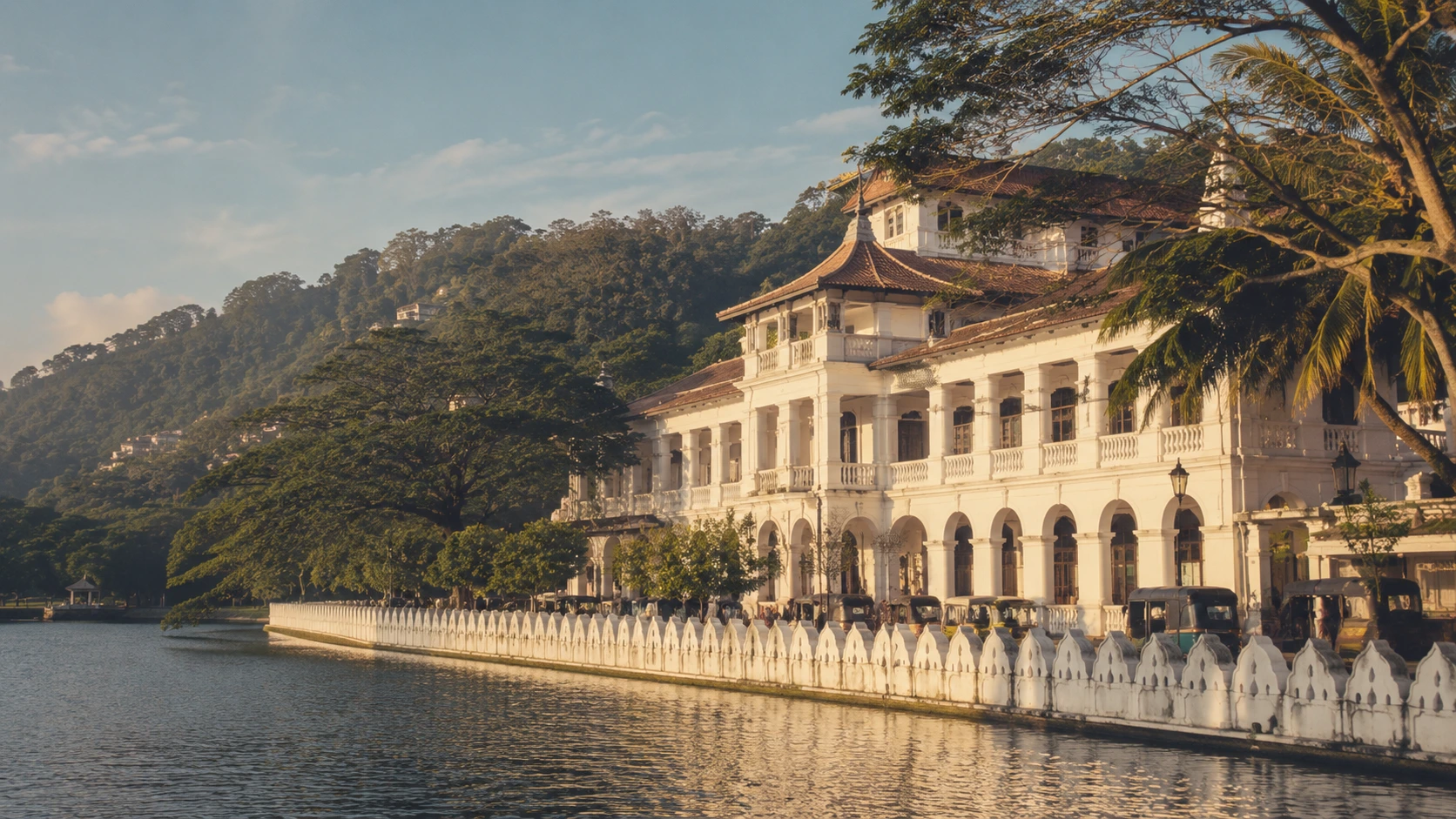
Queen’s Hotel still stands in one of the most iconic locations in Kandy, facing the lake and close to the Temple of the Sacred Tooth Relic. For modern visitors, its setting is one of the hotel’s greatest strengths. The 1889 advertisement shows that this was already true over 130 years ago.
The ad proudly states that the hotel overlooked the Esplanade and the lake, placing it at the centre of Kandy’s social and scenic life. In the late 19th century, this would have mattered greatly to colonial travellers, planters, officials, merchants, and families arriving in the hill capital.
Kandy was not simply another inland town. It was the old royal capital, surrounded by hills, temple architecture, lake views, and a cooler climate than Colombo. For travellers moving through Ceylon, it offered a blend of history, scenery, and comfort.
Queen’s Hotel positioned itself exactly around that appeal.
The Railway Changed the Way Travellers Saw Ceylon
One of the most interesting lines in the advertisement refers to the hotel being within easy reach of the railway. This tells us something important about tourism in Old Ceylon.
By the late 19th century, rail travel had transformed the island. Journeys that were once slow, uncomfortable, and dependent on horses or carriages became easier and more predictable. The Colombo to Kandy journey opened up the hill country to more visitors, including families and long-stay guests.
The advertisement even mentions the train fare:
First-class train fare to Kandy: Rs. 6
Return ticket: Rs. 9
For today’s reader, these figures are historically charming. They show how rail travel was already being packaged as part of the visitor experience. Kandy was not just a destination; it was a journey.
Even now, the train ride to Kandy remains one of Sri Lanka’s classic travel experiences. The scenery, changing climate, station stops, and gradual climb into the hills still carry a sense of old-world travel.
Click on here “Kandy’s Famous Old Lady: The Timeless Queens Hotel”
Close to the Post and Telegraph Offices
The advertisement also highlights proximity to the Post and Telegraph Offices.
This may seem ordinary today, but in 1889 it was a major selling point. Travellers needed access to communication. Letters, telegrams, business messages, plantation updates, and family correspondence all mattered.
A hotel close to the post and telegraph offices offered convenience and status. It told guests that they could remain connected while travelling inland.
In a modern tourism sense, this was the 19th-century equivalent of advertising strong Wi-Fi, business facilities, and central access.
Peradeniya Gardens as a Visitor Attraction
Another key attraction mentioned in the advertisement is Peradeniya Gardens.
This is especially interesting because Peradeniya remains one of the finest places to visit near Kandy today. The Royal Botanic Gardens were already an important stop for visitors in the 1800s, admired for their avenues, palms, tropical trees, orchids, and landscaped beauty.
For Old Ceylon travellers, Peradeniya represented the island’s botanical richness. For modern visitors, it remains a peaceful escape from the busy city, ideal for slow walks, photography, and appreciating Sri Lanka’s natural heritage.
The fact that Queen’s Hotel advertised its access to Peradeniya shows how early tourism in Kandy was already built around scenery, gardens, climate, and culture.
Family Accommodation in Old Ceylon
The advertisement states that Queen’s Hotel had “splendid accommodation for Families.”
This tells us that Kandy was not only a stop for officials or businessmen. It was also a leisure destination. Families travelling inland could stay comfortably, explore the town, visit gardens, enjoy the lake, and experience a cooler hill-country atmosphere.
This is important because it shows how Kandy was being marketed as a complete visitor destination even in the 19th century.
The hotel was not merely offering rooms. It was offering location, convenience, comfort, meals, entertainment, bathing facilities, transport, and access to attractions.
Billiards, Horses, Carriages and Baths
The advertisement proudly lists:
Good billiard tables, horses and carriages.
Hot, cold, and shower baths.
These details capture the lifestyle of hotel travel in Old Ceylon.
Billiards was a classic colonial hotel pastime. It suggested leisure, social life, and evening entertainment. Horses and carriages meant guests could explore Kandy and surrounding areas in comfort. Baths were a luxury worth advertising.
Today, hotel advertisements highlight infinity pools, spas, rooftop bars, curated tours, and heritage dining. In 1889, the equivalent selling points were billiards, carriages, and proper bathing facilities.
There is something beautifully nostalgic in that.
Dining at Queen’s Hotel in 1889
The advertisement also gives a glimpse into dining culture:
Breakfast at 9.30 and 12 a.m.
Tiffin at 2 p.m.
Table d’Hôte at 7.30 p.m. daily.
The use of the word tiffin reflects the colonial dining vocabulary of the period. In Ceylon, as in British India, tiffin usually referred to a light midday meal or lunch.
The term Table d’Hôte refers to a set meal served at a fixed time, often with a shared menu. This was common in hotels of the period and gave guests a structured dining experience.
These meal times remind us that heritage hotels were once highly social spaces. Guests did not simply eat privately and disappear. Dining rooms were part of the travel experience, where visitors, officials, planters, and families crossed paths.
Queen’s Hotel and the Romance of Staying in Kandy
For modern travellers, Queen’s Hotel carries a special type of charm because it is not only a place to sleep. It is part of Kandy’s urban heritage.
Its location places visitors close to the lake, the Temple of the Tooth, the old streets of Kandy, colonial-era buildings, shops, and viewpoints. Even if a traveller does not stay there, passing Queen’s Hotel gives a sense of Kandy’s layered past.
The 1889 advertisement reminds us that this hotel has been part of the city’s travel story for generations. Long before digital travel guides, guests were being invited to come to Kandy for its lake views, gardens, railway access, and comfortable hotel life.
That appeal has not entirely disappeared.
What This Old Advertisement Teaches Modern Travellers
This small newspaper advertisement tells us that tourism in Sri Lanka has deep roots. The language may be old, the typography may be faded, and the travel comforts may sound different, but the core appeal remains familiar.
Visitors still come to Kandy for:
- Heritage hotels
- The lake
- The Temple of the Tooth
- Peradeniya Gardens
- Cooler hill-country air
- Scenic rail journeys
- Colonial-era architecture
- Walkable town-centre charm
The same location that made Queen’s Hotel valuable in 1889 still makes it significant today.
Visiting Kandy Through an Old Ceylon Lens
One of the best ways to enjoy Kandy is to see it not only as a modern city, but as a place layered with memory.
Walk around the lake in the early morning. Look at Queen’s Hotel from across the road. Visit the Temple of the Tooth. Take time at Peradeniya Gardens. Notice the old buildings, verandas, balconies, and street corners that still carry traces of another age.
Kandy is not a museum. It is alive, crowded, noisy, sacred, commercial, and scenic all at once. But that is exactly what makes it interesting.
An 1889 hotel advertisement can still speak to the modern traveller because it captures something timeless: the pleasure of arriving in Kandy, staying near the lake, and experiencing one of Sri Lanka’s most historic cities from its very heart.
Final Thoughts
The Queen’s Hotel advertisement from the Ceylon Observer in 1889 is more than a piece of old newspaper history. It is a miniature travel brochure from another era.
It shows us what mattered to travellers in Old Ceylon: a central location, lake views, easy railway access, good meals, comfortable rooms, leisure, transport, and proximity to gardens and public offices.
More than a century later, Kandy still offers much of the same magic.
The names, prices, and travel habits have changed. But the city’s charm remains — in the lake, the hills, the heritage buildings, the gardens, and the enduring presence of Queen’s Hotel at the centre of it all.