When Trams Ran Through Colombo: Remembering the Tram Lines of Old Ceylon
Colombo tramways | Long before Colombo became a city of crowded buses, three-wheelers and endless traffic, electric trams carried generations of Ceylonese through its familiar streets. An old photograph brings back a chapter of the city’s transport history that has almost disappeared.
When the Tram Was Part of Everyday Colombo
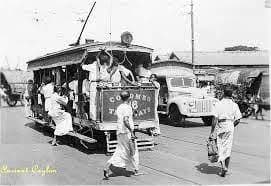
There was a time when the sound of a tram approaching was part of everyday life in Colombo. People heard it coming along the tracks, watched it make its way through the streets and stepped aboard for a journey to work, to the market or perhaps to visit relatives on the other side of town. For those who grew up in Colombo during the first half of the twentieth century, travelling by tram was nothing particularly unusual. It was simply one of the ways people got about the city.
Today, the idea of an electric tram travelling through Pettah, Maradana or Borella seems almost impossible to imagine. These are roads we associate with buses, motorcycles, three-wheelers and traffic that appears to move very little during the busiest hours. Yet for approximately sixty years, tramcars were as much a part of Colombo as its old shops, railway stations, markets and familiar street corners.
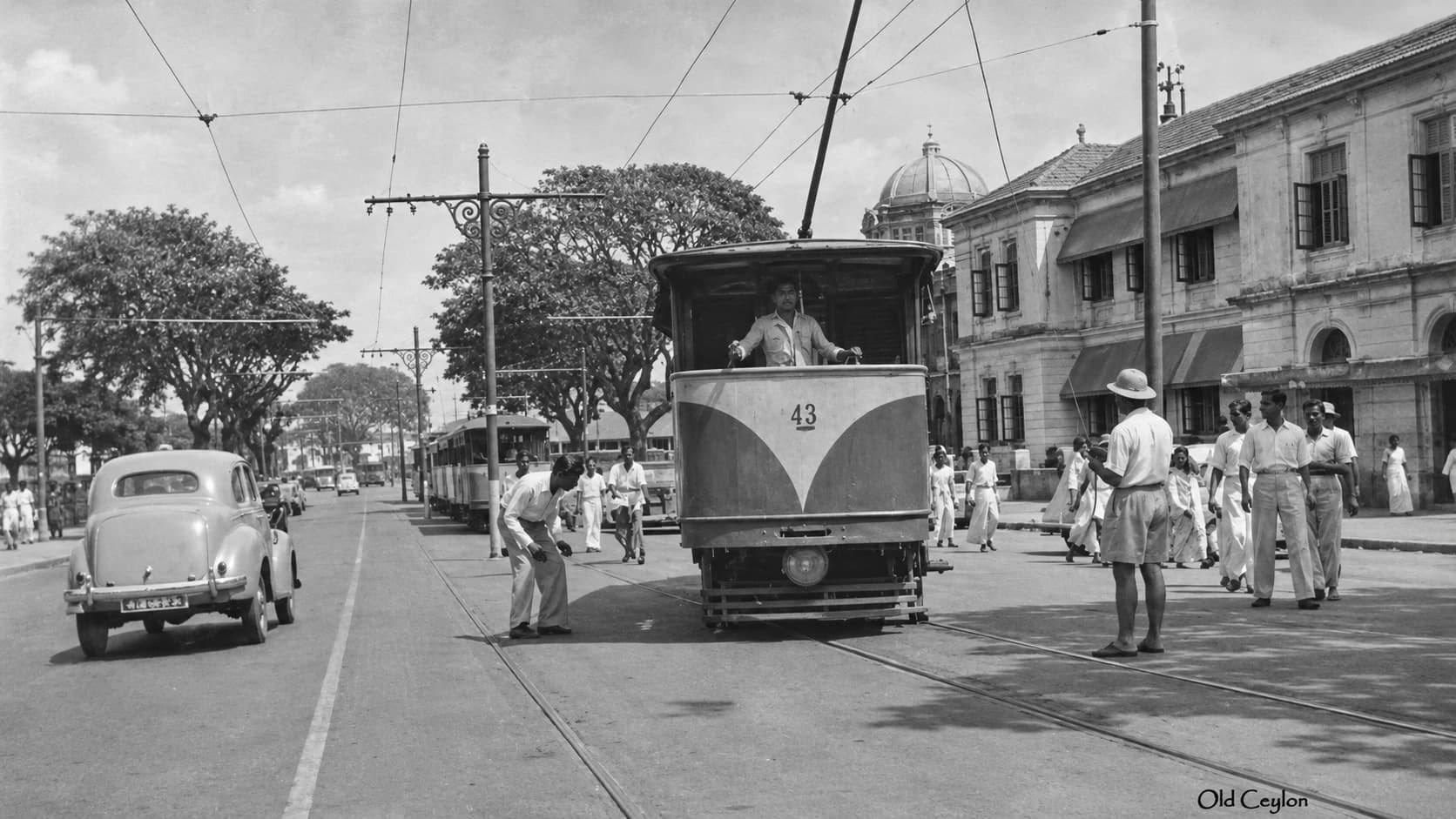
An old photograph showing a tram standing in the middle of a broad Colombo street brings back something of that forgotten period. It is not a ceremonial photograph or a scene arranged to celebrate the tramway. It appears to show an ordinary moment in the working life of the city’s transport system, when an electric tram was simply another familiar vehicle on the road.
An Old Photograph of Colombo’s Electric Tramways
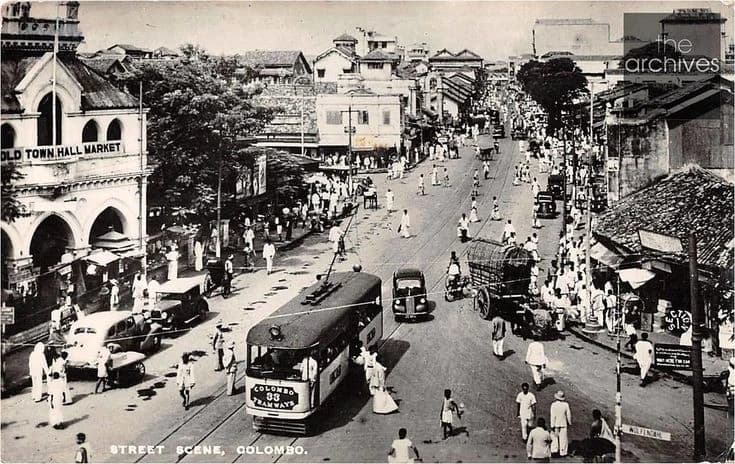
Look closely at the photograph and several details begin to emerge. The tram stands on rails running along the centre of the road, with overhead electrical wires stretching between poles above it. A man bends near the front of the vehicle, apparently attending to something on the road or the tram itself, while another stands nearby wearing shorts and a broad-brimmed hat. A few pedestrians watch from the roadside, and an old motorcar is parked on the left.
Further down the street, another tram can be seen beneath the trees. The road appears relatively open, with buildings set behind the shade of large trees. Pedestrians, motorcars and electric trams share the same street, creating a view of Colombo that is very different from its present-day traffic.
The photograph is especially interesting because nobody appears particularly impressed by the tram. For the people standing nearby, it was an ordinary part of their surroundings. They may have passed the same tramcars every day, either as passengers or while walking through the city.
We do not know where those people were going or why the tram in the foreground appears to have stopped. Perhaps someone was attending to a minor mechanical problem, or perhaps the vehicle was simply waiting before continuing its journey. The photograph does not provide enough information to say. What it does preserve is a moment when Colombo’s electric tramway was still a working part of the city.
When Electric Trams First Came to Ceylon
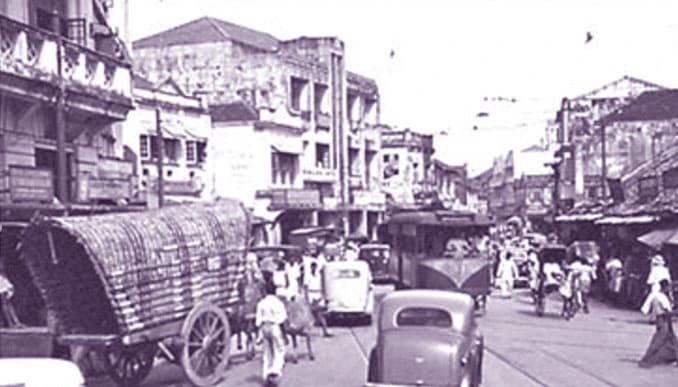
The story of Colombo’s tramways began towards the end of the nineteenth century, when the city was expanding as a commercial and administrative centre of British Ceylon. Colombo’s streets were becoming increasingly busy, and there was a growing need for organised public transport capable of carrying passengers between the commercial centre and developing residential districts.
In 1892, the Colombo Municipal Council invited tenders for the construction of a tramway system. A contract followed with Boustead Brothers, and work on the tracks and electrical infrastructure began in 1897. The first tram journey took place in 1899, while regular public services began in January 1900, according to the historical accounts associated with the city’s tramways.
The earliest route connected the Fort area, near the Grand Oriental Hotel, with Grandpass. Another route subsequently served Maradana and Borella, extending the network into important residential and commercial areas. For Colombo, the arrival of electric trams represented a considerable change in the way people could move around the city.
At a time when horse-drawn vehicles, bullock carts and hand-pulled rickshaws were still familiar sights, the tram offered a different form of public transport. It could carry groups of passengers along a fixed route without depending upon animal or human effort for propulsion. Its arrival also reflected the wider technological changes taking place in colonial cities at the turn of the twentieth century.
The Tramways and the Arrival of Electricity
Colombo’s tramways were closely connected with the early development of electricity in the city. The network required power generation, electrical distribution, overhead wires and equipment to keep the vehicles operating. It was therefore more than a matter of laying rails along existing roads.
The Pettah Power Station, built in 1902, became an important part of Colombo’s developing electrical infrastructure. Electricity was increasingly used for public transport and lighting, helping to change the appearance and practical functioning of the city. The tramways belonged to a period when electric technology was beginning to become visible in everyday urban life.
For residents accustomed to transport pulled by horses, bullocks or people, the electric tram must initially have seemed a considerable novelty. Over time, however, it became familiar enough that passengers no longer needed to think about the technology involved. They simply waited for the next tram, boarded it and continued towards their destination.
This is one of the more interesting aspects of transport history. A development that seems extraordinary when it first appears can become so ordinary within a generation that people barely notice it. Colombo’s electric trams eventually became part of that everyday routine.
The Tram Ride That Older Generations Remembered
A tram journey through Old Colombo would have offered passengers a close view of the streets and neighbourhoods through which they travelled. Office workers made their way towards Fort, traders travelled between commercial districts, and families used public transport to visit shops, markets and relatives. For many, the tram would have been a regular part of the working week.
Some earlier tramcars had open sides, allowing passengers to look directly onto the street, while later vehicles offered more enclosed accommodation. The movement of people boarding and alighting, the calls of conductors and the sound of metal wheels travelling along the rails would have been familiar features of the journey. Overhead, the electrical equipment connected the tramcar to the wires that supplied its power.
The route itself would have become part of a passenger’s memory. Shops, churches, verandahs, commercial buildings and familiar junctions passed by during journeys repeated over many years. Regular commuters may have recognised other passengers who travelled at roughly the same time each morning.
For children, a tram ride into Fort or Pettah could have been an enjoyable part of an outing with their parents. The sights and sounds of the city passed close to the carriage, while the journey offered a different experience from walking or travelling in a private vehicle. For adults going to work, however, the tram was often simply a practical way of reaching their destination.
Like any public transport service, it could be crowded, noisy and occasionally delayed. But for several generations, the tram remained a familiar part of Colombo life.
Through Pettah, Maradana, Borella and Grandpass
The electric tramway connected several of Colombo’s important commercial and residential districts. One route passed through Pettah towards Grandpass, while another linked the Fort area with Maradana and Borella. These services connected neighbourhoods where people lived, worked, attended school and carried out their everyday business.
Pettah was already a busy commercial centre, with traders, wholesale merchants and small businesses occupying its streets. Maradana had developed into an important railway and commercial district, while Borella was growing as a residential and shopping area. The tramways helped people move between these parts of the city without relying entirely on more expensive individual transport.
For people without private motorcars, the tram offered an established route through Colombo. It was useful for journeys that might otherwise have required considerable walking or the expense of hiring another vehicle. The tram was also part of a wider transport system that included railway services, buses, carts and rickshaws.
The network was not without difficulties. Historical accounts refer to overcrowding, accidents and mechanical problems that occasionally interrupted services. As Colombo grew, the tramways also had to operate within streets increasingly shared with motor vehicles.
Nevertheless, the tram remained a recognisable feature of the city for decades. Its tracks and overhead wires became familiar elements of the streetscape, and passengers came to depend upon the services connecting their neighbourhoods.
When Motor Buses Began to Change Colombo
By the middle of the twentieth century, Colombo’s transport requirements were changing considerably. Motor vehicles had become more common, and buses were carrying increasing numbers of passengers along routes that did not require fixed railway tracks. Roads were becoming more congested, while the tramway system itself was growing older.
The development of motor transport introduced greater flexibility in the way public services could operate. A bus could be moved onto a different route without the expense of laying rails or installing overhead electrical equipment. These practical advantages influenced the gradual shift away from the older tramway system.
Electric trolleybuses were also introduced as an alternative. Although they continued to draw electricity from overhead wires, trolleybuses travelled on ordinary rubber tyres rather than steel rails. They represented a different approach to electric public transport, retaining an electrical power supply while allowing vehicles to operate without tram tracks.
For Colombo residents who had known trams all their lives, these developments gradually altered the appearance of familiar streets. Buses became increasingly prominent, and the traditional tramcar was no longer the modern innovation it had seemed at the turn of the century.
The Day Colombo Said Goodbye to Its Trams
On 30 June 1960, Colombo’s electric tramway service officially came to an end. After approximately six decades of operation, the tramcars that had carried passengers through Fort, Pettah and other parts of the city were withdrawn from everyday service. Their closure marked the end of a significant chapter in Colombo’s public transport history.
The vehicles were eventually disposed of, and the tramway infrastructure gradually disappeared as roads were resurfaced and the city continued to develop. Overhead wires were removed, tracks were taken up or covered, and the streets slowly lost the features that had distinguished the tramway era.
For passengers who had spent much of their lives travelling by tram, the change would have altered familiar routines. Someone who had used the tram to reach an office in Fort or a market in Pettah would now have to depend upon another form of transport. The familiar tram stop, the sound of the approaching car and the journey along the rails gradually became things of the past.
The closure was part of a wider change in Colombo’s transport system, rather than an isolated event. By 1960, the city’s streets were already quite different from those of 1900. Motor buses, cars and other road vehicles had become central to daily travel, and the electric tram belonged increasingly to an earlier age.
What Remains of Colombo’s Forgotten Tram Lines?
Today, someone walking through Colombo might pass along a former tram route without realising that electric cars once travelled along the same road. Modern traffic has replaced the tramcars, overhead electrical wires have disappeared, and most visible traces of the old tracks have been removed or covered during decades of roadworks.
Old photographs, maps, newspaper accounts and the recollections of earlier generations now provide much of the evidence of the tramway system. These records help reconstruct the routes and show how the vehicles fitted into the streets of colonial and early post-independence Colombo.
There is an interesting comparison with the transport problems faced by cities today. Electric rail-based public transport continues to be considered in many urban centres as one possible way to improve passenger movement and reduce dependence on road vehicles. Colombo had such a system more than a century ago, although its scale, technology and operating conditions were very different from those of modern light rail.
The tramway was not a perfect solution to the city’s transport needs, and its closure reflected the circumstances and decisions of its time. But it served Colombo for approximately sixty years and became part of the daily experience of generations of residents.
A Colombo That Lives On in Photographs
Returning to the old photograph, it is the small details that make it worth preserving. The motorcar parked beside the road, the men standing in the sunshine, the large trees and the buildings in the background all belong to a Colombo that has changed considerably. At the centre of the scene stands the tram, a vehicle that would once have attracted little attention because it was so familiar.
The exact street and date of the photograph have not been established. It is therefore difficult to say which route the tram was operating or what the men standing beside it were doing. But the image clearly belongs to the period when trams shared Colombo’s streets with pedestrians and motor vehicles.
There are still families who remember hearing parents or grandparents speak about travelling by tram. They may recall accounts of journeys into Fort, shopping trips to Pettah or the experience of riding through Colombo in an electrically powered carriage. For younger generations, such stories can sound like descriptions of another city altogether.
Yet it was the same Colombo, with many of the same roads and familiar neighbourhoods. The buildings have changed, traffic has increased and newer forms of transport have taken over the streets, but the tramways remain part of the city’s history.
An ordinary photograph of a stopped tram reminds us that the everyday things people take for granted can eventually disappear almost completely. For six decades, Colombo residents waited at tram stops, climbed aboard electric cars and travelled along tracks that were as familiar to them as the roads are to us today.
That was once an ordinary way of getting around Colombo. Now it belongs to the history of Old Ceylon, preserved in photographs and in the memories passed down by those who knew the city before its tram lines disappeared.
Visit us: https://trippingsrilanka.com/