St Paul s Church, Kandy: A Foundation of Faith for Generations
For more than 180 years, St Paul’s Church has stood in the heart of Kandy, serving generations of Anglican worshippers. Its history reaches back to the early years of British rule, but its place in the lives of Kandy’s Christian families has continued long after the colonial period ended.
A Church at the Heart of Old Kandy
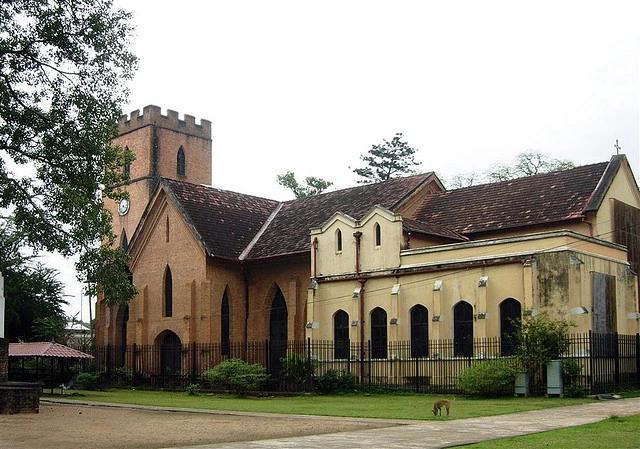
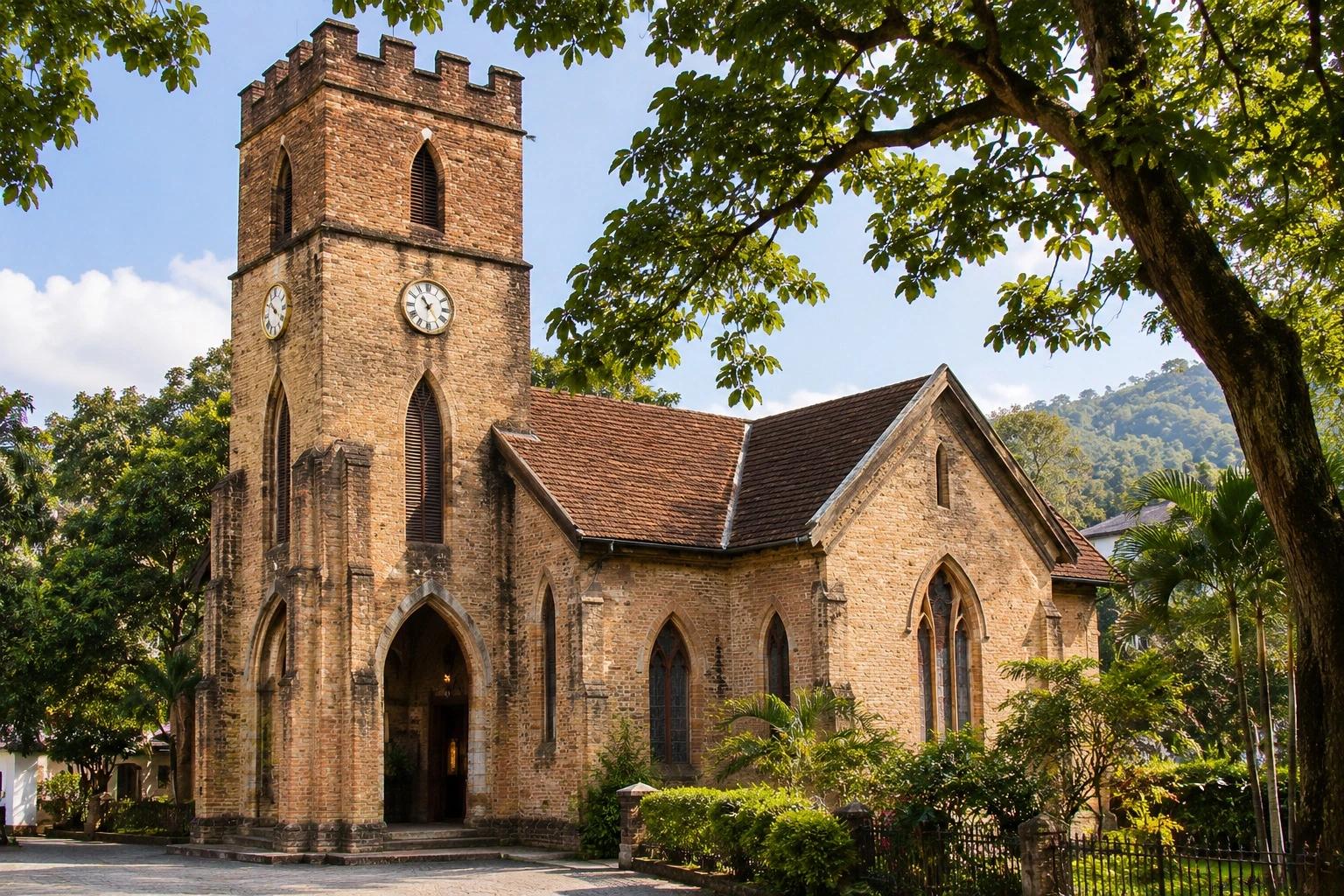
In the centre of Kandy, close to the Temple of the Sacred Tooth Relic, stands a red-brick church that has been part of the city’s religious life for generations. St Paul’s Church, with its distinctive tower, Gothic arches and familiar clock faces, is one of the historic buildings that have survived the many changes experienced by the old Kandyan capital.
For those who have grown up attending services at St Paul’s, the building holds memories that go well beyond its architecture. It is where parents brought their children for baptism, where families gathered for Sunday worship and where couples exchanged marriage vows. Its pews have been occupied by successive generations, and the familiar Anglican hymns and prayers have been part of family life for more than a century.
Kandy has always been closely associated with the history of the Kandyan Kingdom and the Buddhist traditions centred upon the Temple of the Tooth. The presence of St Paul’s adds another chapter to the city’s story, one that began during the early period of British administration and gradually became part of the life of Kandy’s established Christian community.
Although the church was originally built to meet the needs of British officials, soldiers and their families, its congregation did not remain exclusively connected with the colonial establishment. Over the decades, Ceylonese Anglican families made St Paul’s their spiritual home, establishing relationships with the parish that would continue across generations.
The Beginnings of Anglican Worship in Kandy
The history of St Paul’s Church begins in the years following the Kandyan Convention of 1815, when the British assumed control of the Kandyan Kingdom. The establishment of a British military garrison and administrative presence in Kandy created a need for regular Anglican worship.
In those early years, services were held in the former royal Audience Hall, a building associated with the Kandyan monarchy. It was an unusual arrangement, reflecting the circumstances of a city that had only recently come under British rule. The hall had been part of the ceremonial and administrative life of the Kandyan court, and its use for Christian worship belonged to a period of considerable political change.
When Bishop Reginald Heber of Calcutta visited Kandy in 1825, he recognised the need for a permanent church building. A dedicated place of worship would provide the Anglican congregation with a more suitable setting for its services and religious activities.
The proposal took several years to become a reality. On 16 March 1843, Bishop George Spencer of Madras laid the foundation stone of St Paul’s Church. Much of the funding came through public subscriptions, reflecting the efforts of those who wished to establish a permanent Anglican church in the hill capital.
The building opened for worship in 1846, although its formal consecration took place later. On 25 January 1853, Bishop James Chapman, the first Bishop of Colombo, consecrated St Paul’s Church, marking an important stage in the development of the Anglican community in Kandy.
From a Garrison Church to a Parish Community
In its earliest years, St Paul’s was closely associated with the British military presence in Kandy. Soldiers stationed in the hill capital, together with officers, government officials and their families, formed an important part of the congregation. Military chaplains and clergy helped maintain regular services, and the church became a familiar institution within the British administrative community.
Some of those early connections can still be traced through memorial tablets preserved inside the building. These commemorate individuals associated with the military and colonial establishment, offering reminders of the circumstances in which the church was founded.
But the history of St Paul’s did not remain confined to the period of British rule. As Kandy developed, the congregation gradually included more Ceylonese Anglican families who became closely connected with the parish. Their children were baptised there, marriages were solemnised before the altar, and funerals brought families together in prayer and remembrance.
For many households, Sunday attendance at church was an established part of family life. Parents prepared their children for worship, familiar faces gathered before and after services, and friendships developed among people who met regularly as members of the congregation.
The church calendar also shaped the rhythm of the year. Christmas, Holy Week, Good Friday and Easter were important occasions, while confirmations and other special services marked significant stages in the lives of younger members. These traditions continued long after the British garrison ceased to define the church’s purpose.
A Church Beside the Temple of the Tooth
One of the most distinctive features of St Paul’s Church is its location beside the Sri Dalada Maligawa, the Temple of the Sacred Tooth Relic. Few places in Sri Lanka bring two such different religious histories into such close physical proximity.
The Temple of the Tooth has been central to the Buddhist and royal traditions of Kandy for centuries. St Paul’s, by contrast, was established following the British occupation of the Kandyan Kingdom, reflecting the arrival of colonial administration and the institutional growth of Anglican Christianity in the city.
These different histories are important when considering the church’s place in Kandy. St Paul’s was founded within a colonial setting, and its early years were closely linked with the institutions of British rule. Over time, however, the congregation developed its own local identity, and the church became part of the religious life of generations of Sri Lankan Christians.
The proximity of the two places of worship remains one of the more interesting features of Kandy’s historic centre. Visitors walking through the area encounter buildings associated with different beliefs, traditions and periods of the city’s past.
For the Anglican community, St Paul’s provided a permanent place to practise and pass on the Christian faith. Its presence is also a reminder that Kandy’s history extends beyond its royal and Buddhist heritage to include the religious communities that established themselves in the city during later centuries.
The Red-Brick Church and Its Architecture
St Paul’s is among the most recognisable examples of nineteenth-century church architecture in Kandy. Built principally of terracotta brick, the church reflects the English Gothic tradition, with pointed arches, tall windows and a square tower crowned with battlements.
The clocks on three sides of the tower have long been a distinctive feature of the building. For people familiar with central Kandy, the church’s tower is part of the historic streetscape, standing among buildings and landmarks that have witnessed the city’s development over many decades.
The original church was comparatively simple, but alterations and improvements were made as the congregation grew. Significant work took place in 1878, contributing to the building’s later appearance and providing additional facilities for worship.
Inside, the church retains furnishings, memorials and religious features associated with different periods of its history. Some were provided by members of the congregation, while others were gifts made in memory of family members or individuals closely connected with the parish.
These objects give the building a character that cannot be explained by architecture alone. They represent the contributions of people who wished to support the church and leave something of lasting value to the congregation.
The Stained-Glass Window and the Church Organ
Among the treasures associated with St Paul’s is the stained-glass window above the high altar. It was presented in 1874 in memory of Laurence St George Carey, a planter associated with Le Vallon Estate in Pupuressa.
The window depicts scenes from the life of Christ, including the Nativity, Crucifixion and Ascension. For generations of worshippers, it has formed part of the familiar view towards the altar during Sunday services and important religious occasions.
The same year also saw the donation of a pipe organ by Carey’s brother. Music has long occupied an important place in Anglican worship, and an organ provided accompaniment for hymns and other parts of the liturgy.
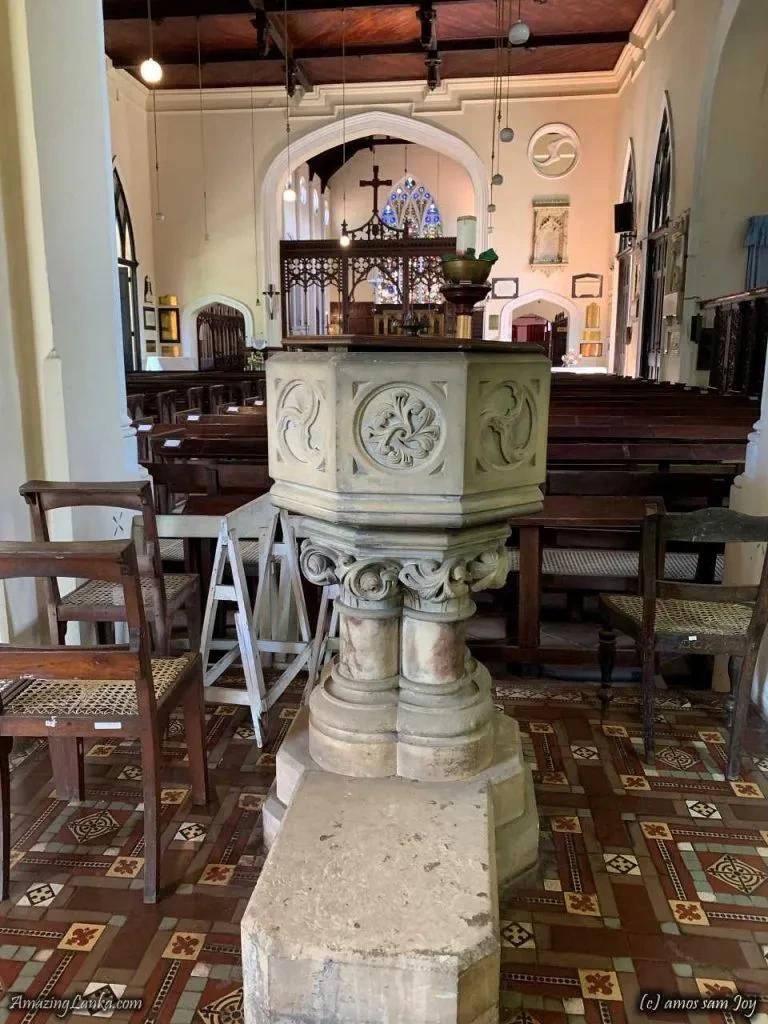
The church’s marble baptismal font is another significant feature. Generations of children have been brought to St Paul’s for baptism, and for many families, the font has been associated with the beginning of a lifelong connection with the parish.
The memorial tablets, furnishings and other historic objects within the building are reminders of the people who contributed to its development. Their names might otherwise have disappeared from everyday memory, but their gifts remain part of the church’s history.
The Parish Registers That Preserve Family Histories
Some of the most valuable records associated with St Paul’s are its old parish registers. These include records dating back to 1823, before the present church building was constructed.
The registers contain details of baptisms, marriages and deaths connected with the Anglican community of Kandy. For historians and families researching their ancestry, such records can provide information that may not survive elsewhere.
A baptismal entry might identify a child born to a family living in nineteenth-century Kandy. A marriage record could preserve the names of a couple whose descendants later settled in other parts of Ceylon or overseas. Burial records might provide dates and family connections that help reconstruct the lives of people who lived in the old hill capital.
These handwritten documents are especially interesting because they concern ordinary parishioners as well as prominent members of society. Not everyone who attended St Paul’s would have left behind a substantial written record, but many names have survived through the routine entries made by the clergy.
The registers also demonstrate the continuity of Christian family life in Kandy. Generations of the same families may appear in records covering baptisms, confirmations, marriages and funerals across many decades.
The history of St Paul’s therefore belongs not only to its clergy, architects and benefactors. It also belongs to the thousands of worshippers whose names were entered into its records and whose lives formed the parish community.
The Day Tragedy Reached St Paul’s
One of the most difficult moments in the modern history of St Paul’s occurred on 25 January 1998, when a bomb attack on the neighbouring Temple of the Tooth caused extensive damage to the church.
The explosion shattered windows and doors, damaged the roof and ceiling, and broke the historic stained-glass window above the altar. The loss was particularly distressing because the window had been part of the church’s heritage for more than a century.
The damage extended beyond the physical structure. St Paul’s had long been a place of worship and reassurance for its congregation, and the attack brought the violence of the country’s civil conflict directly into the historic centre of Kandy.
The restoration that followed became an important example of cooperation among people belonging to different religious communities. Professor Nimal de Silva of the University of Moratuwa, a Buddhist, worked with colleagues to recover and reconstruct the shattered stained glass. Assistance was also provided by people of other faiths who contributed to repairing the damaged building.
For a period after the attack, St Paul’s continued holding services despite the absence of its doors, leading to its description as the Church of the Open Door.
For the congregation, continuing to worship under those circumstances was an expression of their determination to maintain the life of the parish. The building had suffered considerable damage, but the community continued to gather for prayer.
The restoration of St Paul’s remains an important chapter in its history, recalling both the tragedy of 1998 and the efforts of those who helped preserve the church afterwards.
The Sunday Services That Generations Remember
For many families who have worshipped at St Paul’s, the church is associated with memories far more personal than the dates recorded in its history.
There are parents who brought their children for baptism, couples who stood before the altar to exchange marriage vows and families who gathered there during times of bereavement. The same building has witnessed moments of happiness and sorrow across several generations.
Sunday worship has remained central to the life of the parish. The familiar Anglican liturgy, readings from Scripture, hymns and celebration of Holy Communion continue traditions that have been part of the church’s identity for many years.
For those who attended services as children, memories may include getting ready for church on Sunday morning, sitting beside parents or grandparents and listening to hymns that became familiar through repeated singing. Some may remember the clergy who served during their childhood or the people who regularly occupied particular pews.
The church was also a place where friendships developed. Members of the congregation came to know one another through worship, parish activities and family occasions, creating relationships that often continued for decades.
An old parish church becomes part of family history in this way. Its importance is not measured only by the age of the building, but by the memories and experiences of the people who have gathered within it.
St Paul’s Church in Kandy Today
More than 180 years after its foundation stone was laid, St Paul’s continues to stand in the historic centre of Kandy. The city around it has changed considerably, with busy streets, expanding commercial activity and visitors arriving from across Sri Lanka and overseas.
Yet the church remains a place of Christian worship. Its architecture attracts attention, but its continuing significance lies in the congregation that gathers there and the ministry that has been maintained across generations.
St Paul’s also forms an important part of Sri Lanka’s Anglican heritage. Its story recalls the beginnings of organised Anglican worship in Kandy, the development of a local parish community and the religious traditions that survived the transition from colonial Ceylon to an independent nation.
The church has experienced periods of change, uncertainty and tragedy. It has witnessed the end of British rule, the development of modern Sri Lanka and the difficult years of the country’s civil conflict. Through these events, the parish has continued its work and worship.
For visitors, St Paul’s is an important historic church beside one of Sri Lanka’s most famous religious landmarks. For those who have worshipped there over the years, it is a place closely associated with their families, their faith and the memories of earlier generations.
A church may be remembered for its architecture, its stained-glass windows or the historical events connected with it. But its lasting importance also lies in the lives of the people who have made it their spiritual home.
For St Paul’s, that has been the story for more than 180 years. The generations have changed, but the church continues to welcome those who come to pray, worship and find comfort in their faith.
Visit us:https://trippingsrilanka.com/stories