Romantic Ceylon: The Forgotten Book That Captured an Island of Kings, Legends and Lost Stories
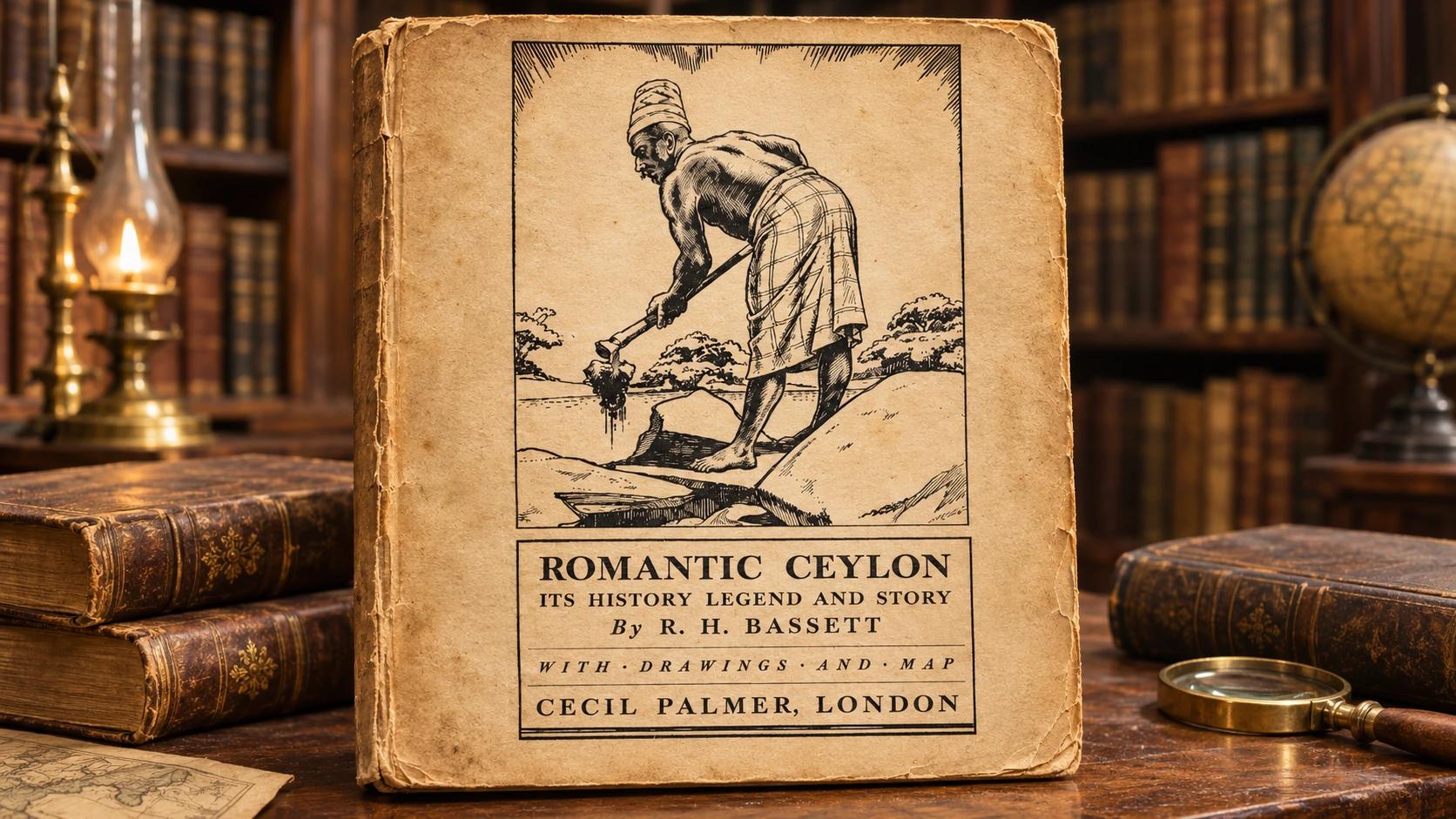
Published in London in 1929, R. H. Bassett’s Romantic Ceylon brought together the history, folklore and local traditions of an island whose stories had been told and retold for generations. Nearly a century later, the book offers an interesting glimpse of how Ceylon’s past was remembered during the final decades of British rule.
An Old Book About a Ceylon of Kings and Legends
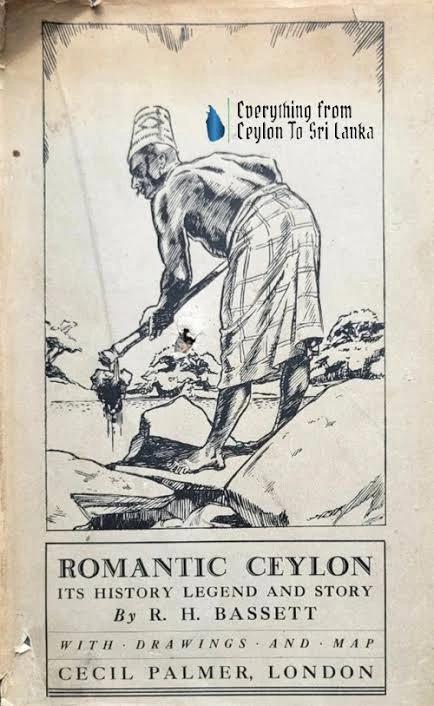
There was a time when books about Ceylon were eagerly read by people who had never visited the island. Travellers wrote about its mountains, ancient cities, tea estates and tropical forests, while colonial officials and historians recorded its customs, political history and everyday life. Among these publications were books devoted to the legends and local traditions that had survived for centuries, often passed down through generations before finding their way into print.
In 1929, a book appeared in London with the rather appealing title Romantic Ceylon: Its History, Legend and Story. Its author, R. H. Bassett, had gathered together a collection of historical episodes, traditional accounts and stories associated with different parts of the island. The first edition was published by Cecil Palmer, and a Ceylonese edition followed in Colombo in 1934 through the Colombo Apothecaries Company.
The title may sound rather old-fashioned today, but it belonged to a period when writers frequently presented the history of distant countries through stories of ancient kings, heroic adventures, religious traditions and local legends. Bassett’s book followed this approach, offering readers something different from a conventional historical textbook.
For those interested in Old Ceylon, its appeal lies partly in the subjects it covers and partly in the way the author gathered his material. The book belongs to a time when historical knowledge, local storytelling and the observations of travellers often appeared together in popular writing.
A Ceylon That Lived Through Its Stories
Bassett did not set out to write a complete chronological history of Ceylon. In his introduction, he explained that his intention was principally to interest and entertain readers. He also acknowledged that his choice of subjects had been influenced by the places where he had worked during his time on the island.
This gives the book a rather personal character. Instead of beginning with the earliest kingdoms and proceeding steadily towards British rule, Bassett moved between different regions and historical periods. A story connected with an ancient ruler might be followed by an account of a religious tradition, a colonial encounter or a legend associated with a particular district.
For readers unfamiliar with Ceylon, the book offered an introduction to subjects that might otherwise have remained buried in historical chronicles or local traditions. For those who knew the island, some of the stories would probably have been familiar, although Bassett’s retelling sometimes gave them a different emphasis.
There is an interesting distinction between this kind of writing and formal history. A traditional account may have been repeated for generations without every detail being supported by documentary evidence. Yet its survival can still tell us something about the importance attached to a particular place, event or historical figure.
Bassett was interested in precisely this world of stories. His book brought together material from written sources and accounts encountered during his travels, reflecting how the past was discussed and remembered in different parts of Ceylon.
From Bintenna and Ruhuna to the Northern Islands
One of the pleasures of examining Romantic Ceylon is discovering the range of places that appear in its chapters. Bassett takes readers through Bintenna, Ruhuna, Sabaragamuwa, Adam’s Peak, Jaffna and the northern islands. He also includes episodes associated with the Portuguese period and other chapters of the island’s history.
These were places with very different histories and traditions. The ancient kingdoms of the south, the religious associations of Sri Pada and the cultural heritage of the Jaffna Peninsula each provided material for his collection.
In the chapters concerning Ruhuna, Bassett revisits the stories associated with Viharamahadevi, King Kavantissa and Dutugemunu. These figures remain familiar through Sri Lanka’s chronicles and historical traditions, but their stories have also been told in ways that combine recorded history with later interpretation and folklore.
For earlier generations, such accounts were not confined to history books. They were part of the stories heard in families, schools, villages and religious settings, often acquiring additional detail as they passed from one storyteller to another.
Bassett’s treatment of these subjects is interesting because it shows how an early twentieth-century writer presented well-known Ceylonese traditions to a wider reading public. His versions should not be treated as definitive historical accounts, but they preserve one way in which these stories were being retold nearly a century ago.
The Pilgrims Who Climbed Adam’s Peak
Among the subjects covered in Romantic Ceylon, Bassett’s account of Adam’s Peak is particularly memorable. The mountain, known to generations of Sri Lankans as Sri Pada, had long been associated with religious pilgrimage and traditions shared across different communities.
Bassett described pilgrims making their way towards the summit, the cold experienced at higher elevations, the lamps, the prayers and the anticipation of sunrise. His writing reflected the physical demands of the journey as well as its religious significance.
For travellers in the early twentieth century, the ascent was considerably different from many modern journeys to Sri Pada. Reaching the mountain involved transport arrangements that could be difficult, followed by a climb undertaken in conditions that were often cold, wet and uncomfortable.
Yet the pilgrimage remained an important experience for those who made it. People travelled in groups, offered prayers and continued towards the summit, where the Sacred Footprint had attracted devotees for centuries.
Bassett’s account is valuable not because he discovered anything new about the mountain, but because he recorded aspects of the pilgrimage as understood and observed in his time. The practical difficulties, the religious customs and the anticipation of reaching the summit are details that help bring an earlier period of travel into focus.
Many of those traditions continue today, although the routes, facilities and circumstances surrounding the pilgrimage have changed.
The People Who Shared Their Stories with Bassett
Perhaps one of the most interesting parts of the book appears in its introduction, where Bassett acknowledges the people who helped him collect his material. He thanked individuals from different communities and backgrounds who shared stories with him during his travels, as well as the government archivist, who assisted him in gaining access to older books.
These acknowledgements reveal something about the way the collection was assembled. Bassett did not rely entirely upon published histories or government records. At least part of the material came through conversations and local accounts encountered during his time in Ceylon.
This was a familiar way of learning about the island before many local traditions had been systematically recorded. A visitor might hear a story connected with a temple, an old tank, a ruined building or a place name and then attempt to trace its origins through other accounts.
Sometimes the stories could be connected with events recorded in chronicles. On other occasions, they belonged to local folklore, preserved because people continued to tell them.
The distinction matters, particularly when reading such material today. An entertaining story may contain historical elements without being an accurate description of events. Nevertheless, these accounts can be valuable evidence of how communities remembered their past.
The people who shared their knowledge with Bassett deserve recognition as part of the book’s history. Their contributions helped preserve stories that might otherwise have remained outside the English-language publications of the period.
From the Newspapers of Old Colombo to a London Publisher
Another interesting detail is that much of the material in Romantic Ceylon had already appeared in newspapers before the book was published.
Bassett acknowledged that several pieces had been printed in the Times of Ceylon, while others appeared in the Ceylon Observer, the Ceylon Independent and other publications. The book therefore brought together articles that had previously reached readers through the newspaper columns of colonial Ceylon.
This connection gives Romantic Ceylon a place in the island’s publishing history as well as its historical literature. Newspapers were an important part of reading life during the British period, carrying not only political and commercial news but also travel writing, historical articles and accounts of local traditions.
A reader in Colombo might have encountered one of Bassett’s stories in a newspaper long before the collected volume appeared. The articles would have been read alongside reports of shipping arrivals, government affairs, plantation business and the ordinary events of the day.
When the material was subsequently published as a book, it reached a different audience. Readers in Britain and elsewhere could discover stories that had first circulated among the newspaper-reading public of Ceylon.
The book’s publication therefore represents an interesting journey of its own, from conversations and local traditions to newspaper articles and finally to a collected volume issued in London.
The Illustrations of Kathleen Murdoch and E. J. Laws
Romantic Ceylon was also illustrated, with drawings by Kathleen Murdoch and E. J. Laws. Their work helped readers visualise the historical episodes and characters described in the text.
The illustrations include scenes associated with royal adventures, religious customs, European encounters and figures from Ceylon’s past. Among the subjects are a Portuguese soldier, a Dutchman in Ceylon around 1800 and a treasure hunter. The volume also included maps, including one showing the Jaffna Peninsula.
These drawings are interesting examples of early twentieth-century historical illustration. They show how artists of the period imagined people and events that belonged to much earlier centuries.
It is important not to confuse artistic interpretation with documentary accuracy. An illustration of an ancient ruler or a scene from a local legend may have been based partly on historical references, but it was also shaped by the imagination and assumptions of the artist.
Nevertheless, the illustrations add considerably to the character of the book. They belong to a style of historical publishing in which pictures were used to make unfamiliar stories accessible to readers.
Today, the artwork has an interest beyond the subjects it depicts. It forms part of the visual record of how Ceylon’s history was presented during the colonial period.
Reading Romantic Ceylon Nearly a Century Later
Reading a book published in 1929 requires some awareness of the period in which it was written. Bassett belonged to the world of British colonial Ceylon, and his descriptions were influenced by the assumptions and attitudes common among writers of that time.
Some passages include broad generalisations about communities and customs that modern readers may find inaccurate or objectionable. Such descriptions should not be accepted uncritically merely because they appeared in an old publication.
The same caution applies to the historical stories themselves. Bassett’s purpose was to entertain and interest his readers, rather than provide a fully researched academic history. The legends and traditional accounts he included were not necessarily supported by contemporary evidence.
Yet these limitations do not make the book irrelevant. They are part of what historians and readers must consider when examining older publications.
Romantic Ceylon tells us something about the stories that circulated in the early twentieth century, the subjects that interested its author and the manner in which the island was represented to readers both in Ceylon and overseas.
It also reminds us that books can preserve cultural memories even when their authors do not interpret those memories in ways we would accept today.
The Ceylonese Edition of 1934
The first edition of Romantic Ceylon: Its History, Legend and Story was published in London by Cecil Palmer in 1929. Five years later, a Ceylonese edition appeared in Colombo, published by the Colombo Apothecaries Company in 1934.
The Colombo edition ran to 324 pages and included illustrations and folding maps. Its publication suggests that the collection continued to attract interest among readers on the island, where many of the places and traditions described in the book would have been familiar.
The Colombo Apothecaries Company was a well-known name in the commercial life of colonial Ceylon, with activities extending beyond the pharmaceutical business into printing and publishing. Its involvement gives the Ceylonese edition a connection with the island’s own publishing history.
The book was later reprinted by Asian Educational Services in 1997, allowing a new generation of readers to encounter Bassett’s collection.
Original editions have since become of interest to collectors of Ceylonese books and colonial-era publications. Yet their lasting value lies less in their rarity than in the material they preserve.
The Stories That Survived Beyond the Book
Nearly a century has passed since Romantic Ceylon first appeared. The island has gained independence, changed its name and experienced enormous political, economic and social transformations. The Ceylon that Bassett knew belonged to a different period, when much of the country was connected by slower forms of transport and local traditions were often recorded through conversations and newspaper articles.
Yet many of the places he wrote about remain familiar. Pilgrims continue to climb Sri Pada, the historical traditions of Ruhuna are still widely known, and the ancient sites and settlements of the northern districts remain important parts of Sri Lanka’s cultural heritage.
Stories also continue to survive through families and communities. Some are retold during religious observances, while others are associated with old buildings, village names, archaeological sites or events remembered through local tradition.
The way these accounts reach readers has changed considerably. In Bassett’s time, a story might be heard during a journey, written down and published in a Colombo newspaper before finding its way into a book. Today, similar accounts may be shared through websites, digital archives and social media.
But the interest in such stories has not disappeared.
This is why Romantic Ceylon remains worth revisiting. It is not a complete history of Sri Lanka, nor should every legend within its pages be mistaken for historical fact. Its importance lies in gathering together a collection of stories that interested readers in the final decades of colonial rule.
Some of those accounts are still familiar. Others may be less frequently heard today. Together, they offer a view of the island’s past as it was presented through one writer’s collection of history, folklore and local tradition.
For anyone interested in the literature of Old Ceylon, Bassett’s book is a reminder that the past has always been remembered in different ways. Some records survive in archives and official documents, while others are preserved through the stories people continue to tell.
And occasionally, those stories find their way into a book that remains on a shelf for decades, waiting for someone to open it again.
Visit us: https://trippingsrilanka.com/stories