Jaffna Fort is one of the most powerful colonial landmarks in northern Sri Lanka. Standing beside the Jaffna Lagoon, its thick ramparts, wide moat and weathered stone walls tell a story very different from the better-known colonial sites of Colombo and Galle. This is not only a picturesque fort for travellers. It is a northern stronghold of Old Ceylon, shaped by conquest, maritime strategy, regional trade, military engineering and the long memory of Jaffna itself.
For visitors interested in colonial Ceylon, Jaffna Fort offers a deeper and more complex heritage experience. It carries Portuguese origins, Dutch redesign, British occupation and the scars of more recent conflict. Unlike Galle Fort, which became a living colonial town filled with homes, cafés and boutique hotels, Jaffna Fort feels more open, austere and military. Its atmosphere is quieter, but its historical weight is immense.
A walk through Jaffna Fort is also a walk into the northern story of colonial Sri Lanka. It reminds us that the island’s colonial past was not limited to the western coast, the southern ports or the hill country plantations. The north had its own strategic importance, its own kingdoms, its own trade networks and its own encounters with European power.
Why Jaffna Fort Matters in Colonial Sri Lanka
Jaffna’s importance did not begin with the Europeans. Long before the Portuguese arrived, the north of Sri Lanka had its own political and cultural identity, closely linked to the Jaffna Kingdom and the wider world of South India and the Palk Strait. The region was connected to maritime routes, local agriculture, temple culture and trade.
When European powers began competing for control of Ceylon, Jaffna became strategically valuable. Its location near the Palk Strait made it important for watching sea routes between Sri Lanka and South India. The northern region also had economic value through trade, including elephants, pearls and local produce.
This is why Jaffna Fort became more than a local defence post. It was part of a wider colonial system. Whoever controlled Jaffna could influence the northern peninsula, the lagoon, nearby islands and the maritime routes facing India. In colonial Ceylon, geography was power, and Jaffna’s geography made it a prize.
Portuguese Beginnings: A Fort After Conquest
The Portuguese built the first major European fort at Jaffna in the early 17th century, after their conquest of the Jaffna Kingdom. Their fort was closely linked to military control, Catholic missionary activity and the consolidation of Portuguese authority in the north.
The early Portuguese fort was not the grand pentagonal structure seen today. It was smaller and simpler, designed for immediate defence and occupation. Yet it marked a major turning point in the history of Jaffna. Power shifted from the old royal centre of Nallur towards a colonial military and administrative base by the lagoon.
The Portuguese period in Jaffna was also marked by religious change and conflict. Churches, missionary work and colonial administration became part of the new landscape. The fort itself was associated with the name “Fortress of Our Lady of Miracles of Jafanapatão”, showing how military control and Catholic symbolism were closely connected in Portuguese colonial expansion.
For visitors today, little of the Portuguese fort survives clearly as a separate structure. But its historical importance remains. It was the foundation upon which later Dutch power would build one of the most impressive fortifications in colonial Sri Lanka.
The Dutch Transformation of Jaffna Fort
The Dutch captured Jaffna from the Portuguese in 1658, after a siege that ended Portuguese rule in the north. This was a decisive moment in the colonial history of Ceylon. After taking control, the Dutch gradually transformed the earlier Portuguese fort into a much stronger and more sophisticated military structure.
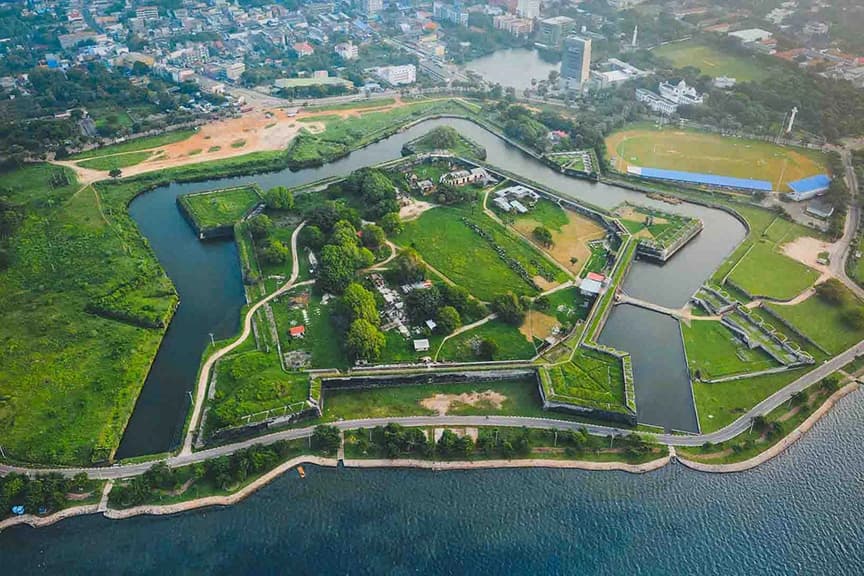
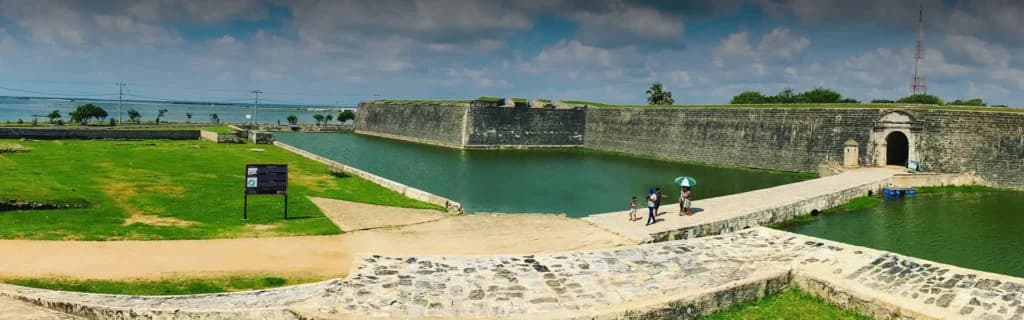
The Dutch were skilled in fortress engineering, and Jaffna Fort became one of their major works in Ceylon. The structure was redesigned as a bastion fort, with a pentagonal plan, projecting bastions, ramparts, outer defences and a surrounding moat. Its geometry was not accidental. It was designed for artillery warfare, allowing defenders to cover multiple angles of attack.
This is what makes Jaffna Fort so fascinating for history readers. It is not simply an old wall around a town. It is a carefully planned military machine. The shape of the fort, the angles of the bastions, the moat and the outer defensive features all reflect the military thinking of early modern Europe, adapted to the landscape of northern Sri Lanka.
The Dutch fort also served as the administrative centre of their northern command. Jaffna was not a minor outpost. It was one of the main centres of Dutch authority in Ceylon, alongside Colombo and Galle. That status explains the scale and ambition of the fort.
A Fort Beside the Lagoon
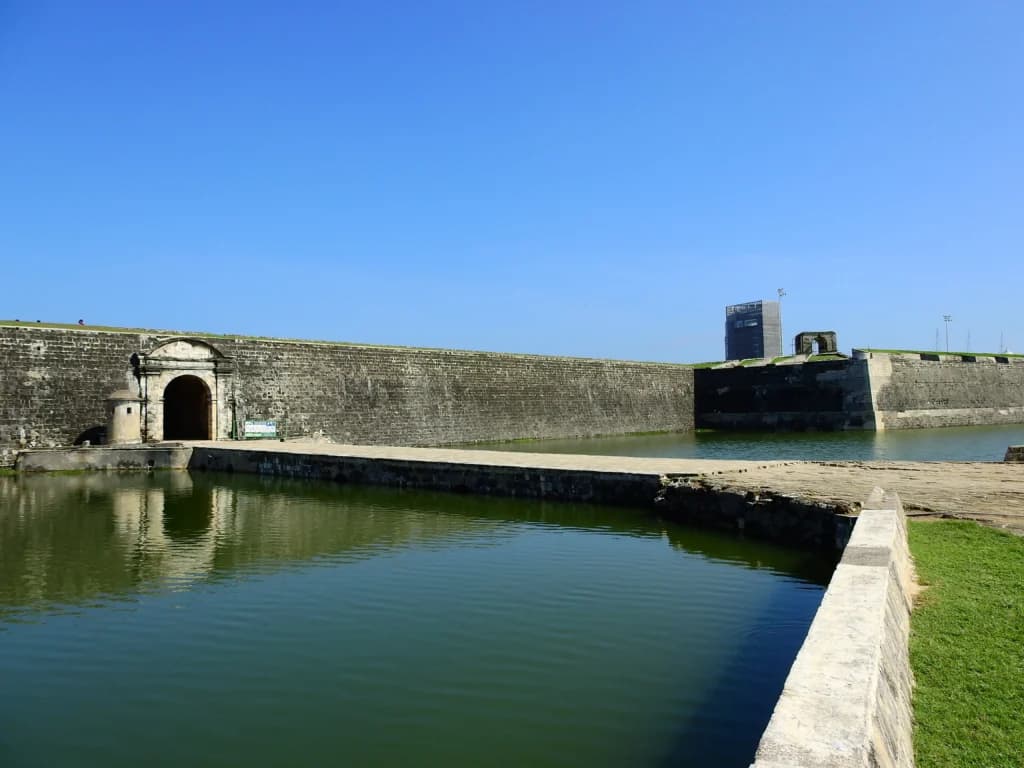
One of the most memorable features of Jaffna Fort is its setting. The fort stands beside the Jaffna Lagoon, giving it a quiet and open atmosphere. The water, sky and stone create a very different impression from the enclosed streets of Galle Fort or the crowded commercial blocks of Colombo Fort.
The lagoon was not just scenic. It was part of the fort’s strategic world. Water shaped movement, defence and trade. The moat around the fort added another layer of protection, while the wider lagoon connected the site to Jaffna’s maritime geography.
Walking along the ramparts, visitors can see why this location mattered. The fort commands space. It looks across the flat northern landscape and the water beyond. Even in its present condition, it has a sense of authority.
This setting also gives Jaffna Fort a strong travel appeal. It is especially beautiful in the late afternoon, when the light softens and the stone walls take on warmer tones. The wide open grounds make it one of the best places in Jaffna for slow walking, photography and reflection.
What to See Inside Jaffna Fort
Jaffna Fort is best experienced on foot. Visitors can walk along parts of the ramparts, look across the moat, explore the open interior and study the surviving walls and gateways. The fort’s scale becomes clearer only when you move through it slowly.
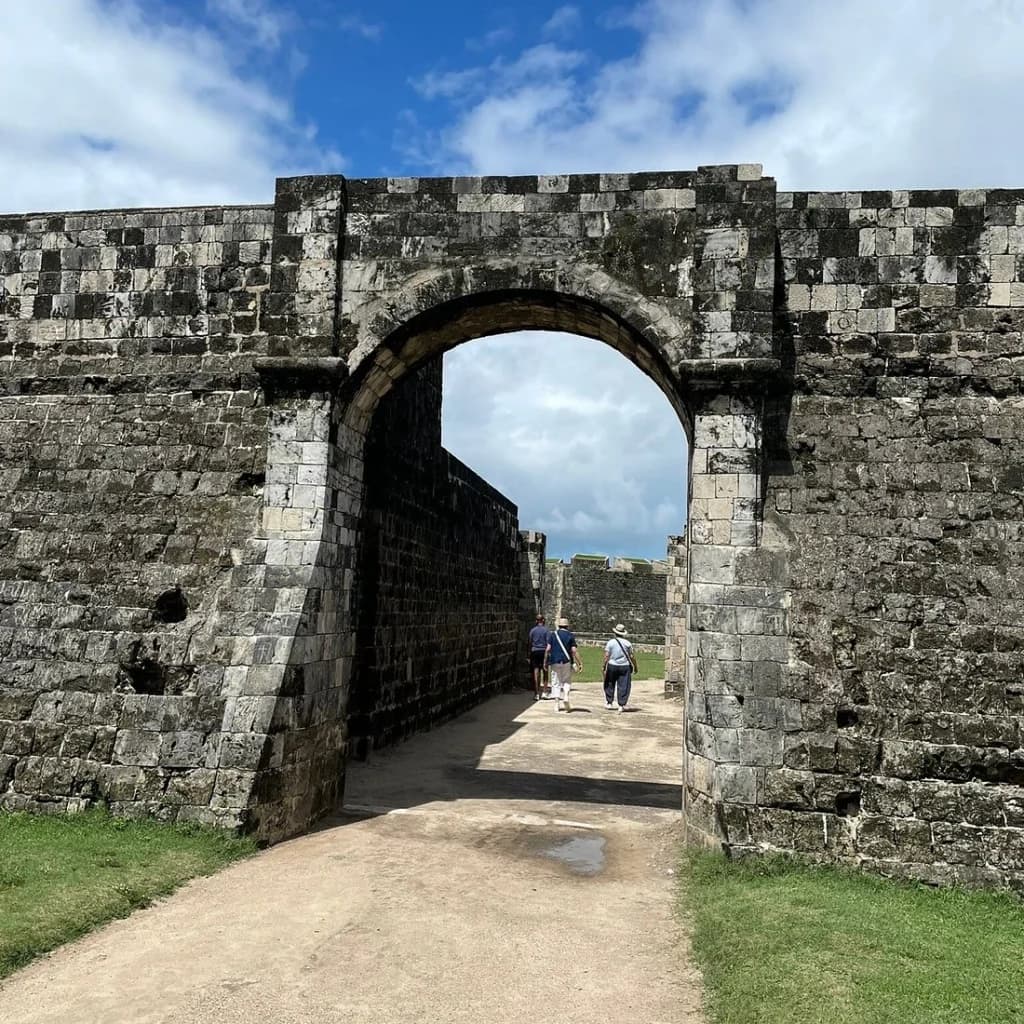
The main gateway is one of the most striking features. Its arched entrance and heavy masonry create an immediate sense of age and defence. From there, the fort opens into a broad interior space where many internal buildings were damaged or lost over time.
Unlike Galle Fort, Jaffna Fort does not have a dense townscape of cafés, homes and shops inside the walls. That absence is part of its character. The emptiness allows visitors to read the fort as a military structure. The walls, bastions and open ground dominate the experience.
Look closely at the stonework. Some sections are older and darker, while restored parts may appear lighter. This contrast reveals the long process of damage, conservation and reconstruction. Jaffna Fort is not a perfectly untouched monument. It is a heritage site that has survived through violence, neglect and repair.
The Bastions and Military Design
The bastions are among the most important features of Jaffna Fort. These projecting defensive points allowed soldiers to observe and fire along the walls, reducing blind spots and strengthening the fort against attack. In the age of artillery, this kind of design was essential.
Jaffna Fort’s pentagonal form and bastioned layout make it one of the most geometrically impressive colonial forts in Sri Lanka. Its design reflects the Dutch understanding of modern warfare in the 17th and 18th centuries, when European powers competed fiercely for control of ports and sea routes across Asia.
For travellers, the bastions offer excellent viewpoints. For researchers and history enthusiasts, they are evidence of how military architecture moved across the world through empire. Designs developed in Europe were carried to Ceylon, then adapted to coral stone, tropical weather, lagoon terrain and local labour.
This is one of the reasons Jaffna Fort deserves more attention. It is not merely a northern tourist stop. It is one of the best places in Sri Lanka to study colonial military architecture.
British Rule and the Fort’s Later Role
In 1795, Jaffna Fort passed from Dutch to British control. Under the British, the fort remained a military and administrative site, although its role changed as colonial warfare and governance evolved. By the 19th century, British Ceylon was increasingly shaped by roads, railways, plantations, courts, schools and civil administration rather than by coastal fortresses alone.
Still, Jaffna Fort remained important. It was part of the British colonial presence in the north and continued to symbolise authority. Around Jaffna, British rule also brought major changes through missionary education, roads, administrative reforms and new institutions.
This British layer is important because colonial Sri Lanka was never shaped by one European power alone. Jaffna Fort is a layered site. Portuguese conquest, Dutch engineering and British administration all left their mark. To stand inside the fort is to stand inside several centuries of colonial transition.
The Fort and Modern Memory
Jaffna Fort also carries the memory of Sri Lanka’s more recent history. During the civil war, the fort and the surrounding region experienced conflict, damage and military use. Many internal structures were destroyed or badly damaged, and the fort became a symbol not only of colonial history but also of modern loss.
This makes the visitor experience more serious. Jaffna Fort is not simply a romantic ruin. It is a place where different histories overlap: kingdom, colony, war, restoration and public memory. For sensitive travellers, that complexity should be approached with respect.
The conservation of the fort has helped restore sections of the ramparts and preserve the site for future generations. But the visible contrast between old stone, reconstructed sections and open ruins reminds us that heritage is fragile. Buildings can survive for centuries and still be transformed in a few years by conflict.
Best Time to Visit Jaffna Fort
The best time to visit Jaffna Fort is early morning or late afternoon. The northern sun can be strong, and the fort’s open spaces offer limited shade. Comfortable shoes, water, a hat and sun protection are useful.
Late afternoon is especially rewarding because the fort becomes atmospheric as the light changes. The lagoon views, open ramparts and wide sky create one of the most memorable heritage experiences in Jaffna.
Visitors can combine Jaffna Fort with other nearby attractions such as the Jaffna Public Library, Nallur Kandaswamy Temple, Jaffna market and the causeways leading towards the islands. Together, these places show that Jaffna’s appeal is not limited to colonial history. It is also a centre of Tamil culture, religious life, education, food and northern identity.
Why Jaffna Fort Deserves More Attention
Galle Fort is more famous, and Colombo Fort is more central to the story of the capital. But Jaffna Fort has a different kind of importance. It represents the northern frontier of colonial Ceylon, where European power met the legacy of the Jaffna Kingdom and the maritime world of the Palk Strait.
Its silence is part of its strength. There are fewer distractions here. The visitor is left with stone, water, wind and history. The fort does not need to be crowded with restaurants or restored mansions to be meaningful. Its value lies in its military form, strategic position and layered past.
For anyone interested in colonial Sri Lanka, Jaffna Fort is essential. It shows that the island’s colonial story was not one single narrative. It was coastal and inland, southern and northern, administrative and military, commercial and cultural.
Final Thoughts: Walking Through the Northern Memory of Old Ceylon
Jaffna Fort is one of the most important colonial forts in Sri Lanka, but it is also one of the most thought-provoking. Its beauty is not polished. Its history is not simple. Its walls have seen Portuguese ambition, Dutch military design, British occupation and modern conflict.
To walk through Jaffna Fort is to encounter Old Ceylon from the north. It is to see how empire reached into the Jaffna peninsula, how military architecture shaped the landscape, and how heritage continues to survive even after damage and change.
For travellers, Jaffna Fort offers a quiet but powerful experience. For history readers, it offers one of the richest colonial sites in Sri Lanka. For researchers, it remains a valuable example of Dutch fortification, northern strategy and layered historical memory.
Stand on the ramparts and look across the lagoon. The view is calm today, but the stones beneath your feet carry centuries of conflict, control, survival and restoration. That is the lasting power of Jaffna Fort.
FAQs About Jaffna Fort
Who built Jaffna Fort?
Jaffna Fort was first built by the Portuguese in the early 17th century after their conquest of the Jaffna Kingdom. The Dutch later captured it and transformed it into a larger and more advanced bastion fort.
Why is Jaffna Fort important?
Jaffna Fort was a major northern stronghold in colonial Ceylon. It controlled a strategic position near the Jaffna Lagoon and the Palk Strait, making it important for military defence, administration and maritime influence.
Is Jaffna Fort Portuguese or Dutch?
Jaffna Fort has Portuguese origins, but the structure seen today is mainly associated with Dutch redesign and expansion. It later came under British control.
Can visitors walk around Jaffna Fort?
Yes. Visitors can walk through the fort grounds, view the ramparts, moat, gateway and lagoon-facing sections. Some areas may be uneven, so comfortable footwear is recommended.
What is the best time to visit Jaffna Fort?
Early morning and late afternoon are the best times to visit because the weather is cooler and the light is better for photography.
Visit Us: https://trippingsrilanka.com/
More from Old Ceylon

Colombo Public Library at 100: The Names That Still Remain
The Toll Gate at the Bridge: When Travelling Across Ceylon Cost a Few Cents at a Time