When Kandy Lake Was the Heart of the Town: An Ordinary Day in Old Ceylon
There was a time when the northern end of Kandy Lake was not simply a place to admire the scenery. It was part of the town’s everyday life, where people came and went on foot, rickshaw pullers waited for passengers, and the shade of enormous trees offered some relief from the afternoon heat.
An Ordinary Day Beside Kandy Lake
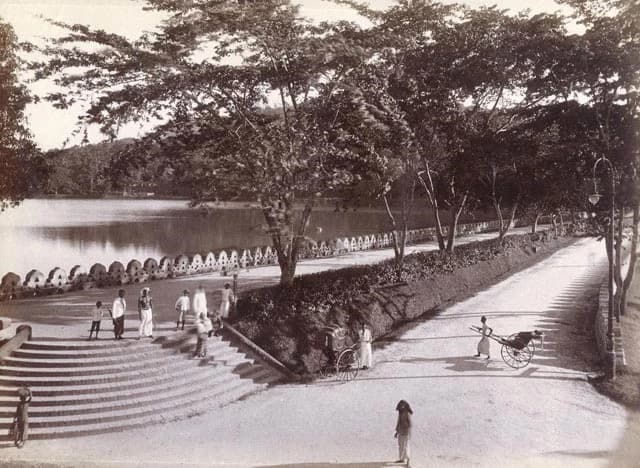
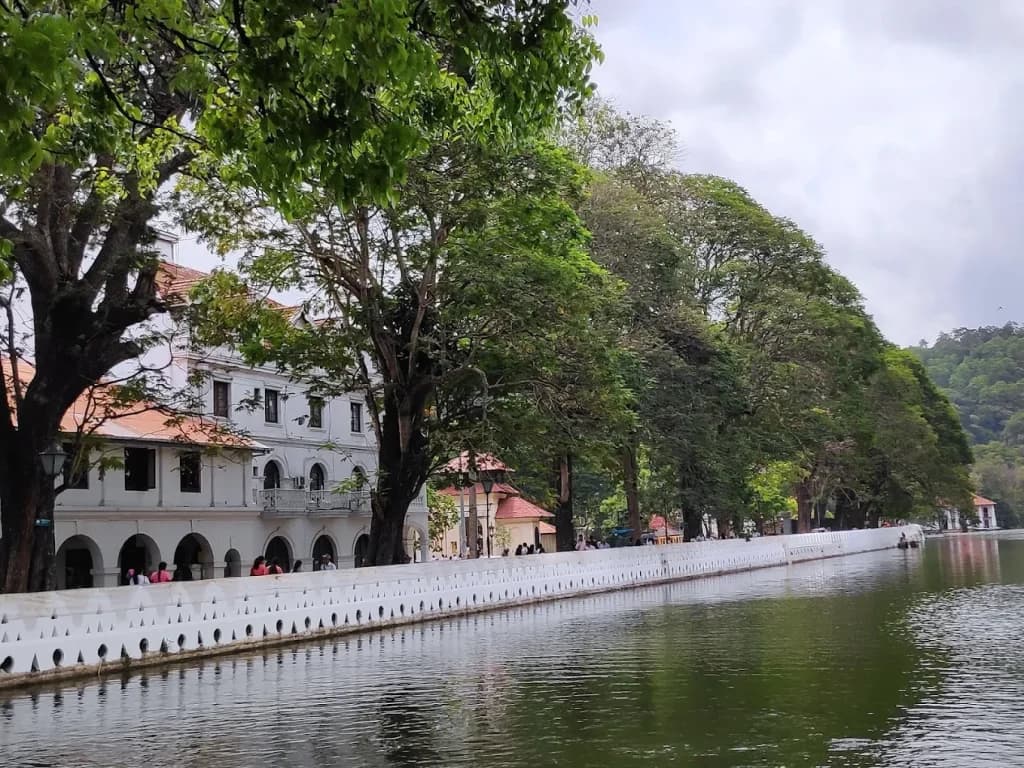
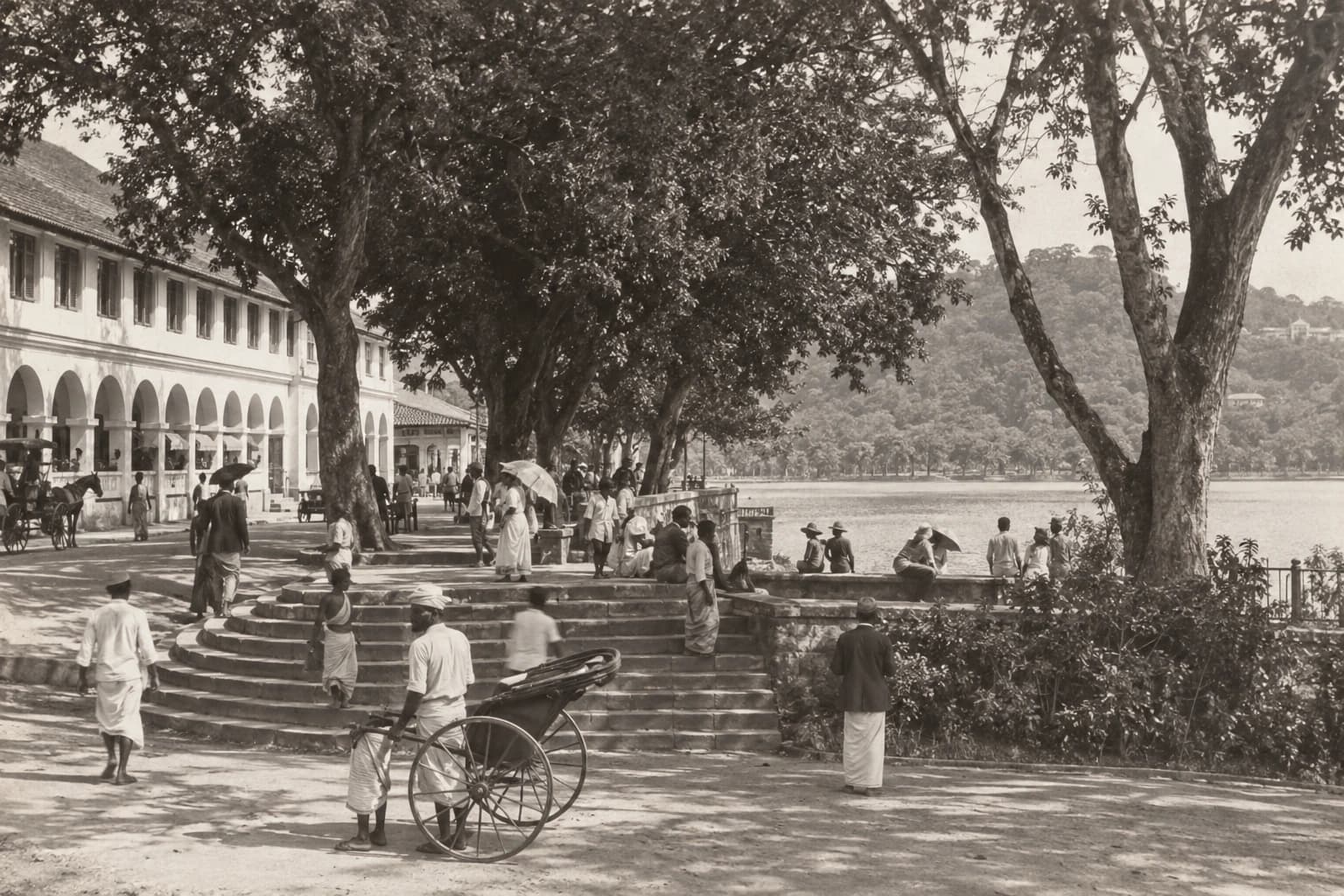
An old photograph, believed to date from the early 1900s, captures something of a forgotten Kandy. There are no motorcars crowding the road, no tourists holding up mobile phones, and none of the hurried traffic that has become so familiar around the lake today. Instead, there are people standing on stone steps, others making their way along the roadside, and a hand-pulled rickshaw waiting in the foreground.
It is the sort of photograph that becomes more interesting the longer one looks at it. The people are not posing for a formal portrait, and most seem occupied with their own business. A man stands beneath an umbrella, several figures gather near the steps, and others linger beneath the trees. Behind them, a long colonial-era building with an arched verandah looks out towards the lakeside.
We do not know their names or why they were there that day. Perhaps some were on their way to the market, others returning from a visit, or simply taking advantage of the shade. Whatever brought them together, they left behind a record of ordinary life in colonial Kandy, when the lake was already one of the town’s most familiar landmarks.
The Lake That Changed the Town
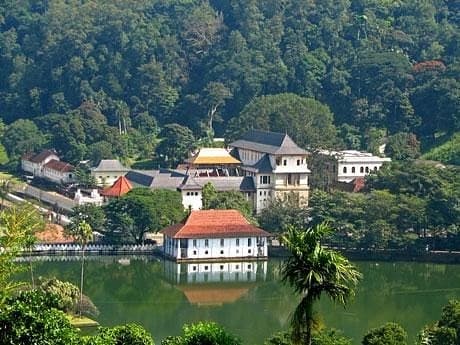
Long before this photograph was taken, the ground occupied by Kandy Lake had been a very different landscape. The area was once associated with paddy fields known as Tigolwela, near the royal palace and the Temple of the Tooth. During the reign of Sri Wickrama Rajasinghe, the last king of Kandy, the land was transformed into the artificial lake that became known as Kiri Muhuda, or the Sea of Milk.
Work took place in the early nineteenth century, with historical accounts recording significant construction between 1810 and 1812. The project was undertaken during the final years of the independent Kandyan Kingdom, before British annexation in 1815. What had once been agricultural land became a substantial body of water beside the royal and religious centre of the city.
By the time the camera captured this lakeside scene, the lake had already witnessed nearly a century of British rule. The royal capital had changed considerably, with improved roads, European-style buildings and expanding commercial activity around the old royal centre. Yet the lake remained where the last Kandyan king had placed it, surrounded by hills and closely connected to the religious and cultural life of the city.
For the people of Kandy, the lake had become a familiar part of the town rather than simply a monument to its royal past. Its presence shaped the roads, buildings and public spaces around it, making it a natural meeting point between the older Kandyan city and the colonial town that developed afterwards.
A Different Kind of Lakeside Traffic
Perhaps the most striking detail in the photograph is the hand-pulled rickshaw. Today it seems almost impossible to imagine such a vehicle negotiating the busy streets around Kandy Lake. Yet rickshaws were part of the transport landscape of colonial Ceylon, particularly in towns where people needed to travel relatively short distances.
The vehicle in the foreground has two large wheels and a passenger seat, with its shafts extending towards the man standing beside it. Unlike the motorised three-wheelers that would eventually become a familiar feature of Sri Lankan roads, these rickshaws depended entirely upon human labour. They provided a means of getting around town without walking, but the physical effort required to move them fell upon the puller.
For the passenger, the journey offered convenience. For the man pulling, it was demanding work, particularly in a hilly town such as Kandy. The photograph therefore tells us something beyond the appearance of the old streets. It reminds us that many of the conveniences of colonial town life depended upon the labour of people whose names were rarely recorded.
There are other small details worth noticing in the scene. The clothing is varied, with traditional garments appearing alongside styles influenced by the colonial period. Umbrellas are visible, and the large trees dominate much of the roadside. In a town where walking remained an important means of getting about, their shade would have been particularly welcome during the warmer hours of the day.
The Steps Beside the Water
The broad stone steps are another interesting feature of the photograph. They appear to connect the higher roadside with the lower lakeside area, creating a space where people could move between different levels of the waterfront. Rather than being merely an architectural detail, the steps seem to have formed part of the ordinary movement of people around the northern end of the lake.
The northern and western edges of Kandy Lake underwent changes during the British period, including alterations to roads and stonework around the water. Historical descriptions also refer to older steps and embankments associated with the lake’s construction. The arrangement seen in the photograph therefore belongs to a landscape that had already been adapted and altered over several generations.
In the photograph, the steps have become an informal gathering place. Some people are standing, others appear to be walking down, and a few are gathered near the lower edge. There is no indication that anything particularly important was taking place. It may have been no more than an ordinary afternoon when people paused or passed through on their way elsewhere.
That is part of what makes the photograph valuable. History tends to remember kings, governors, temples and grand buildings, but photographs such as this preserve the spaces between those larger events. They show where people waited, talked, worked and passed one another without knowing that their ordinary day would eventually become part of the town’s historical record.
When the Royal Lake Became Everyone’s Lake
Kandy Lake began as a royal undertaking, but by the early twentieth century it had become part of the everyday experience of the town. Its surroundings brought together different aspects of Kandy’s identity. The Temple of the Tooth and the former royal precinct represented the city’s Kandyan heritage, while colonial buildings and commercial establishments reflected changes that followed British occupation.
Between them lay the lake, a familiar landmark to generations of residents. People travelled around it to reach different parts of the town, and its banks offered places where the activity of the streets could be observed. The lake was therefore more than a picturesque feature admired by visitors. It belonged to the geography of everyday Kandy.
The historic Queen’s Hotel, overlooking the lake, offers one example of the changes that took place around the former royal centre. Its building had earlier associations with a Kandyan residence and later British military use before becoming a hotel during the nineteenth century. The hotel became part of the colonial townscape, standing near an area whose importance had begun long before British rule.
The northern lakeside was therefore a meeting point between several periods of Kandy’s history. Royal buildings, religious institutions, colonial commercial premises and ordinary working life existed within a relatively small area. The old photograph captures something of that mixture, showing a town whose historical importance was already well established but whose daily life continued around it.
The Kandy of Rickshaws and Shaded Roads
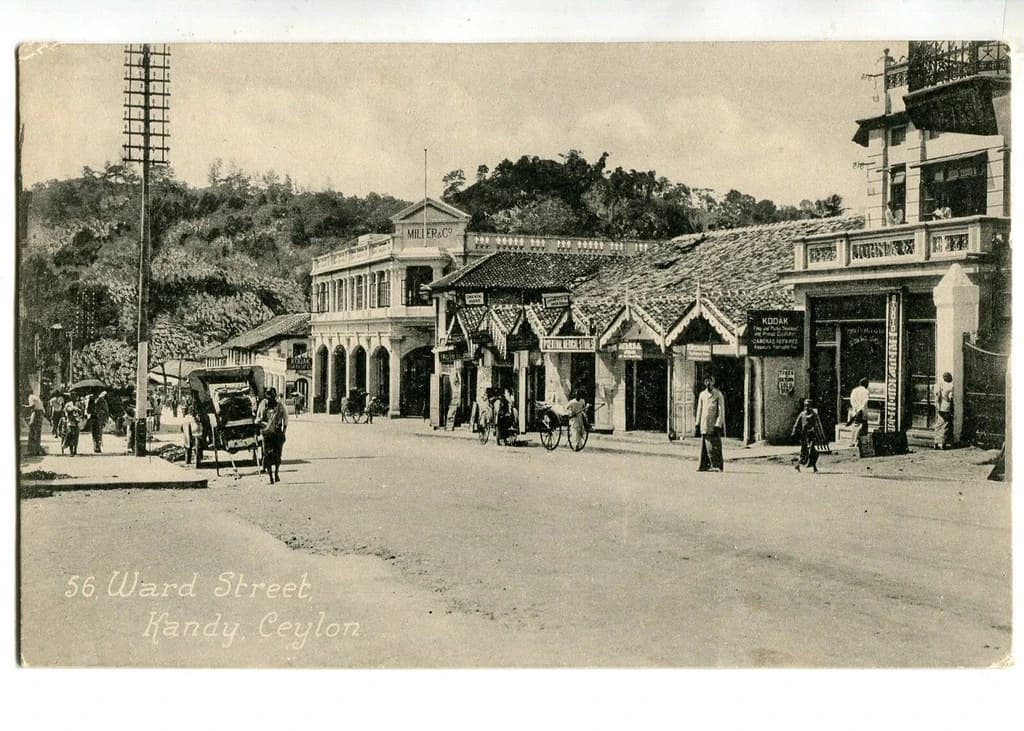
The Kandy of the early twentieth century would have been familiar in some ways and surprisingly different in others. The hills still surrounded the town, the lake occupied its central position, and the Temple of the Tooth remained an important religious destination. But the streets carried a different mixture of traffic, and many of the buildings around the lake belonged to an earlier architectural world.
Pedestrians shared the roads with hand-pulled rickshaws, carts and other forms of transport. Journeys around the town could require more time and physical effort than they do today, particularly for people travelling between the central streets and the surrounding hills. Roads were not yet dominated by the motor traffic that would later transform the atmosphere of the town.
The large roadside trees in the photograph are another reminder of that older setting. Their shade provided relief to people moving through the town on foot, while the buildings behind them created a streetscape quite different from the one familiar to modern visitors. The old photograph preserves these ordinary details without making them the subject of any formal historical record.
For the people pictured, the lake and its surroundings were simply part of their home town. They may have passed through the same place countless times, using the steps, walking beneath the trees or waiting for transport. The scene mattered to them because it belonged to everyday life, not because it was historic.
What the Photograph Leaves Behind
More than a century later, Kandy Lake remains one of the most recognisable places in Sri Lanka. The water is still there, the Temple of the Tooth continues to draw worshippers, and the surrounding hills still give the city its distinctive character. People continue to walk around the lake, just as earlier generations did.
But the rhythm of the place has changed. The rickshaw pullers have disappeared, motor vehicles have taken over the streets, and much of the quieter town recorded in early photographs has given way to modern traffic and commercial activity. Generations of residents who knew Kandy before these changes have passed away, taking with them their memories of the streets and people of another time.
What remains in the photograph is not simply a view of old buildings and roads. It is a moment in the life of a city, preserved before its people could know how much their surroundings would change. Somewhere among those figures might have been a shopkeeper returning home, a visitor seeing Kandy for the first time, or a child who would grow up remembering the days when rickshaws waited beside the lake.
We cannot identify them, and their personal stories have disappeared. Yet the photograph allows us to see them within a familiar setting, surrounded by landmarks that still form part of Kandy today. It is a reminder that the history of a town belongs not only to its rulers and famous buildings but also to the people who moved through its streets.
An Ordinary Day in Old Kandy
Looking at the photograph now, one can almost hear the footsteps on the stone steps, the quiet conversations beneath the trees and the wooden wheels of a rickshaw moving along the road. Beyond those everyday sounds lay a city with a much longer history, shaped by the Kandyan kings, British occupation and generations of people who made their homes around the lake.
The photograph records only a small part of that story. It does not show a royal procession, a religious ceremony or a great public event. It shows people going about an ordinary day beside a lake that had already witnessed nearly a century of change.
That was Kandy, too. Not merely the city of kings and temples, but a place where ordinary people lived, worked, travelled and met one another beside the water. The old rickshaw, the shaded steps and the figures gathered along the roadside belong to a town that has changed considerably, but they remain part of the history of Kandy Lake.
Visit Us: https://trippingsrilanka.com/stories