Old Paintings of Nuwara Eliya: How Artists Remembered Little England in Ceylon
Nuwara Eliya paintings| has always looked like a place made for painting. Mist sits low over the hills. Water reflects the sky. Tall trees frame quiet roads. Old cottages appear through rain and cloud. Tea slopes rise in soft green layers beyond the town. Even today, Nuwara Eliya feels less like a single destination and more like a mood.
That is why old paintings of Nuwara Eliya are so fascinating.
They do not only show what the town looked like in the past. They show how people felt about it. In colonial Ceylon, Nuwara Eliya became known as “Little England”, the cool hill-station retreat where British officials, planters, travellers and artists escaped the heat of the lowlands. Its scenery appeared in watercolours, travel sketches, framed paintings, postcards, lithographic prints and early photographic views.
A recently shared old painting, believed to show Nuwara Eliya, reminds us that Sri Lanka’s visual history is still scattered across the world — in private homes, antique shops, family collections, auction catalogues and even car boot sales in Britain. But that painting is only one part of a larger story.
Nuwara Eliya has been painted, sketched, printed and photographed for more than a century. Together, these images preserve the visual memory of Old Ceylon’s most famous hill city.
They show us a town of water, mist, gardens, cottages, tea estates, mountain roads and quiet colonial leisure. They also remind us that heritage is not only found in buildings. Sometimes, it survives in a faded painting, a handwritten caption, a postcard album or a landscape remembered by someone who stood there long ago.
Why Nuwara Eliya Inspired Artists
Nuwara Eliya was different from the rest of colonial Ceylon. Colombo was hot, commercial and coastal. Galle and Trincomalee were shaped by forts and harbours. Kandy carried the memory of the last kingdom. But Nuwara Eliya offered cool air, mist, gardens, lakes and European-style leisure.
This made it irresistible to artists.
For British residents in Ceylon, Nuwara Eliya felt familiar. Its climate allowed them to build cottages, clubs, gardens, golf grounds, racecourses and holiday homes. For visiting artists, it offered a rare contrast within the tropics. A traveller could move from palm-fringed lowlands to a mountain town of rain, lake views and cool mornings.
Old paintings of Nuwara Eliya often focused on this contrast. They did not always show dramatic events. Instead, they showed water, trees, clouds, hills, roads, bungalows and tea-country scenery.
That is why these works still matter. They reveal Nuwara Eliya as it lived in the imagination of colonial travellers: peaceful, elevated, refined and slightly dreamlike.
The town’s beauty was not loud. It was atmospheric. A hill road disappearing into mist, a lake reflecting trees, a cottage roof beneath clouds, or a tea slope fading into blue distance could say more about Nuwara Eliya than a formal description ever could.
Nuwara Eliya as Little England in the Colonial Imagination
Nuwara Eliya’s nickname, “Little England”, did not come from nowhere. During British Ceylon, the town became the island’s best-known hill station. Its cool climate, high elevation and misty scenery attracted governors, officials, planters and European families who wanted relief from the lowland heat.
They brought with them certain ideas of comfort and landscape. They valued lawns, gardens, fireplaces, cottages, clubs, horse racing, golf, afternoon tea and quiet walks. Over time, the town’s visual identity began to reflect this world.
Painters and postcard publishers helped strengthen that image. They framed Nuwara Eliya as a hill retreat of order and calm. The red-brick Post Office, old hotels, garden paths, lake views and cottage roofs all became part of the town’s artistic language.
Yet Nuwara Eliya was never simply England in the tropics. It was a Sri Lankan mountain town reshaped by colonial taste, plantation wealth and local labour. The mist, trees, water and tea slopes belonged to Ceylon. The architecture and leisure culture carried British influence. Old paintings often show this mixture beautifully.
That is why they remain valuable today. They reveal both the charm and the complexity of colonial Nuwara Eliya.
Ernst Haeckel and the European Traveller’s Eye
One of the most important European artists connected to Ceylon’s old visual record was Ernst Haeckel, the German naturalist, scientist and artist. Haeckel travelled in Ceylon in the early 1880s and later published tropical landscape images connected to the island.
His work is important because it shows how Ceylon attracted not only colonial officials and planters, but also scientists, naturalists and intellectual travellers. For such visitors, the island was a place of observation. Plants, rivers, mountains, forests and light became subjects for study and art.
Views associated with Haeckel and Ceylon often reveal a bold attention to landscape and vegetation. When we connect this tradition to Nuwara Eliya, we see how the hill country appealed to the European eye: not only as a colonial retreat, but as a natural world of altitude, cloud, water and unusual plant life.
Haeckel’s Ceylon works remind us that old paintings were not merely decorative. They were part of how foreign visitors studied, interpreted and sometimes romanticised the island.
For a scientist-artist, Nuwara Eliya’s appeal would have been more than social. Its plants, temperature, cloud forms and mountain ecology were visually different from the coast. That difference made the hill country a subject worth recording.
Tea Pluckers in Nuwara Eliya
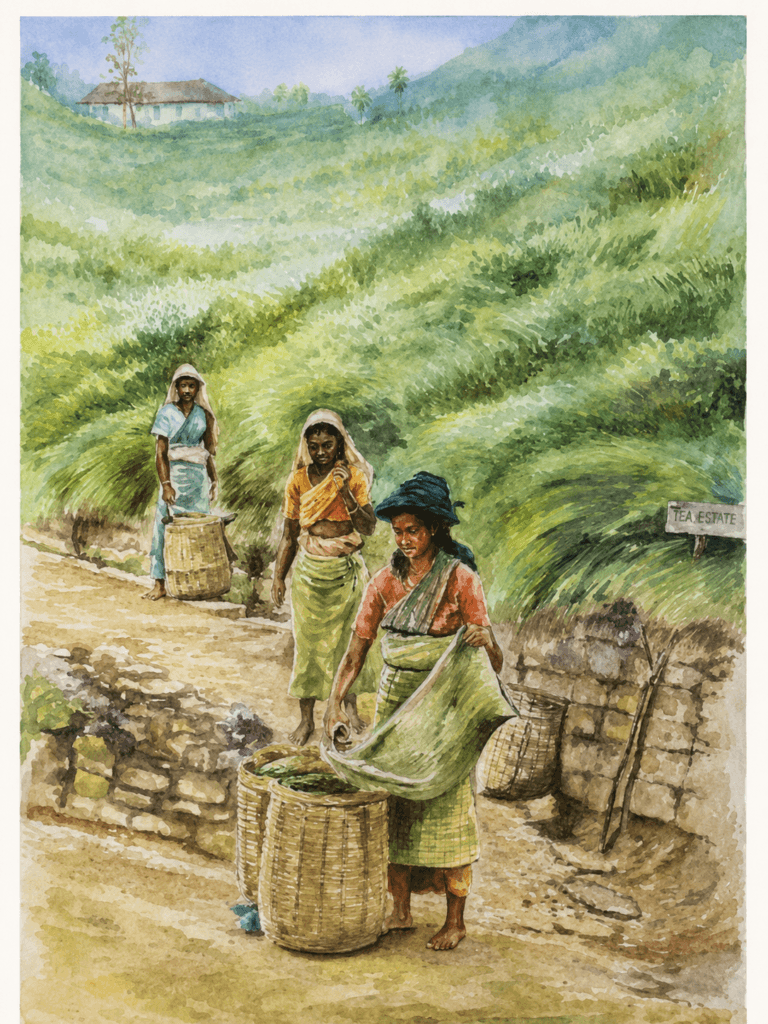
Tea pluckers are an essential part of Nuwara Eliya’s hill-country identity. Across the misty tea estates, they move carefully through rows of bright green tea bushes, handpicking the tender leaves that become world-famous Ceylon tea. Their daily work connects the cool mountains, plantation history and living traditions of Old Ceylon, making them a powerful symbol of Nuwara Eliya’s tea country heritage.
Their work is not only part of Sri Lanka’s tea industry, but also part of the living heritage of Old Ceylon. From early morning mist to cool mountain evenings, tea pluckers represent the strength, skill and tradition behind every cup of Ceylon tea.
Unknown Watercolours of Nuwara Eliya
Many old paintings of Nuwara Eliya were not created by famous artists. Some were done by unknown travellers, colonial residents, military officers, civil servants, planters’ family members or amateurs living in Ceylon.
This makes them especially interesting.
An unsigned watercolour titled “Nuwara Eliya, Ceylon” from around 1900, for example, can still carry strong historical value. Even when the artist is unknown, the image may show how the town was seen at the time — its lake, trees, roads, bungalows, hills or quiet public spaces.
These unknown works preserve private memory. They are not official government records. They are personal acts of looking.
A traveller may have painted a lake because it reminded them of home. A planter’s family member may have painted a bungalow garden. A visitor may have sketched a mountain road after a rainy afternoon. A resident may have painted the town not for fame, but for memory.
Today, such works help us rebuild the visual atmosphere of colonial Nuwara Eliya.
They are also valuable because they sometimes show ordinary views that formal photographers ignored. A small bridge, a lakeside path, a clump of trees, a bungalow garden or a misty ridge may appear in an amateur painting even when it never became a famous postcard scene.
Lake Views: The Favourite Subject of Old Nuwara Eliya Art
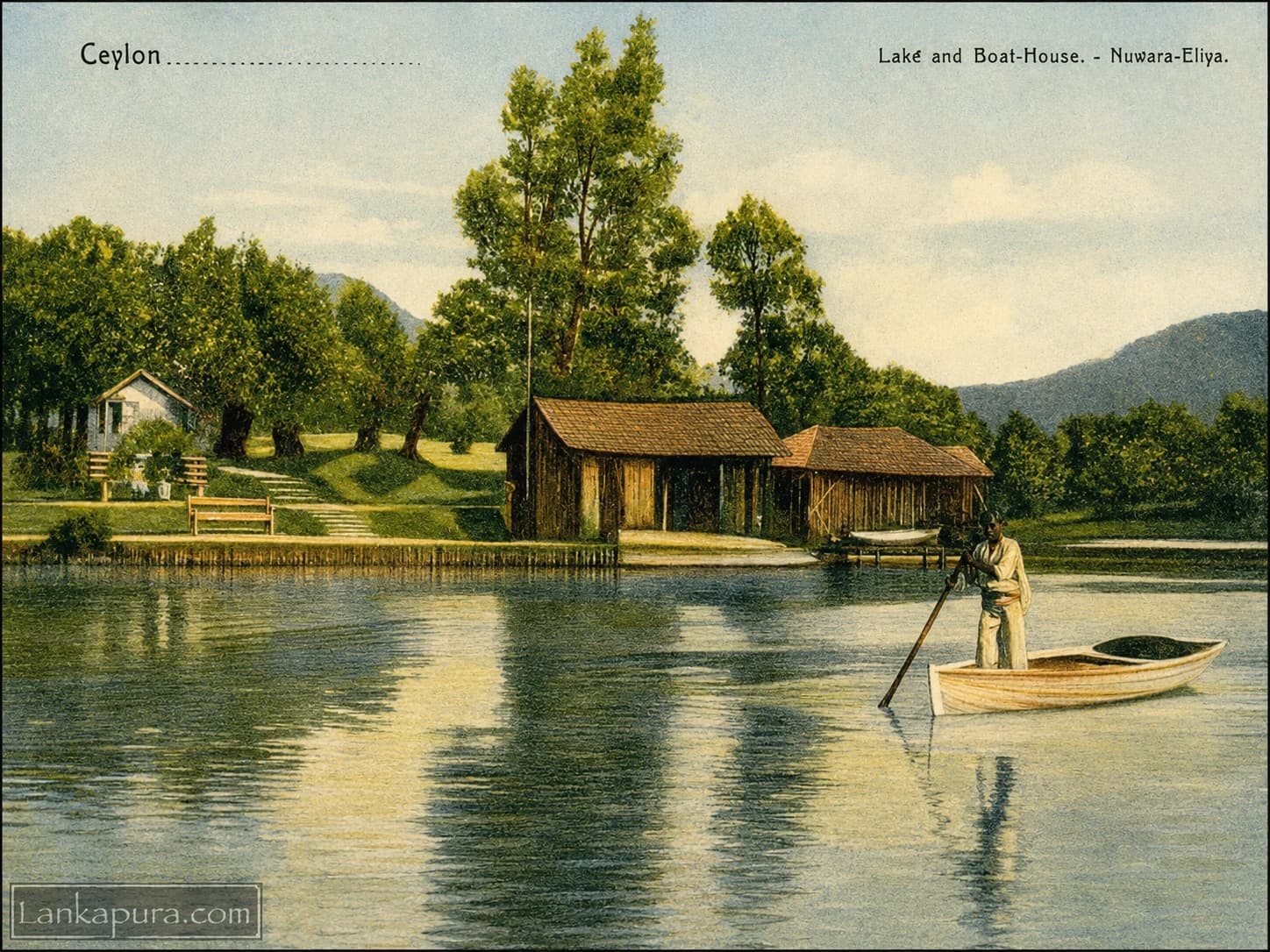
Lake scenes appear again and again in old Nuwara Eliya paintings, postcards and prints. This is not surprising. Water gave the town its calmest and most poetic image.
In many old views, the lake acts like a mirror. It reflects clouds, hills, trees and sky. Small boats, distant buildings or footpaths sometimes appear around the edge. The mood is almost always slow and quiet.
These lake views helped define Nuwara Eliya as a leisure landscape. The lake was not only scenery. It was part of the colonial hill-station experience — boating, walking, resting, picnicking and looking out across cool water after leaving the heat of the lowlands.
The recently shared painting appears to belong to this same tradition. Its power comes from the stillness of the water and the softness of the surrounding hills.
This is why lake paintings are so important to Nuwara Eliya’s memory. They show the town not as a commercial centre, but as a retreat.
For travellers today, old lake paintings also offer a way of comparing past and present. Modern Nuwara Eliya is busy, but the lake still holds moments of silence. In the early morning, when mist sits close to the surface and the hills are pale in the distance, it is possible to understand exactly why artists returned to this subject again and again.
Gregory Lake and the Painted Memory of Leisure
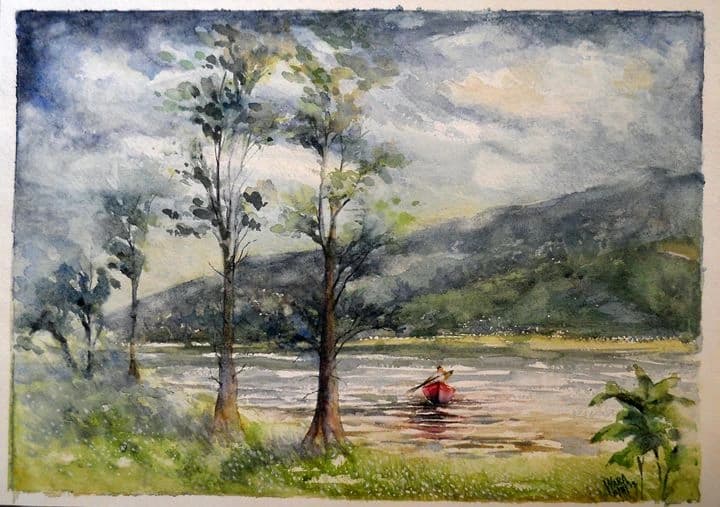
Gregory Lake became one of the strongest visual symbols of Nuwara Eliya. In old images, it often appears as a calm centre of the hill station, framed by trees, mountain ridges and open sky.
For colonial visitors, the lake represented more than nature. It suggested leisure, order and comfort. It was a place for boating, walking and viewing the town as a designed landscape. Artists naturally gravitated towards it because the lake gathered many of Nuwara Eliya’s qualities into one view: water, cool air, mountains, trees and quiet recreation.
Paintings and postcards of lake scenes helped create the romantic image of Nuwara Eliya that still survives. They made the town feel timeless, even though it was changing rapidly through roads, buildings, plantations and tourism.
This is why old lake paintings are so powerful. They do not only show scenery. They show the ideal of Nuwara Eliya as a place of rest.
Paintings of Colonial Buildings and Hill-Station Life
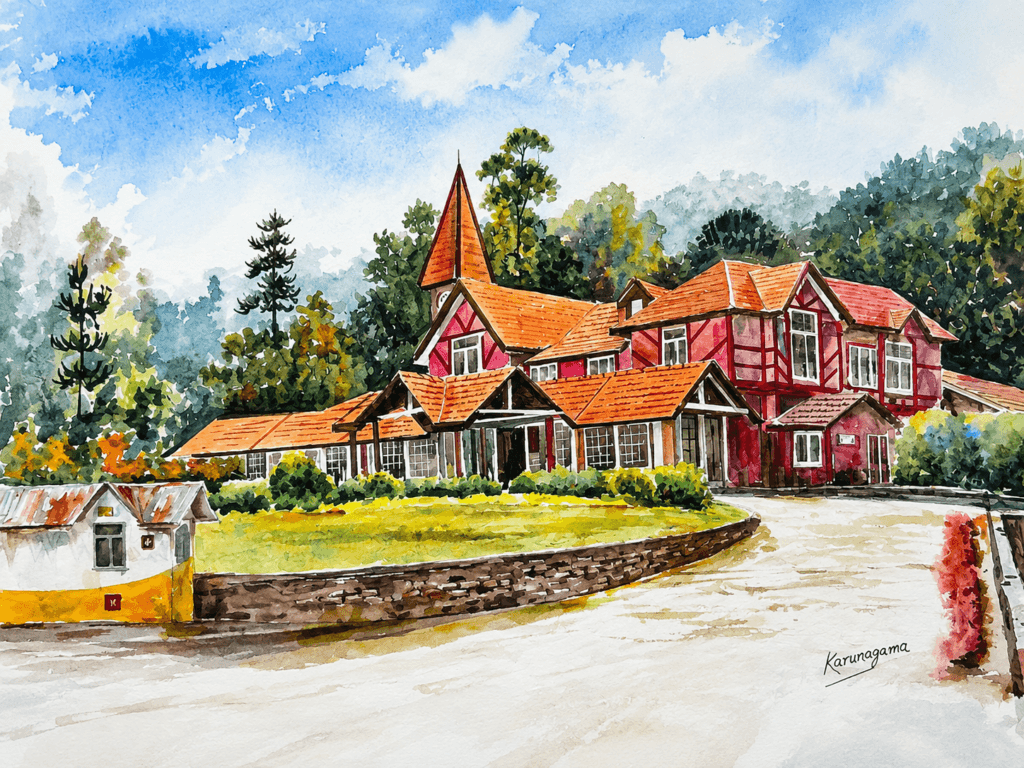
Old Nuwara Eliya art did not focus only on nature. Artists and postcard publishers also loved the town’s colonial buildings.
The red-brick Post Office, old hotels, cottages, churches, clubs and garden houses became favourite subjects because they represented the town’s identity as “Little England”. These buildings gave visual form to the colonial dream of a cool-weather European-style retreat in the tropics.
Paintings and prints of these buildings often show them surrounded by gardens, lawns or misty roads. The architecture is rarely isolated from landscape. It is always part of the hill-station atmosphere.
This is important because Nuwara Eliya’s colonial identity came from both building and climate. A cottage alone would not have created Little England. A lake alone would not have done it either. It was the combination of architecture, weather, gardens, roads and mountain scenery that made the town so visually memorable.
In many old images, even a simple street scene appears softened by the environment. Roofs are shown against cloud. Windows face lawns. Roads curve through trees. Buildings seem to belong to the mist rather than dominate it.
The Red-Brick Post Office in Visual Memory
Among Nuwara Eliya’s colonial buildings, the Post Office became one of the most recognisable. Its red brick, steep roof and Tudor-style appearance made it perfect for postcards, paintings and travel imagery.
The building symbolised the town’s British hill-station character. It was practical, but also picturesque. It looked like something that belonged to a cool-weather colonial town, not a tropical lowland city.
Old images of the Post Office helped fix it in public memory. For many travellers, it became one of the visual shortcuts for Nuwara Eliya itself. Even today, the building remains one of the most photographed landmarks in the town.
This shows how art and imagery can turn a building into an icon. The Post Office was not only used. It was seen, painted, printed, collected and remembered.
Vintage Postcards and Printed Images
By the late nineteenth and early twentieth centuries, postcards became one of the most powerful ways of spreading the image of Ceylon. Nuwara Eliya appeared frequently on postcards because it looked different from the rest of the island.
Postcards showed the lake, the Post Office, hotels, streets, gardens, racecourse, golf links, tea estates and mountain roads. These images travelled overseas in letters, albums and collections. For many people in Britain and Europe, the first image of Nuwara Eliya may have come not from a painting in a gallery, but from a small printed postcard.
Publishers such as Plâté & Co. helped create this visual memory of Ceylon. Their photographs and postcards turned places like Nuwara Eliya into collectible images.
Although postcards are not paintings in the strict sense, they belong to the same visual world. They shaped how Old Ceylon was imagined abroad.
They also influenced later artworks. A postcard view could inspire a watercolour. A printed image could be copied, recoloured or reframed. Over time, paintings, photographs and postcards fed into one another, creating a shared visual idea of Nuwara Eliya.
Tea Country in Old Paintings and Prints
The wider Nuwara Eliya district was also closely tied to tea. Old paintings, prints and postcards often show tea slopes, estate roads, factories, planter bungalows and mountain scenery around the town.
Tea changed the hill country of Ceylon. British plantation expansion transformed the landscape, economy and labour structure of the region. The beautiful green slopes seen in many old images were also working landscapes shaped by estate labour and global demand for Ceylon tea.
This makes tea-country images more complicated than they first appear. A painting of rolling green hills may look peaceful, but it also belongs to the history of plantations, land use, labour and export wealth.
For Old Ceylon readers, this is important. The beauty of Nuwara Eliya cannot be separated from the plantation world that surrounded it.
A tea-estate painting may show a pleasing landscape, but behind that view are estate roads, labour lines, factories, managers’ bungalows and global markets. These images should therefore be read with both admiration and awareness.
Planter Bungalows and Estate Views
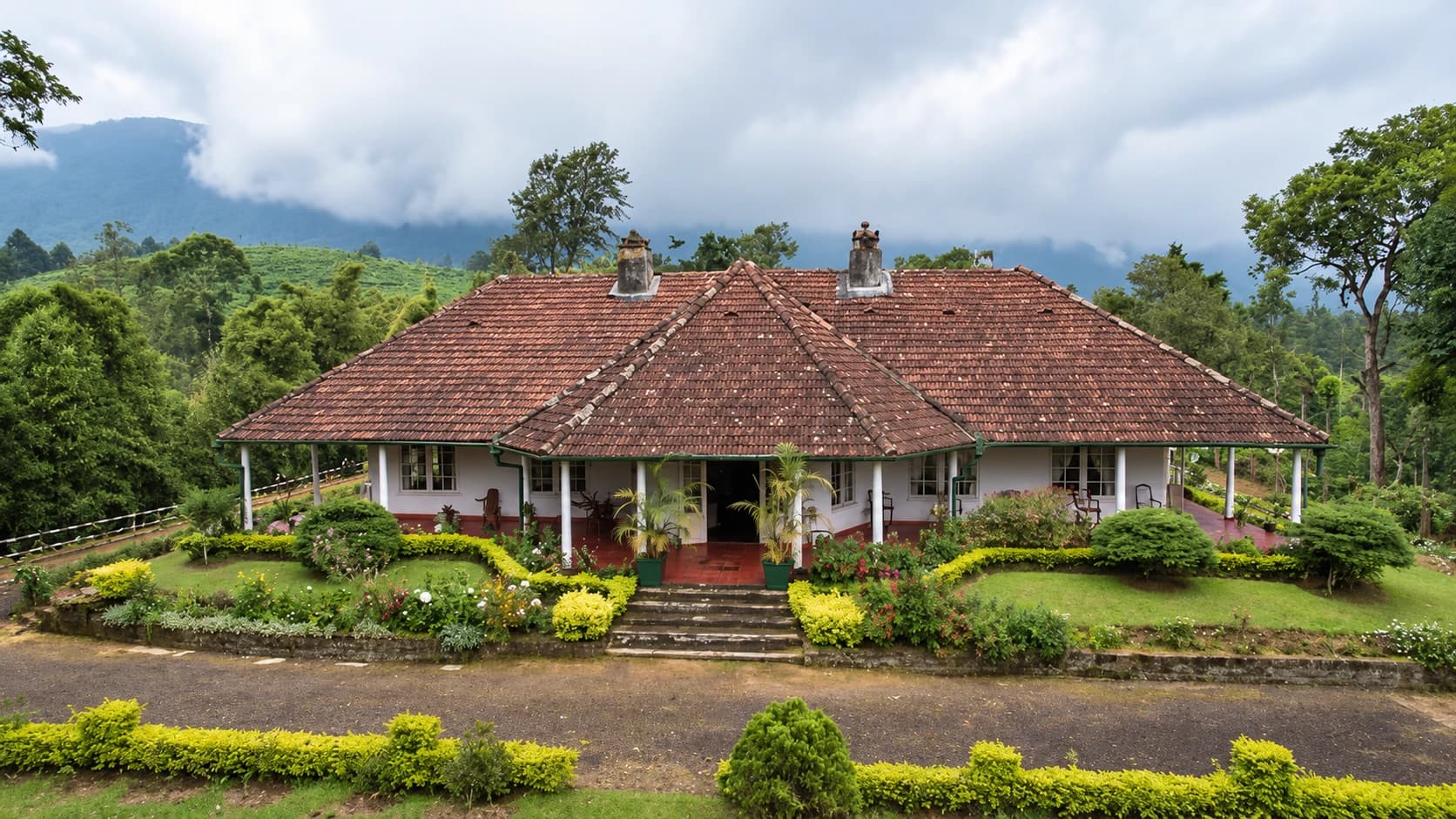
Another recurring subject in old Nuwara Eliya and hill-country art is the planter bungalow. These houses were often shown on ridges, among gardens, or overlooking tea slopes.
To colonial viewers, the bungalow suggested comfort, control and ownership. It stood above the estate, surrounded by managed greenery. It represented the planter’s world — distant from Colombo, but still connected to British habits and imperial economics.
Old paintings and postcards often made these bungalows look peaceful and romantic. But they also belonged to a strict social and economic order. The estate landscape was beautiful, but it was built on labour.
This is why modern readers should look carefully. Old art gives us beauty, but it also asks us to understand the system behind that beauty.
Hakgala, Gardens and Mountain Roads
Some old images of Nuwara Eliya and its surroundings also focus on gardens and roads. Hakgala Botanical Garden, mountain passes, wooded lanes and estate roads all formed part of the wider visual identity of the district.
These subjects appealed to artists because they combined nature and order. Gardens showed colonial attempts to organise and display plant life. Roads showed movement through the hills. Mountain passes gave artists dramatic viewpoints from which to frame valleys, lakes and distant ridges.
In paintings and postcards, these scenes helped create the image of Nuwara Eliya as a place of cultivated beauty. It was wild and controlled at the same time. Misty mountains stood behind carefully planted gardens. Estate roads curved through planned tea fields. Old bungalows sat within landscapes shaped by both nature and empire.
Hakgala, in particular, offered a different visual mood from the town centre. It was botanical, dramatic and slightly mysterious, with mountain backdrops and carefully arranged plant collections. For artists, it provided both scientific interest and scenic beauty.
Racecourse, Golf Links and the Social Landscape
Nuwara Eliya’s old paintings and postcards also preserve the social landscape of the hill station. The racecourse, golf links and club grounds were important parts of colonial leisure life.
These scenes showed Nuwara Eliya not simply as a natural retreat, but as a social world. Horse racing, golf and club gatherings allowed colonial residents to recreate familiar forms of British leisure in the highlands of Ceylon.
In old images, these spaces often appear open, green and orderly. They helped present Nuwara Eliya as refined and civilised according to colonial taste. The town became a place where landscape and society were arranged together.
For modern travellers, this adds another layer to the old paintings. A view of a racecourse or golf ground is not only a pretty green field. It is an image of colonial social life.
Churches, Cottages and Quiet Roads
Some of the most charming old images of Nuwara Eliya show smaller subjects: churches, cottages, quiet roads and garden paths.
These scenes may not be as famous as lake views, but they are deeply atmospheric. They capture the lived texture of the hill station. A church under a grey sky, a cottage behind a hedge, a road lined with trees, or a garden gate opening onto mist can tell us how the town felt to those who moved through it slowly.
These paintings and postcards are especially valuable because they preserve everyday colonial scenery. They show the town not only as a destination, but as a place where people lived, walked, worshipped, visited and remembered.
How to Read an Old Nuwara Eliya Painting
When looking at an old painting of Nuwara Eliya, it helps to ask a few careful questions.
What is the main subject? Is it a lake, building, road, garden, mountain or tea estate?
What mood does the artist create? Is the scene calm, dramatic, lonely, orderly, romantic or documentary?
What has been left out? Are there people, workers, animals, roads or signs of daily life?
What does the painting want the viewer to feel?
These questions matter because old paintings are not neutral. They frame the past. A painting may make colonial life look peaceful while leaving out labour, inequality or environmental change. Another image may focus entirely on nature and avoid the social world around it.
To read Old Ceylon art properly, we must enjoy the beauty while also noticing what is hidden.
Paintings as Memory, Not Exact Records
When looking at old paintings of Nuwara Eliya, we must remember that they are not always perfect records. Artists often adjusted what they saw. They softened hills, enlarged lakes, moved buildings, exaggerated trees or simplified human figures.
That does not make the works less valuable.
A painting tells us what the artist wanted to remember. It shows mood, feeling and viewpoint. If the lake looks more peaceful than reality, that tells us something. If the trees look taller, or the hills softer, or the buildings more romantic, that also tells us something.
Old paintings of Nuwara Eliya are valuable because they show how the town was imagined. They capture the emotional truth of the hill station, even when the details are uncertain.
This is exactly why the recently shared painting matters. It may not answer every question, but it preserves a feeling that belongs strongly to Old Ceylon.
A Hidden Archive Scattered Across the World
Many old paintings and postcards of Nuwara Eliya are no longer in Sri Lanka. They are scattered across the world in private homes, antique shops, auction catalogues, libraries, family albums and online collections.
A framed painting bought at a car boot sale in the United Kingdom may carry a fragment of Sri Lanka’s past. A postcard album in Europe may preserve a view of Nuwara Eliya that has changed completely. A watercolour by an unknown traveller may show a lakeside path, building or tree line from a forgotten angle.
This scattered archive is important. Every rediscovered painting adds a new piece to the visual history of colonial Sri Lanka.
For heritage lovers, these images are more than decoration. They are clues.
They can help identify old viewpoints, vanished buildings, altered landscapes and forgotten names. They can also reconnect Sri Lanka’s present with objects that left the island generations ago.
Why Collectors Value Old Ceylon Art
Old Ceylon paintings, postcards and prints are increasingly valued by collectors because they preserve scenes that may no longer exist. A painting of Nuwara Eliya from around 1900 may show a quieter lake, fewer buildings, different tree lines or older road patterns.
Collectors are often drawn to three things: age, subject and atmosphere. Nuwara Eliya offers all three. It is a famous colonial town, its scenery is highly recognisable, and its old images carry a strong emotional mood.
For Sri Lankan heritage audiences, these works are valuable beyond market price. They are visual documents of memory. They show how places were seen before modern development changed them.
This is why even a small, unsigned painting can matter. It may not be famous, but it may still preserve a view of Old Ceylon that would otherwise be lost.
Nuwara Eliya Then and Now
Modern Nuwara Eliya is still beautiful, but it is much busier than the world shown in old paintings. Traffic, tourism, shops, holiday crowds and new development have changed the town.
Yet the older mood has not disappeared completely.
It is still there on misty mornings around the lake. It is there in the red-brick Post Office, old hotels, flower gardens, tea roads and rain-soaked trees. It is there when clouds move across the hills and the town becomes quiet for a moment.
Old paintings help us notice these surviving elements. They teach us to look slowly.
They remind us that Nuwara Eliya’s heritage is not only architectural. It is atmospheric. The town’s old identity lives in climate, light, water, gardens and mountain views.
For travellers, this is important. To experience Nuwara Eliya properly, one must do more than visit the standard attractions. One must look for the old compositions: lake and hill, road and tree, cottage and mist, garden and mountain.
A Heritage Route Inspired by Old Paintings
Travellers can use old paintings and postcards as a guide to experience Nuwara Eliya differently.
Start with the lake in the morning, when the water is calm and the hills appear softly behind it. Then visit the old Post Office, not only as a landmark but as one of the town’s most painted and photographed colonial buildings. Walk through Victoria Park and notice how garden culture shaped the town’s identity.
Continue towards old hotels, churches and quiet roads where colonial architecture still survives in fragments. Then move beyond the town towards tea estates, Hakgala and mountain roads, where the wider painted landscape of Nuwara Eliya begins.
This approach turns a visit into a visual journey. Instead of only taking photographs, travellers can compare what they see with how artists once framed the same town.
That is one of the best ways to feel Old Ceylon.
Final Thoughts: Nuwara Eliya Through the Artist’s Eye
Old paintings of Nuwara Eliya give us more than pretty scenes. They preserve the emotional memory of colonial Ceylon’s most famous hill station.
The recently shared painting is one doorway into that world. But beyond it lies a wider tradition: Ernst Haeckel’s Ceylon landscapes, unknown watercolours from around 1900, vintage postcards, lake views, garden scenes, colonial building studies, tea-country images, racecourse views, churches, cottages and mountain roads.
Together, they show why Nuwara Eliya fascinated artists for more than a century.
For today’s traveller, these images offer a lesson. Do not rush through Nuwara Eliya only looking for famous sites. Look at the lake in the morning. Look at the trees against the mist. Look at old buildings through rain. Watch the hills fade into blue.
That is where the paintings came from.
That is where Old Ceylon still remains.
FAQs About Old Paintings of Nuwara Eliya
Why are there many old paintings of Nuwara Eliya?
Nuwara Eliya attracted artists because of its cool climate, misty hills, lakes, colonial buildings, gardens and tea-country scenery. It looked very different from the tropical lowlands of Ceylon.
Were old Nuwara Eliya paintings always accurate?
Not always. Many paintings were artistic impressions rather than exact records. Artists often adjusted buildings, trees, mountains or water to create atmosphere.
What subjects appear most often in old Nuwara Eliya art?
Common subjects include lake views, misty mountains, colonial buildings, the Post Office, tea estates, gardens, cottages, hill roads, racecourse scenes, golf links and quiet water scenes.
Are there famous old paintings of Nuwara Eliya?
There are known colonial-era watercolours and travel images of Nuwara Eliya, including works associated with European travellers, unknown artists and early twentieth-century postcard publishers.
Why do old postcards matter?
Old postcards helped spread the image of Nuwara Eliya internationally. They show how the town was presented to travellers, collectors and families abroad during colonial Ceylon.
How can travellers experience Nuwara Eliya through old art today?
Travellers can visit the lake, Post Office, old hotels, Victoria Park, Hakgala, tea estate roads and colonial streets while comparing the scenery with old paintings, postcards and photographs of the town.
Why are old paintings useful for heritage research?
They help identify old viewpoints, lost buildings, former landscapes and the way people emotionally remembered places. Even when they are not fully accurate, they preserve valuable visual memory.
Visit Us: https://trippingsrilanka.com/stories