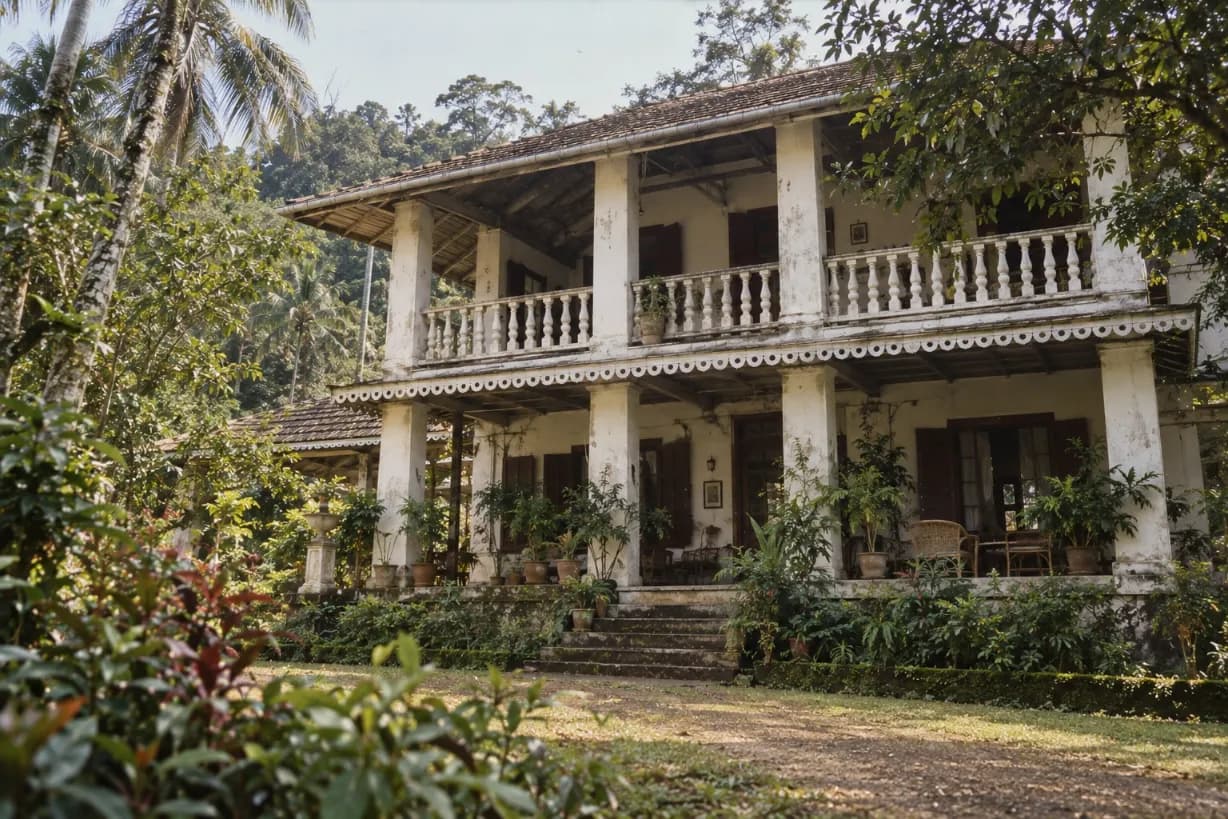
Somewhere in Ratnapura, more than a century ago, someone stood back far enough from this bungalow to fit the whole house into a photograph.
Perhaps the photograph was taken for a family album. Perhaps it was sent home in a letter. Or perhaps someone simply wanted to remember the place as it looked then.
We don’t know.
What survives is a two-storey bungalow, its long verandahs disappearing into shadow, flower pots gathered around the entrance and several people barely visible beneath the roof. One person stands quietly on the steps.
The photograph is identified as Palm Garden Plantation, Ratnapura.
At first it seems like one of the many old photographs left behind from Ceylon’s plantation years.
Then you find a line in an old directory.
On 18 January 1910, the bungalow at Palm Garden Estate was destroyed by fire.
And suddenly you look at the photograph differently.
Palm Garden Before the Fire
Palm Garden was already an established estate before the twentieth century arrived.
In 1899, the Ceylon Government Gazette recorded a planter named A. Eck of Palm Garden, Ratnapura.
It is hardly a dramatic piece of history. Just a name, an occupation and a place.
But those little entries are sometimes all that remain of an earlier world.
At the time, Ratnapura was becoming increasingly tied to Ceylon’s plantation economy. This was not the cool, misty country usually imagined when we think of old planter bungalows. Palm Garden belonged to the wetter, warmer country of Sabaragamuwa, where heavy rain could arrive suddenly and vegetation seemed capable of swallowing a neglected garden in a season.
The house in the photograph looks at home there.
Its verandahs are deep. The rooms sit well back from the sun. The upper floor opens almost completely towards the garden.
There must have been days when rain hammered against that roof and turned the ground beyond the steps into mud.
And there must have been other mornings when every door was opened to catch whatever breeze came through the garden.
That was simply life in the house.
Nobody living there would have thought of it as an “old Ceylon bungalow”.
It wasn’t old yet.
18 January 1910
Then came the fire.
Ferguson’s Ceylon Directory later recorded the event in only a few words: the bungalow at Palm Garden Estate, Ratnapura, had been destroyed by fire on 18 January 1910.
That is all.
No description of flames through the roof.
No account of people rushing outside.
No mention of furniture being carried down the steps or trunks being dragged from bedrooms.
We don’t even know how the fire started.
For the people who knew the house, it must have been a considerable event. In the historical record, it became a line.
And that line leaves us with a question about this photograph.
Is this the bungalow that burnt in 1910?
It could be.
But we don’t know.
There is no reliable date attached to the photograph that allows us to place it before or after the fire. The house could equally be a later bungalow built on the estate.
Until another photograph or estate record appears, it is better to leave the question unanswered.
Still, once you know about the fire, it is difficult to look at the photograph without wondering.
Look Closely at the House
There is something wonderfully ordinary about it.
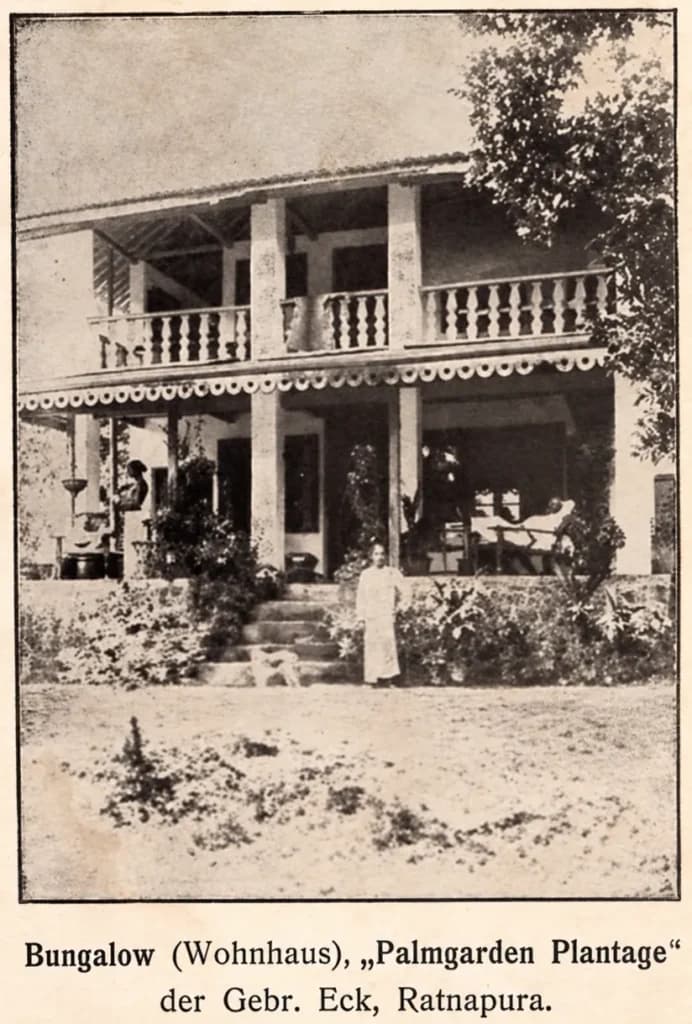
The entrance isn’t particularly grand. Plants have been allowed to crowd around the verandah. Pots sit beside the columns. Furniture and other objects can just be made out in the darkness behind them.
Someone clearly lived here.
That matters because restored plantation bungalows can sometimes make the past look tidier than it really was.
Real houses were never museum pieces.
There would have been muddy shoes after rain. Wet clothes. Furniture that needed repairing. Mosquitoes in the evening. A roof that occasionally leaked. Letters waiting to be answered.
There were also many people required to keep an estate bungalow running.
Cooks, gardeners and domestic workers moved through these houses every day, while beyond the garden a much larger plantation workforce carried out the labour on which the estate depended.
Their names rarely appear in directories.
Yet they knew these houses intimately.
They knew which windows stuck.
They knew where the keys were kept.
They knew what time meals had to be ready.
They knew every step in that photograph.
Palm Garden Carried On
Whatever happened to the bungalow, Palm Garden itself continued.
More than fifty years after the fire, the estate appears again in the records.
The Tea Research Institute’s 1963 annual report recorded Palmgarden Group, Ratnapura, with 270 acres of clonal tea.
By then, much had changed.
Ceylon had become independent. The old plantation society was fading. Generations of people who had known Palm Garden at the beginning of the century had moved away or died.
But tea was still growing there.
Today, the name survives as Palmgarden Estate, part of Balangoda Plantations PLC. The company lists the Ratnapura property at 821.18 hectares and categorises it as a rubber estate.
More than a century after that brief report of a bungalow fire, Palm Garden is still a working plantation.
The People in the Photograph
But it is difficult to finish the story with acreage and crops.
Your eye keeps returning to those people.
Especially the figure on the steps.
We don’t know who that person was. There is no point giving them an imaginary name or inventing a story about their life.
All we can say is that, on one particular day, they stood there.
Perhaps someone called out before the photograph was taken.
Perhaps nobody paid much attention to the camera.
A few seconds later the person on the steps probably walked away. Someone returned inside. Work continued. Lunch had to be prepared. Something needed doing on the estate.
It was an ordinary day.
Years passed.
The people disappeared.
Ceylon became Sri Lanka.
And Palm Garden changed with it.
Yet somehow this one moment survived.
An old bungalow.
Plants around the verandah.
People standing in the shade.
And a person on the steps who could never have imagined that, generations later, strangers would still be looking at their photograph and wondering about the house behind them.
Perhaps somewhere in an old album there is another photograph of Palm Garden.
And perhaps, written faintly on the back, is the one thing we would most like to know:
The date.
Heritage places mentioned
Palm Garden Bungalow
More from Old Ceylon

Colombo Public Library at 100: The Names That Still Remain
The Toll Gate at the Bridge: When Travelling Across Ceylon Cost a Few Cents at a Time