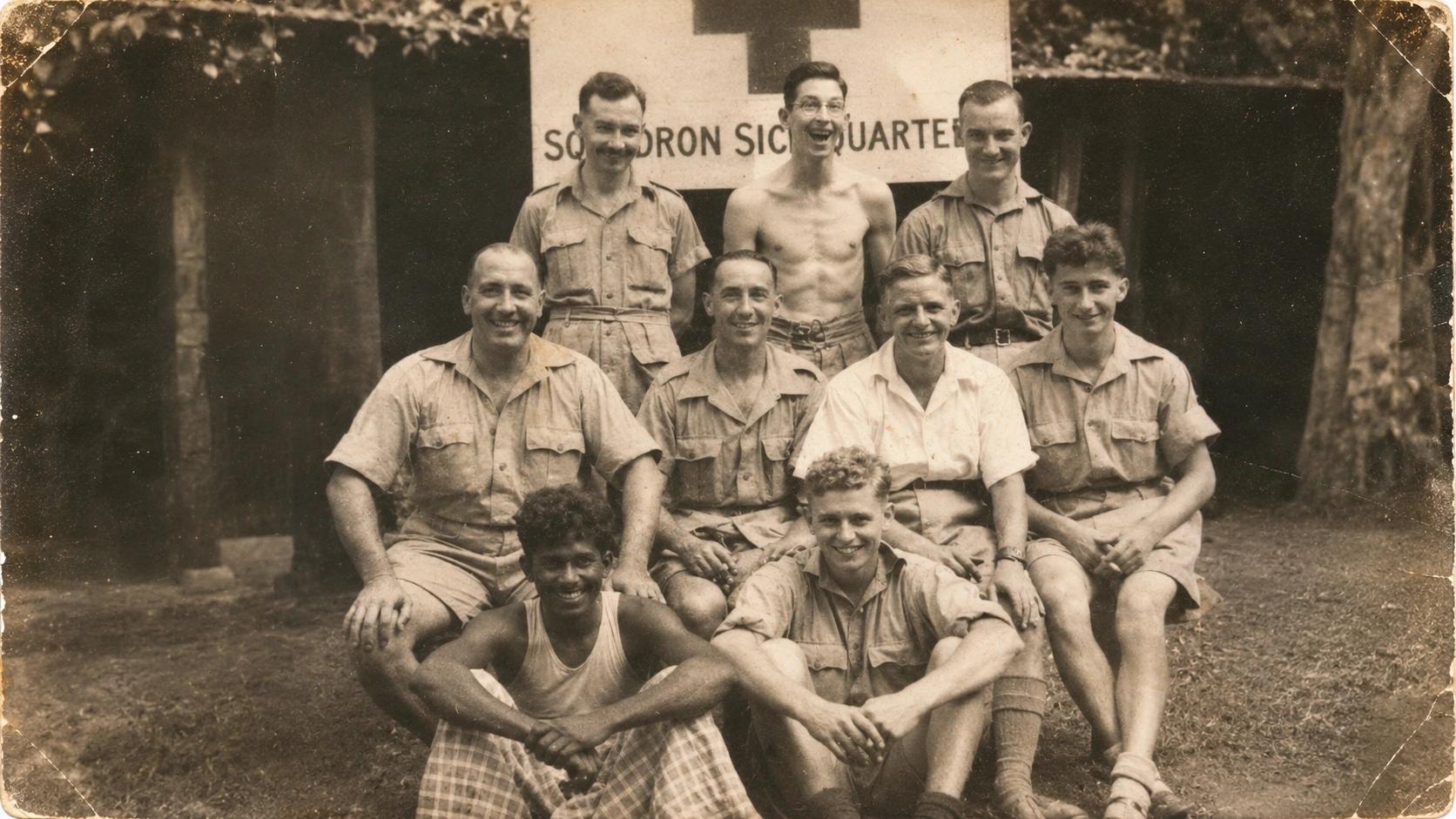
wartime Ceylon photograph | An old photograph, believed to have been taken in Ceylon during the Second World War, captures nine men smiling together outside what appears to have been a military medical facility. Their names have been lost, but the picture preserves a small, personal moment from a very different time.
Nine Men and an Ordinary Afternoon
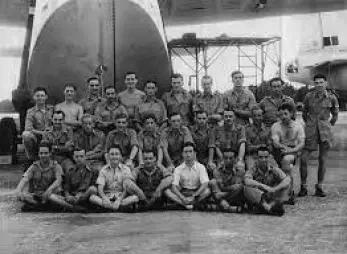
They must have been having a good day. There is something about the smiles in this old photograph that makes you think so. Nothing seems particularly organised. Some of the men are sitting on chairs, three are standing at the back, and two have made themselves comfortable on the ground. Nobody seems especially concerned about looking formal for the camera.
One has taken off his shirt, perhaps because of the heat. Another is wearing a white shirt that looks a little more respectable than the rest. At the front, a man in a vest and checked sarong sits with his arms resting on his knees, looking perfectly at home among the others. They seem relaxed and comfortable in one another’s company, as though someone had suggested a photograph in the middle of an ordinary afternoon.
The photograph is believed to have been taken in Ceylon during the Second World War, although its exact date and location are unknown. Behind the men is a sign that appears to read “Squadron Sick Quarters”, suggesting a connection to a military medical facility, possibly associated with an air force unit. The wording offers an interesting clue, but it is not enough to identify the establishment with certainty.
What catches your attention, however, is not the building or the sign. It is the people sitting outside it, smiling at whoever stood behind the camera. Whatever else was happening in their lives, they appear to have enjoyed that particular moment together.
When Servicemen from Faraway Places Came to Ceylon
During the Second World War, many servicemen from overseas found themselves stationed in Ceylon, thousands of miles from their homes. The island was strategically important to British and Allied operations in the Indian Ocean, particularly after the war expanded across Southeast Asia. Military personnel served at airfields, naval establishments, hospitals and camps in different parts of the country.
For those arriving from Britain or other distant countries, Ceylon would have been a considerable change from the places they knew. The tropical heat, unfamiliar surroundings, sudden downpours and different rhythms of daily life must have taken some getting used to. Even ordinary activities such as travelling into town, buying something from a local shop or finding relief from the afternoon sun would have become part of their experience of the island.
Military life involved discipline, routine and uncertainty, but it also included long stretches of ordinary daily activity. Men worked together, shared accommodation, ate their meals and spent their free time in one another’s company. Friendships could develop between people who might never have met under other circumstances.
A letter from home, a decent meal or an afternoon spent talking with friends could make life far from familiar surroundings a little easier. Looking at this photograph, one gets the impression that at least some of these men knew one another well. Their relaxed appearance suggests a moment away from the more formal demands of military life, although we cannot know what had brought the group together.
The Man in the Checked Sarong
One of the most interesting figures in the photograph is the man sitting at the front in his checked sarong. While the others are dressed in a mixture of shirts, shorts and casual clothing, his attire immediately draws the eye. He sits comfortably among the group, apparently just as much a part of the occasion as anyone else.
Who was he? Perhaps he worked at the quarters, helped with the daily running of the establishment or had become a familiar face among the men stationed there. He might have been a local employee, a visitor or someone whose connection to the group would have been obvious to the original owner of the photograph. Without names or accompanying records, it is impossible to say.
His presence makes one think about the many Ceylonese people whose lives crossed those of foreign servicemen during the war. Cooks, drivers, clerks, medical attendants, labourers and other civilian workers contributed to the daily operation of military establishments. Their involvement was an important part of wartime Ceylon, although their individual experiences were not always recorded in the histories written afterwards.
Some encounters between local people and overseas servicemen would have been brief, lasting only as long as a particular posting or period of employment. Others may have developed into friendships remembered long after the war ended. We cannot assume what relationship existed between the men in this photograph, but their presence together suggests a shared moment that someone considered worth recording.
Perhaps somewhere in an old family album in Britain, Australia or Sri Lanka, there is another photograph showing some of these same faces. It is entirely possible that somebody once knew their names, where they worked and what happened to them afterwards.
A Photograph Someone Thought Worth Keeping
Old photographs often make us wonder about the person who first owned them. This one might have been kept by a serviceman stationed in Ceylon, sent home to his family or placed in an album alongside other memories of the war years. It may have carried a note on the back identifying the men or the place where the picture was taken.
Perhaps somebody once wrote a few names beneath it, or mentioned the occasion in a letter. The photograph might have been shown to relatives after the war, accompanied by stories about the people who appeared in it. What now seems mysterious could once have been entirely familiar to the family who kept it.
As the years passed, however, the people who remembered those stories grew older. Photographs changed hands, albums were rearranged and possessions were passed from one generation to another. Sometimes the notes that explained a picture were lost, leaving the image separated from the people and circumstances that had originally given it meaning.
We do not know how this particular photograph survived or who preserved it. What remains is a group portrait with a possible wartime connection and several unanswered questions. The men would probably have found it rather amusing to know that people might one day spend so much time wondering about their ordinary photograph.
They were not necessarily trying to record an important event. They may simply have wanted a picture of themselves together.
The Small Pleasures of Wartime Life
The Second World War is usually remembered through military campaigns, major political decisions and the enormous human losses it caused. Ceylon’s wartime history includes the Japanese air attacks of April 1942, the presence of Allied military forces and the island’s importance as a strategic base in the Indian Ocean. These events form an essential part of understanding the period.
But the war also consisted of thousands of ordinary days in which people continued with their work and tried to make the best of difficult circumstances. Servicemen still had meals to eat, letters to write and friendships to maintain. Local civilians continued with their lives while wartime demands changed the world around them.
A photograph such as this reminds us of those quieter moments. The men appear relaxed, without the formality of a military parade or an official group portrait. Their clothing varies, their seating arrangement is informal, and their smiles suggest that the photographer caught them in a pleasant mood.
It is tempting to imagine someone calling the others over, a few chairs being moved into place and some laughter as everyone tried to fit into the frame. We have no evidence that the photograph was arranged in exactly that way, but anyone who has gathered friends for an informal picture will recognise the possibility.
Even during a war, people found opportunities to enjoy one another’s company. A conversation, a shared joke or a photograph taken with friends could provide a welcome interruption to the demands of daily life. These moments rarely entered official records, but they mattered to the people who experienced them.
If Only We Knew Their Names
The most frustrating thing about this photograph is how little we know about the people in it. Their faces are clearly visible, and some of their personalities seem almost to emerge through their expressions. Yet we cannot identify a single man with confidence.
We do not know who was always telling jokes, who complained about the heat or who longed most to return home. Perhaps one had a sweetheart waiting thousands of miles away. Another might have written letters describing Ceylon’s scenery, people and unfamiliar surroundings. The man in the checked sarong may have had a family living only a short distance from wherever the picture was taken.
These are possibilities rather than facts, but they remind us that each person in the photograph had a life extending far beyond the moment recorded by the camera. They had families, responsibilities, hopes and experiences that the image cannot reveal.The sign reading “Squadron Sick Quarters” may eventually provide a clue.If the location can be identified through wartime records or other photographs, it might become possible to establish which unit was stationed there and when the picture was taken. Even a small detail such as the building’s appearance or the wording of the sign could help someone familiar with the period recognise the setting.
Until then, the photograph remains a small mystery from wartime Ceylon, preserving nine people whose personal histories have become separated from their faces.
A Forgotten Day That Has Never Quite Disappeared
There is something touching about an old photograph that shows people enjoying themselves without any apparent reason beyond being together. No grand occasion is visible here, and there is nothing to suggest that the group had gathered for a formal ceremony. The men simply appear to have been sharing a pleasant moment outside a building somewhere in Ceylon.
We do not know what happened after the photograph was taken. Some may have remained on the island for months or years, while others might have been transferred elsewhere. Local members of the group may have continued their ordinary working lives after the foreign servicemen departed. The war eventually ended, and the people in the picture went their separate ways.
Today, their names and stories are unknown, but the photograph has survived. It allows us to look back at a moment when these nine men were together, smiling and apparently enjoying one another’s company.
Much of Old Ceylon’s history survives through photographs of buildings, railway stations, military installations and important events. Pictures like this preserve something equally valuable: the ordinary people who occupied those places and lived through those years.
Whoever took the photograph probably intended only to remember a few familiar faces. More than eighty years later, it has become a little record of friendship, working life and the personal side of Ceylon’s wartime history.
For one brief afternoon, nine men sat together and smiled for a camera. We may never know their names, but thanks to this photograph, that moment has not quite disappeared.
Visit us: https://trippingsrilanka.com/