A Paper Message from the Age Before Instant Communication
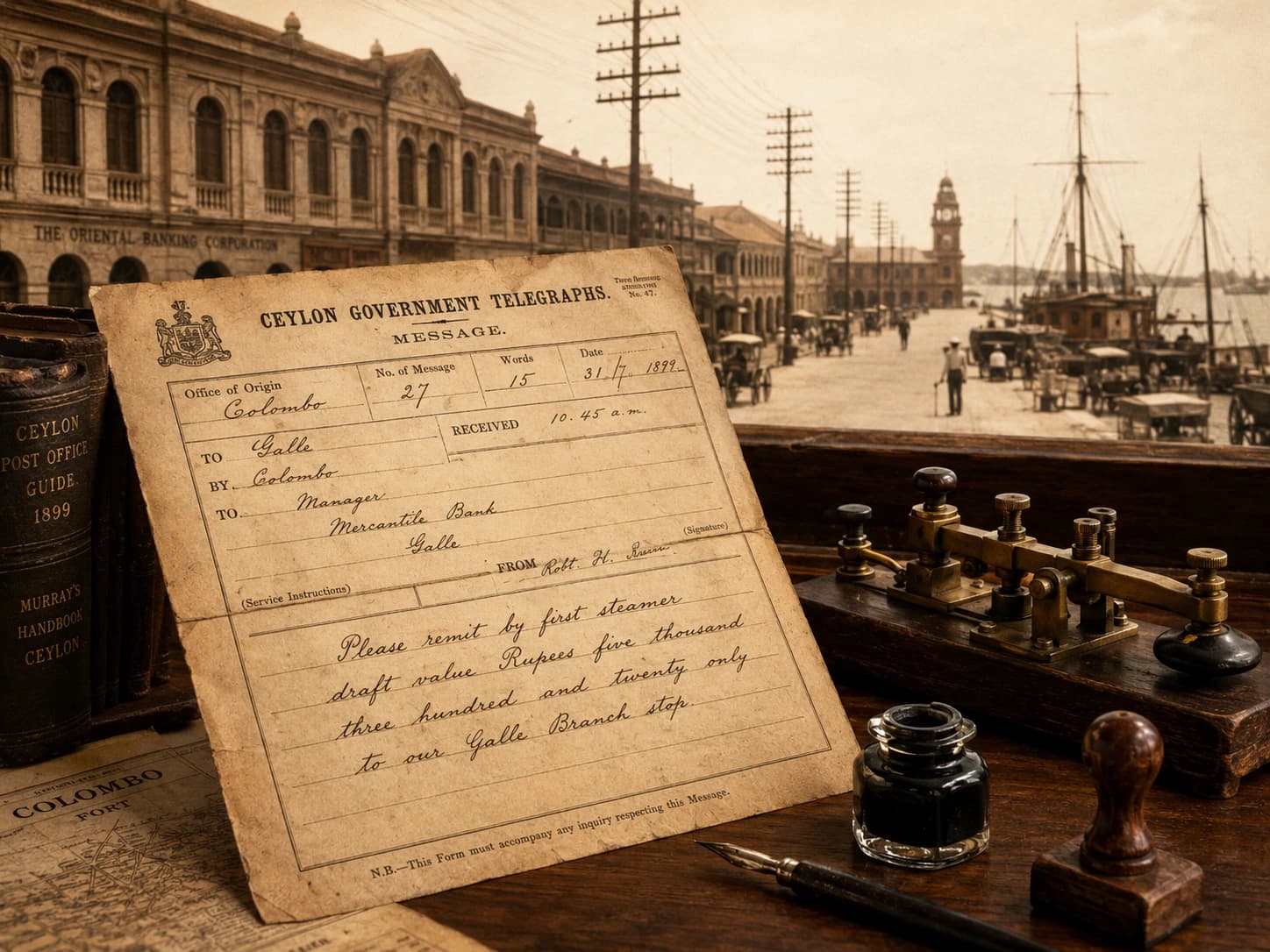
1899 Ceylon Telegraph Form| More than a century ago, long before mobile phones, emails or instant messaging, urgent news travelled across Ceylon through wires stretched between towns, railway stations, ports and government offices.
A surviving Ceylon Post Office Telegraph form, dated 30 June 1899, offers a remarkable glimpse into that vanished world.
The ageing sheet carries the printed heading “Ceylon Post Office Telegraph”, handwritten instructions, administrative boxes and a faded rectangular Colombo date mark. Although the message itself is now difficult to decipher, the document remains an evocative fragment of everyday life in British Ceylon.
It represents a time when receiving a telegram could signal a family emergency, an important business instruction, a government order or news that could not wait for the ordinary post.
Check our previous article- https://trippingsrilanka.com/stories/old-ceylon-postcards-to-england
What the 1899 Telegraph Form Shows
At first glance, the form appears modest: a thin sheet of paper divided into ruled sections for the destination, recipient, number of words, transmission time and official instructions.
Yet every printed line reveals something about the organised telegraph system operating in Ceylon during the closing years of Queen Victoria’s reign.
At the top of the form are spaces marked:
- Class
- To Station
- From Station
- Words
- Day
- Hour
- Minute
- Official Instructions
Below these administrative fields is the section where the telegram’s message was written for delivery to its recipient.
The destination appears to have been recorded as Colombo Central, while the date stamp at the bottom clearly reads “COLOMBO 30 6 99.” This places the document in Colombo on 30 June 1899.
The paper has been folded, handled and creased. Its handwriting has faded, and portions of the message are no longer easily readable. Rather than attempting an uncertain transcription, its greatest value lies in what the form itself reveals about communication in Old Ceylon.
Why This Document Is Rare
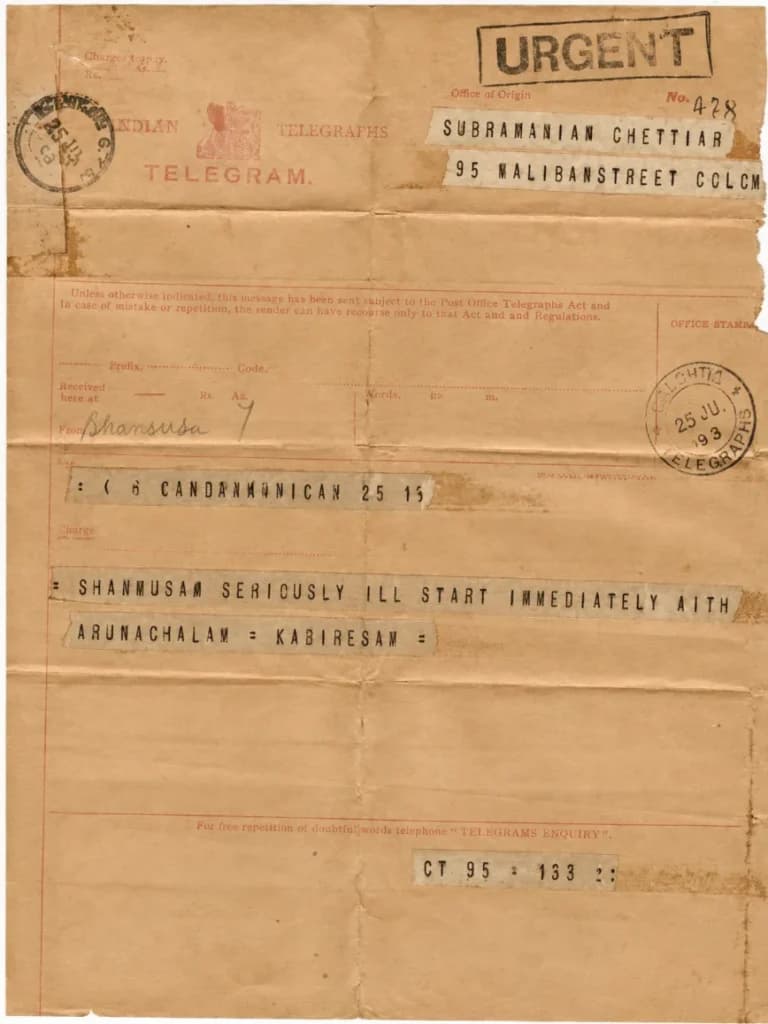
Specialist philatelic records identify surviving examples of this type as Ceylon Telegraph delivery forms used in Colombo.
Complete documents are less commonly encountered than individual telegraph stamps because many official message portions were routinely discarded after they had served their administrative purpose.
That makes this surviving form important.
It is not only a piece of stationery. It is a fragile working document from the communications system of colonial Colombo.
Most telegrams were never meant to survive. They were read, folded, filed, discarded or destroyed. Office copies were often kept only temporarily. In Ceylon’s humid climate, paper also deteriorated easily.
The survival of this form allows us to see how an urgent message physically reached its recipient in 1899.
Before the Telegraph Reached Ceylon
For much of Sri Lanka’s earlier history, information could travel only as quickly as the person, horse, cart or vessel carrying it.
Messages between Colombo and Kandy had to cross difficult terrain. Communications with Galle, Jaffna, Trincomalee or the plantation districts could take days. Overseas news depended upon ships arriving at Ceylon’s ports.
The postal system had already begun to develop under Dutch rule. According to Sri Lanka’s Department of Posts, five post offices were established in the maritime districts in 1798, although the service was mainly intended for government and East India Company purposes rather than unrestricted public use.
After the British assumed control, the postal network was reorganised and gradually extended to the island’s major towns.
Letters remained essential, but the arrival of electric telegraphy introduced an entirely different idea: a written message could be converted into electrical signals, transmitted through a wire and reconstructed many miles away.
Distance was no longer measured only in days of travel.
The Arrival of Telegraphy in Ceylon
Ceylon’s first government telegraph service was established during the 1850s.
An early telegraph connection operated between Colombo and Galle in 1857, followed by circuits linking Colombo and Kandy. The Department of Posts records the introduction of Morse signalling during this period and notes that Colombo was receiving direct telegrams from Europe by 1865.
This was a major transformation.
Colombo and Galle were important ports on the maritime routes of the Indian Ocean. Kandy was the administrative centre of the central highlands, while the expanding coffee and later tea plantation economy increasingly depended upon rapid communication between estates, agents, exporters, railway officials and government departments.
The telegraph allowed information to move independently of the person or object concerned.
A ship’s arrival could be reported before its cargo was unloaded. A railway delay could be communicated to another station. A plantation superintendent could contact an agency house in Colombo. Government officials could transmit instructions without waiting for a messenger to cross the island.
By 1899, when this particular form was used, telegraphy had already been part of life in Ceylon for approximately four decades.
Colombo at the Centre of the Telegraph Network
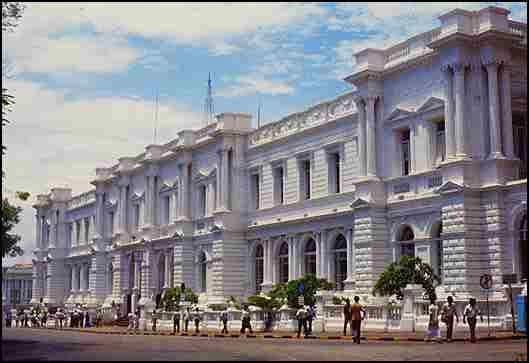
The telegram belongs to a particularly important period in Colombo’s development.
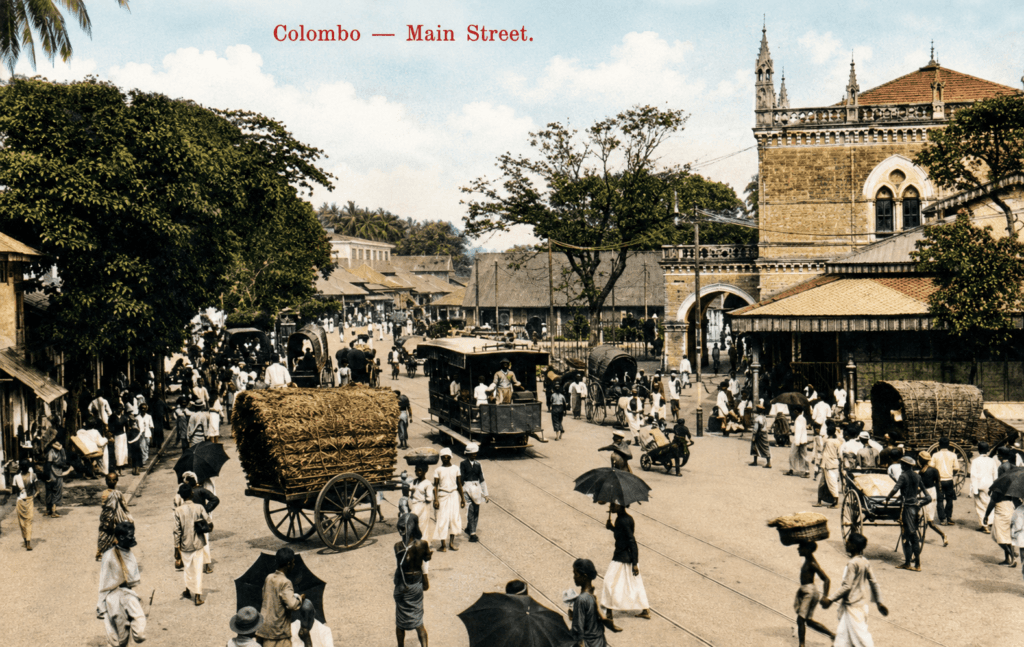
During the late nineteenth century, Colombo was rapidly emerging as the commercial and administrative heart of British Ceylon. The harbour was expanding, railway lines converged upon the city, European agency houses occupied imposing buildings in the Fort, and Pettah remained a busy centre of local commerce.
The General Post Office had moved into its grand purpose-built premises opposite Queen’s House in 1895, only four years before this telegram was delivered. Located on what was then Queen’s Street, now Janadhipathi Mawatha, the building became one of the principal institutions of colonial Colombo.
The Post Office was more than a place for letters.
Postal, telegraph and eventually telephone services formed part of an interconnected communications system. Clerks received messages, calculated charges, operated telegraphic equipment, copied transmitted words onto forms and arranged their delivery.
Behind a simple sheet such as this stood an entire chain of human labour: the sender, counter clerk, telegraph operator, receiving operator, copying clerk and messenger who carried the final paper to its destination.
How a Ceylon Telegram Was Sent
Sending a telegram required careful economy.
The customer wrote the recipient’s address and message on a form at a post or telegraph office. Charges were generally calculated according to the number of words and the destination.
Because additional words increased the price, telegrams developed their own compressed style. Polite introductions and lengthy explanations were often abandoned. Messages were reduced to essential facts.
Typical telegram wording might have looked like:
- ARRIVING FRIDAY
- SHIP DELAYED
- SEND DOCUMENTS IMMEDIATELY
- RETURN HOME URGENT
The clerk counted the chargeable words and recorded the relevant details. The message was then transmitted in coded electrical pulses, usually using Morse signalling.
At the receiving station, an operator interpreted the signals and reconstructed the words. The message was copied onto a delivery form such as the surviving 1899 document. A messenger then carried it to the named recipient.
What appears today to be a piece of routine stationery was therefore the final physical stage of a remarkably sophisticated nineteenth-century process.
Why Is the Form Described as “Stampless”?
The absence of an adhesive stamp does not necessarily mean that the telegram was transmitted free of charge.
Ceylon issued specialised telegraph stamps for the payment of telegraphic fees. The charging procedure followed a system developed in India. A long stamp representing the fee was placed across the dividing line between the sender’s receipt and the message section of the original submission form.
The stamp was then divided.
One portion remained with the receipt given to the sender, while the other remained attached to the office’s message record.
The message portion was retained temporarily in case questions arose and was later normally destroyed. This helps explain why surviving complete telegraph documents and lower stamp halves can be considerably less common than detached receipt portions.
A delivered copy could therefore be stampless even though the required fee had already been paid and recorded elsewhere.
It is not possible to determine the precise administrative circumstances of this particular sheet from its appearance alone. What can be said is that the absence of a stamp should not automatically be interpreted as evidence of unpaid transmission.
Telegraph Stamps of Old Ceylon
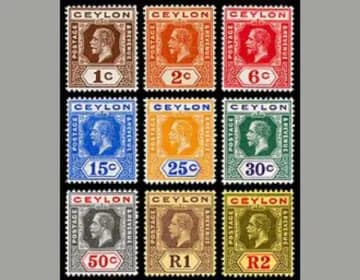
Ceylon’s specialised telegraph stamps form a fascinating branch of postal history.
Before the island issued its own series, Indian telegraph stamps overprinted for use in Ceylon were employed. Ceylon’s first permanent telegraph stamp series was released on 14 February 1881.
These stamps were unusually long and often carried two portraits of Queen Victoria. The duplicated design had a practical purpose: when the stamp was divided between the receipt and message sections, a royal portrait could remain on each half.
Values ranged from relatively modest amounts to high denominations intended for lengthy or expensive transmissions.
Surviving examples now attract the interest of collectors specialising in Ceylon, revenue stamps, postal stationery and the history of telecommunications.
Yet the stamps tell only part of the story. A complete delivery form places the stamp system within its human and administrative setting.
The Human Drama of the Telegram
Unlike an ordinary letter, a telegram often created immediate tension.
The arrival of a telegraph messenger at a residence, office or estate bungalow could interrupt the entire household. The small envelope or folded form suggested that something important had happened.
Telegram messages announced:
- Births
- Deaths
- Illnesses
- Travel arrangements
- Commercial orders
- Legal instructions
- Examination results
- Shipping information
- Official summonses
- Family emergencies
Some brought relief. Others brought devastating news.
The surviving 1899 Colombo form does not reveal its complete personal story to us. The names and wording have faded into uncertainty. But perhaps that uncertainty makes the document even more compelling.
It once mattered enough for someone to pay for immediate transmission. A clerk handled it. An operator sent it. Another received it. A messenger delivered it. Someone in Colombo opened it and read words that were important on that June day in 1899.
A Symbol of Colonial Modernity
The telegraph was one of the defining technologies of the British imperial age.
Its wires frequently followed railway lines and connected ports, government centres and commercial districts. In Ceylon, it served an administration attempting to govern the island while also supporting the needs of shipping, plantations, railways and international trade.
However, the system cannot be understood only as an instrument of colonial government.
Local clerks, operators, messengers and technical workers kept the service functioning. Local merchants and families used it. Messages passed through the system in English, Sinhala and Tamil, reflecting the multilingual society operating beneath its formal colonial structure.
The telegraph therefore became woven into Ceylonese life.
Although established within a colonial framework, it was used by people across the island for their own commercial, professional and personal purposes.
Tracing Telegraph History in Colombo Today
Travellers interested in this chapter of Old Ceylon can still encounter parts of its architectural setting in Colombo Fort.
The former General Post Office on Janadhipathi Mawatha is one of the most prominent surviving buildings associated with the island’s postal history. Completed and opened in 1895, its imposing colonial façade reflects the importance attached to communication and administration during the period.
The later Central Telegraph Office on Duke Street belongs to the early twentieth century, having been completed around 1910 or 1911. Although it postdates the 1899 form, it represents the continued growth and specialisation of Colombo’s telecommunication services.
Together with the old commercial buildings, railway landmarks and harbour surroundings of the Fort, these structures help visitors imagine a city once filled with telegraph clerks, shipping agents, railway officials, government messengers and merchants awaiting news from across Ceylon and beyond.
Why This Form Matters to Old Ceylon
This 1899 telegraph form matters because it reveals a side of Old Ceylon that is often overlooked.
Old Ceylon is usually remembered through buildings, plantations, railways, forts, churches and photographs. But communication systems were just as important to the island’s transformation.
The telegraph connected:
- Ports with inland towns
- Government offices with regional stations
- Plantation districts with Colombo agencies
- Railway stations with control points
- Families separated by distance
- Merchants with shipping information
- Ceylon with the wider world
It helped create a faster, more connected island.
A single sheet of telegraph paper therefore tells a much larger story: the story of how information moved through colonial Ceylon.
A Fragile Survivor from Old Colombo
The significance of this form lies not in its monetary value or the importance of its message.
Its value comes from survival.
Most telegrams were temporary objects. They were read, folded, placed in drawers and eventually discarded. Office records were routinely destroyed when no longer required. Paper deteriorated in Ceylon’s humid climate.
This single creased sheet survived.
Today, it provides a direct connection to Colombo in 1899 — a city of horse-drawn vehicles, steamships, railway whistles, crowded commercial streets and telegraph wires carrying urgent messages above the rooftops.
The handwriting may have faded, but the form still speaks.
Final Thoughts: A Message from Old Colombo
The 1899 Ceylon Post Office Telegraph form is more than an old document.
It is a surviving fragment of a communication revolution.
It reminds us that Old Ceylon was not isolated or silent. By the end of the nineteenth century, the island had become part of an international communication network through which information travelled at a speed earlier generations could scarcely have imagined.
A message written in one place could pass through wires, operators, offices and messengers before arriving in another part of the island within hours.
For Tripping Sri Lanka readers, this small sheet of paper opens a larger story of Colombo, communication, empire, technology and everyday life.
It is fragile, faded and difficult to read.
But as a witness to Old Ceylon’s telegraph age, it remains remarkably powerful.
Visit Us: https://trippingsrilanka.com/stories
More from Old Ceylon

Colombo Public Library at 100: The Names That Still Remain
The Toll Gate at the Bridge: When Travelling Across Ceylon Cost a Few Cents at a Time