All Saints’ Church, Maskeliya: The Old Stone Church and the People Who Never Left
An Old Stone Church in the Tea Country
All Saints’ Church Maskeliya | There is something about the old churches of Sri Lanka’s hill country that makes you want to stop. Perhaps it is because they seem so unexpected. You drive for miles through tea estates, past factories, estate lines and hills covered in carefully clipped green bushes, and then suddenly there is a stone church that looks as though it belongs in an English village.
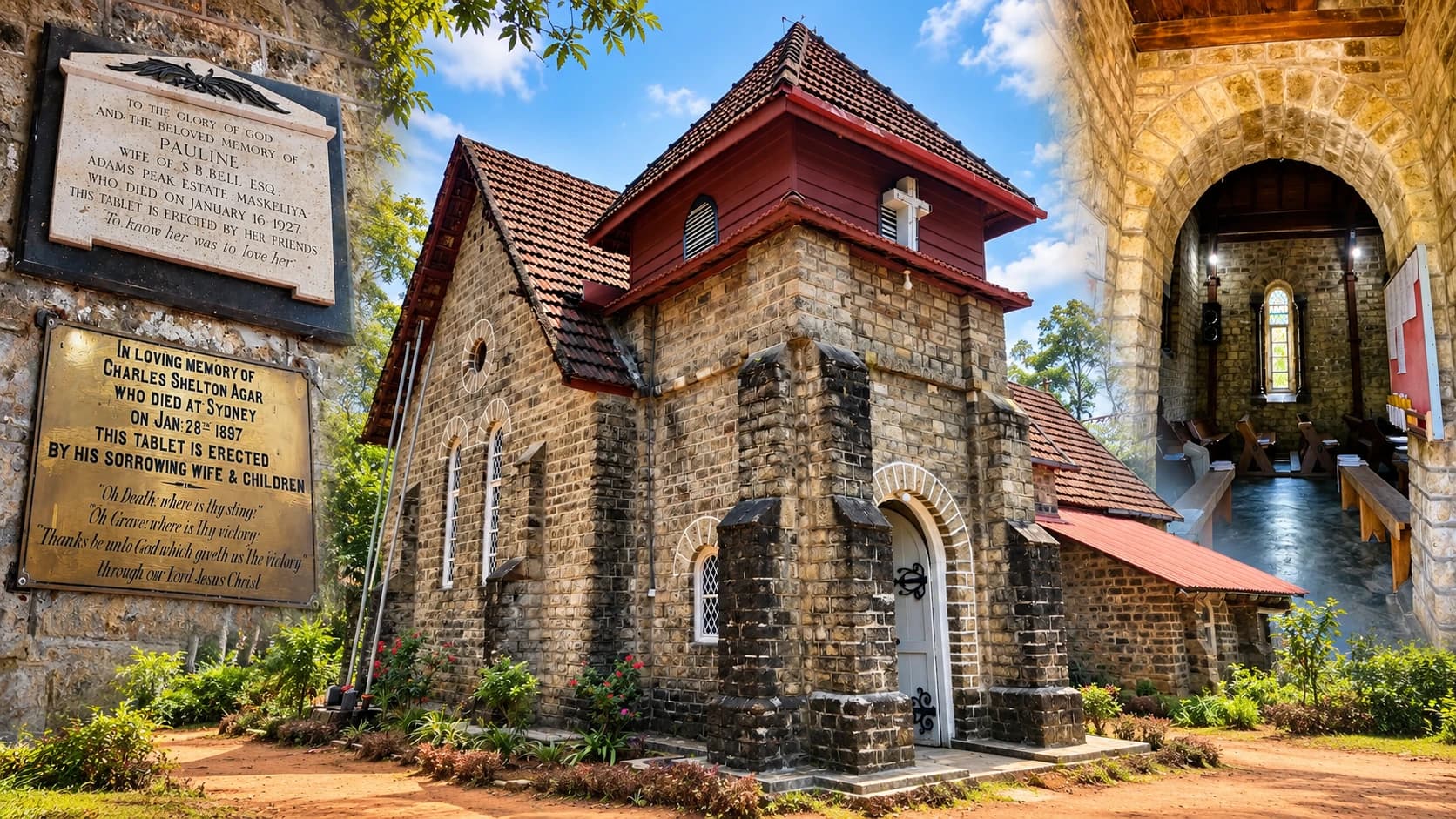
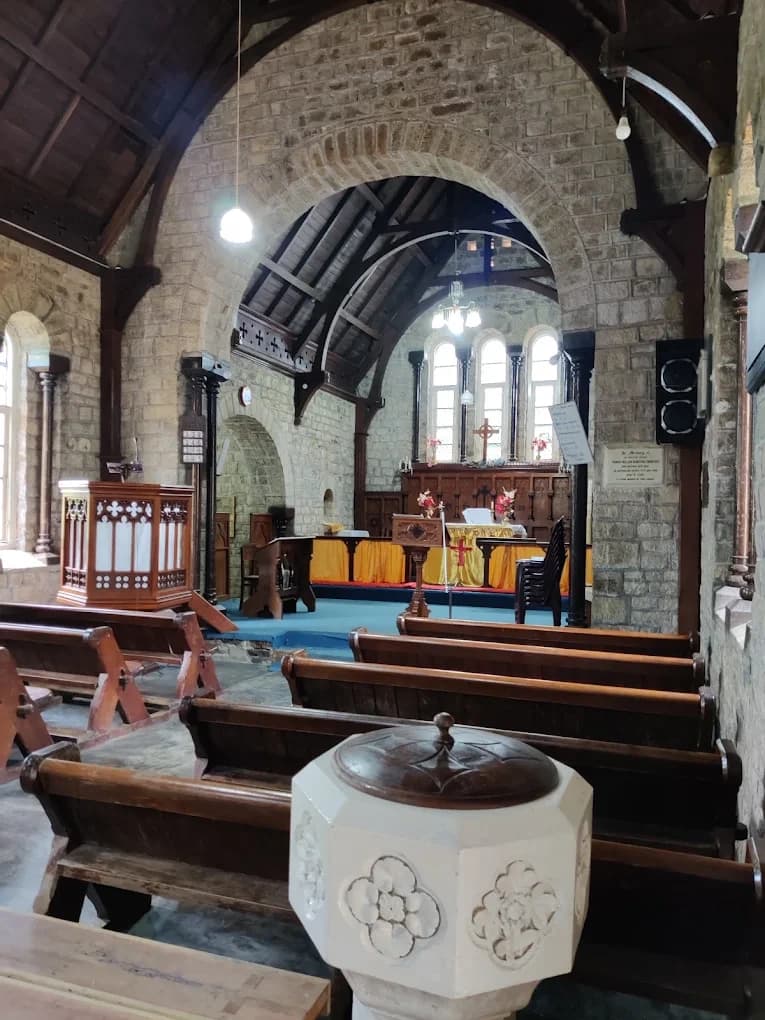
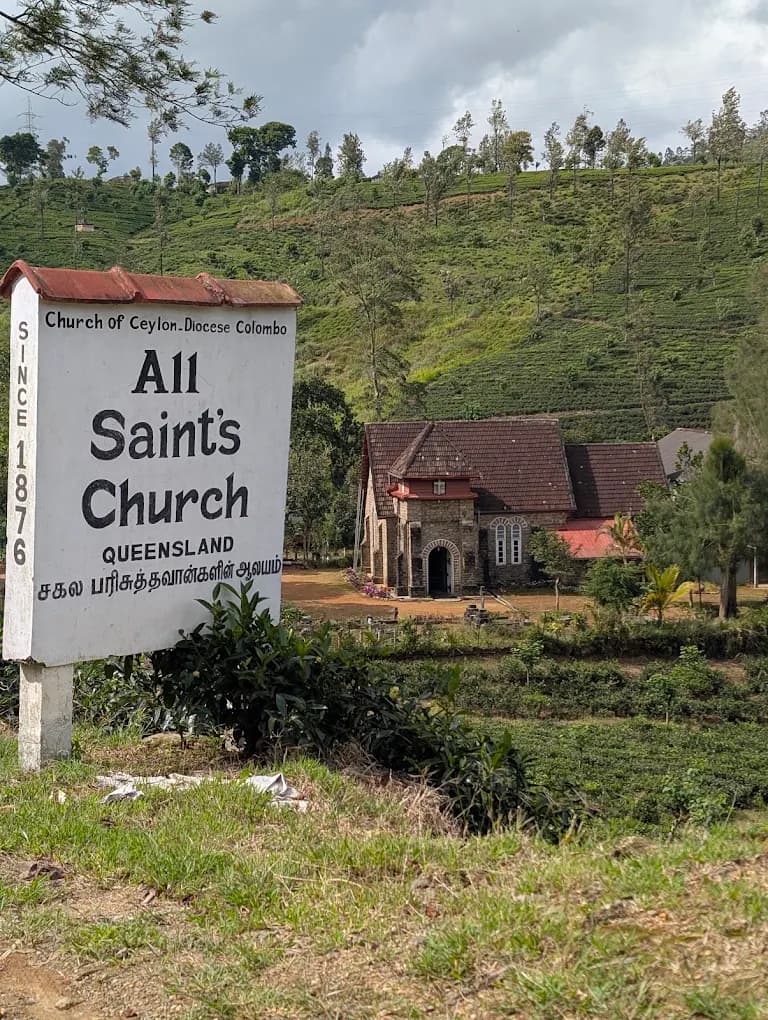
All Saints’ Church at Maskeliya is one of those places. It stands at Queensland, along the old plantation country around Maskeliya, its dark stone walls carrying more than a century of rain, mist and mountain weather. At first glance, it is easy to see it simply as another surviving building from British Ceylon. But walk around the churchyard and the place begins to tell a different story.
There are names here. People who came to this remote corner of Ceylon when Maskeliya was still being opened up by the plantation industry. People who worked on estates with names that still survive on maps today. People who expected eventually to return home. And people who never did.
That may be the real story of All Saints’. Not simply the story of a church, but of a little community in the mountains and the traces it left behind.
Read our previous article: https://trippingsrilanka.com/stories/st-margarets-church-of-kotagala
Maskeliya Before the Town We Know Today
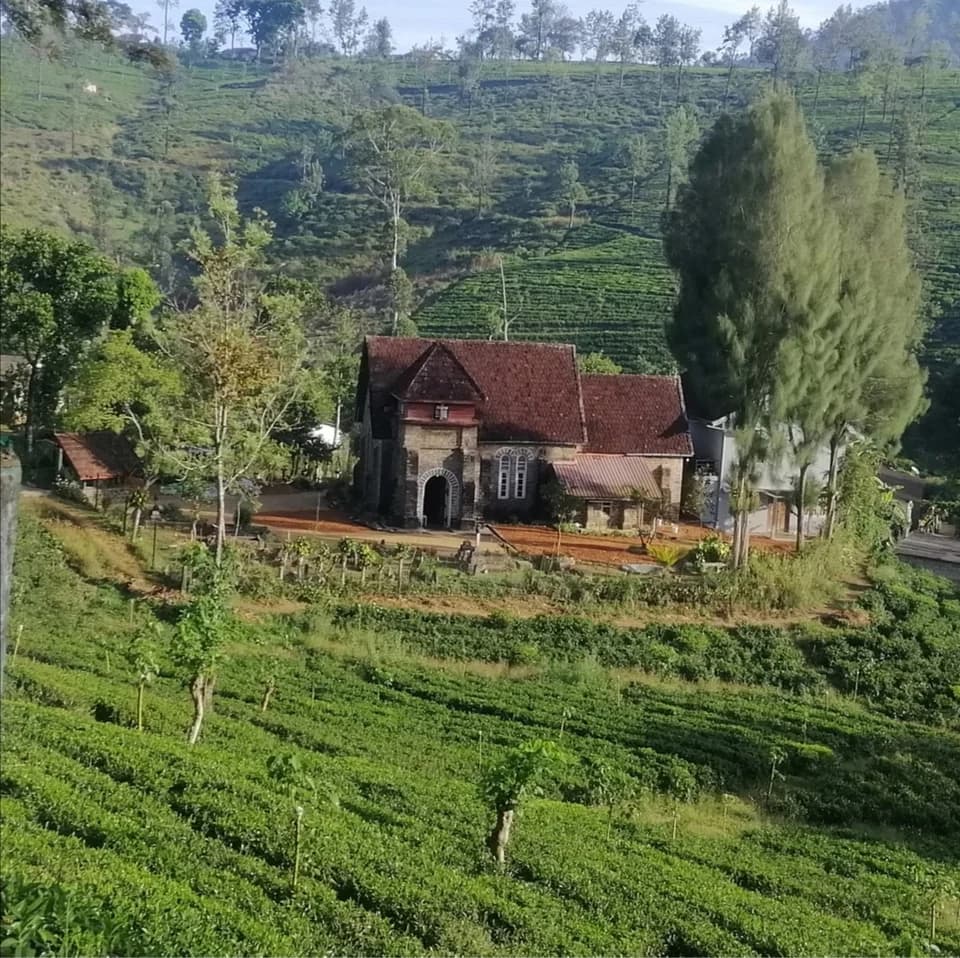
It is difficult now to imagine Maskeliya without tea. The crop has become so completely associated with these mountains that the landscape seems almost timeless. Tea covers the slopes, estate roads wind between the fields, and factories and workers’ settlements appear wherever the terrain allows.
But the Maskeliya into which All Saints’ was born was still a relatively young plantation district. During the nineteenth century, European planters had pushed farther and farther into Ceylon’s central highlands in search of land suitable for coffee. Forest was cleared, estates were surveyed and rough roads were cut across country that had previously been extraordinarily difficult to reach.
Life on those early estates could be isolated. Colombo was far away, and even neighbouring estates could involve difficult journeys, particularly during the rains. Planters created their own small social world in these districts. There were clubs, associations and gatherings, but churches also became important meeting places.
All Saints’ was part of that world. One surviving government record gives us an important historical anchor: a list of registered places of worship from the colonial period records All Saints’ Church at Queensland Estate in the Maskeliya district as a Church of England church, with a registration date of 27 October 1879. Modern accounts commonly give 1876 as the year the church was consecrated. The dates are not necessarily contradictory, because registration and consecration are different events, but the distinction is worth preserving rather than turning two historical records into one convenient date.
Either way, by the late 1870s there was an Anglican church standing at Queensland in Maskeliya. And the graves show that its story had already begun.
A Grave from 1877
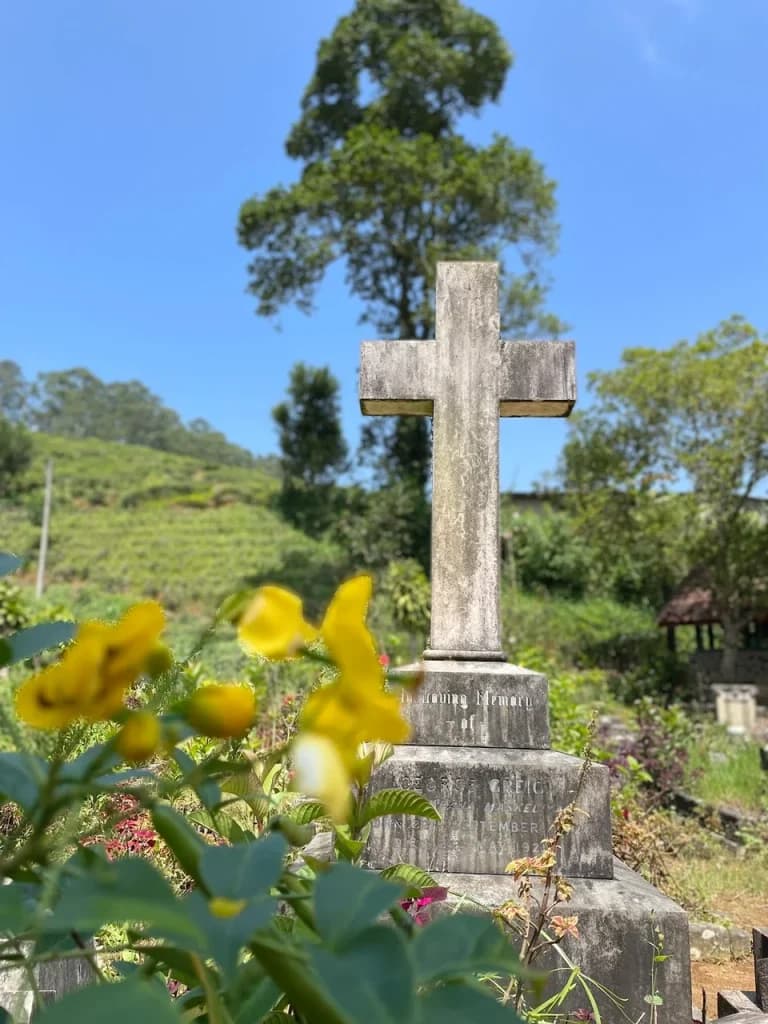
Among the old records connected with the churchyard is a name that takes us remarkably close to the beginning: James B. Cruickshank. He died on 21 January 1877, aged only 31. His memorial records him as the son of the Reverend J. Cruickshank of Stevenston, Scotland, and places his grave in the churchyard of All Saints’, Maskeliya.
It is one of those tiny pieces of history that makes the nineteenth century suddenly feel less distant. Thirty-one years old. A young man from a Scottish family, thousands of miles from Scotland, buried in the mountains of Ceylon. We know his name. We know his age. We know where he was laid to rest. Much of the rest of his life has disappeared.
And James was far from alone. The graveyard surrounding All Saints’ gradually became a record of the people who lived across the Maskeliya planting district. Some died young. Others spent decades in Ceylon. Some had probably arrived believing that the island would be a temporary adventure before returning to Britain. For several of them, Maskeliya became the final destination.
The Man Who Was Going Home
Perhaps the most poignant story preserved at All Saints’ belongs to the Reverend Thomas Nattle Gregg. Gregg was not a young planter. He had been educated at Cambridge and had served as rector of Lambley in Nottinghamshire. By the time he was in Maskeliya, he was already an elderly man by nineteenth-century standards.
Then came the journey he never made. Gregg died at Theberton, Maskeliya, on 29 February 1884, aged 73. His memorial contains one heartbreaking detail. He died on the eve of his departure for home.
There is something extraordinarily human about those few words. After however long he had spent in Ceylon, arrangements had apparently been made. Perhaps luggage had been packed. Perhaps farewells had already been said. Perhaps he had begun imagining England again.
He was going home. And then, just before leaving, he died. Instead of returning to England, Thomas Nattle Gregg remained in Maskeliya. His memorial was still recording that unfinished journey long after everyone who had personally known him was gone.
The Churchyard Became an Archive
This is what makes places such as All Saints’ so valuable. Official histories tend to remember governors, businessmen, wars, railway openings and important political events. Churchyards remember ordinary lives.
The cemetery records associated with All Saints’ preserve people who might otherwise have disappeared almost completely from the historical record. There was Edward Mortimer, born at Picton in Nova Scotia on 21 May 1823. He eventually found himself on the opposite side of the world, in Ceylon. Mortimer died at Cleeland, Maskeliya, on 15 October 1898 and was commemorated at All Saints’.
Another surviving record points to Charles Shelton Agar, a Ceylon planter who died in Sydney in 1897. A memorial tablet to him was placed inside All Saints’ Church. Other names survive in cemetery indexes, including Albert Alexander Pillans, who is recorded in connection with All Saints’ at Maskeliya.
Taken individually, these are fragments. Together they begin to recreate a lost community.
Life in the Old Planting District
It is tempting to romanticise nineteenth-century plantation life. The surviving bungalows, fireplaces, clubs and stone churches can make the period look rather comfortable from a distance. The reality could be much harsher.
Maskeliya was remote. Medical care was limited compared with anything we would recognise today. Accidents, disease and the difficulties of travelling through mountain country were part of everyday life. Even accounts discussing the old churches of the planting districts remark on the strikingly young ages visible among the graves at All Saints’.
That changes the atmosphere of the churchyard. These were not simply elderly people being buried after long retirements. The stones record lives interrupted. For families thousands of miles from Britain, a death in Ceylon meant something particularly final. There was no quick journey home. The mountains became the resting place.
Then Maskeliya Changed Around Them
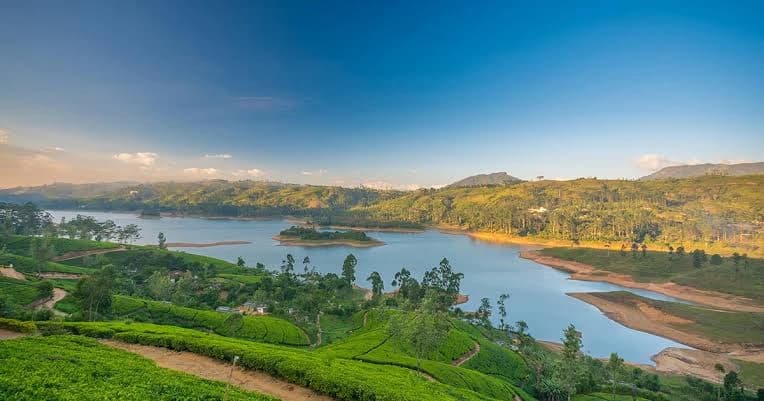
While those graves accumulated, the world outside the churchyard was being transformed. The great coffee enterprise that had drawn so many European planters into Ceylon’s mountains collapsed under coffee leaf disease. Tea replaced it.
Estate by estate, the landscape changed. The hills around Maskeliya that had once carried coffee gradually became the tea country familiar to us today. New generations of people arrived. Plantation communities grew. Roads improved. The railway changed travel through the hill country. The economic and social landscape of Ceylon evolved around the old church.
Eventually the British Empire itself disappeared from the island. Ceylon became independent in 1948. Later it became Sri Lanka. Estate ownership changed. The descendants of the original planting community scattered across Britain, Australia, Canada and elsewhere. The society that had created All Saints’ was effectively gone.
But the church was still there.
A Church That Found Another Life
That is an important part of the story. All Saints’ did not become an abandoned colonial ruin. It remained a church. Today it continues within Sri Lanka’s Anglican community and is listed among the churches serving the hill-country archdeaconry.
That means the building has now lived several lives. It began in the world of nineteenth-century Ceylon plantations. It survived the transition from coffee to tea. It passed through the final decades of colonial rule. It witnessed independence. And it became part of a Sri Lankan Christian community very different from the small European planting population for whom it had originally served.
That continuity makes All Saints’ more interesting than a preserved monument. It is not merely something that survived history. It continued through it.
Queensland, Maskeliya
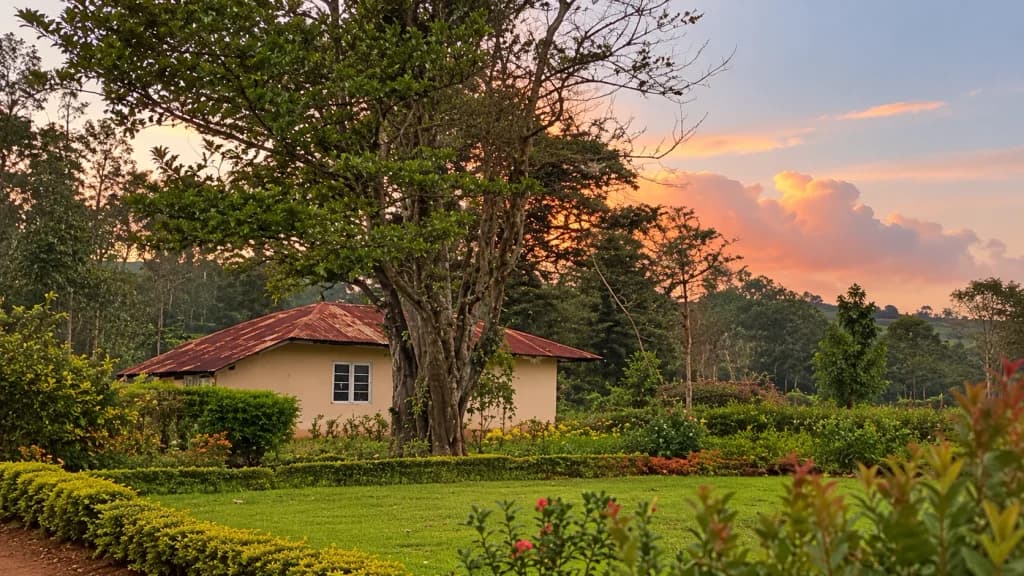
Even the address carries a little piece of the old world: Queensland Estate. Across Sri Lanka’s plantation districts, names like these remain everywhere. Norwood, Warleigh, Strathdon, Somerset, Devon and Queensland. They are remnants of the peculiar geography created during the plantation era, when pieces of Britain and the wider British world were transplanted onto mountains thousands of miles away.
Some estates disappeared. Some were divided. Some names changed. Others became so deeply embedded in local geography that nobody thinks twice about them anymore.
All Saints’ is one of the physical reminders of how that landscape came into existence. Its stones belong to the same history as the estate roads, old factories, planters’ bungalows and forgotten cemeteries scattered across the hills. But unlike many of those places, this one still has a congregation.
When You Visit, Walk Around the Back
Most people who stop at All Saints’ will probably photograph the church first. That is understandable. The old masonry against the green Maskeliya landscape makes a beautiful picture. But spend a little longer there.
Walk around the church. Look at the stones. Read the names if they are still legible. Notice the ages. Somewhere beneath that grass are people who crossed oceans to reach a district that, to them, must once have felt like the edge of the world.
One came from Scotland. Another was born in Nova Scotia. One prepared to return to England but died the day before he could begin the journey. Others worked on estates whose names still appear around Maskeliya. Most could never have imagined that, more than a century later, strangers would stand beside their graves trying to reconstruct their lives.
The People Who Never Left
There are grander churches in Sri Lanka. There are churches with more elaborate architecture, larger congregations and much better-known histories. All Saints’ does not need to compete with them. Its power is quieter.
It comes from the fact that the building, the churchyard and the landscape still sit together. The mountains those nineteenth-century residents knew are still there. Rain still falls across Queensland. Mist still drifts through Maskeliya. The estate roads still climb through the hills. And every morning, the sun reaches an old churchyard containing people who arrived in Ceylon when this part of the country was still being transformed by plantations.
Their world disappeared a long time ago. The coffee vanished. The empire vanished. Many of the bungalows they knew have vanished too. Their families moved away, and eventually even the memories of individual lives began to fade.
But at All Saints’, some of their names remain. Perhaps that is the most fitting way to think about this little stone church in Maskeliya. Some came to Ceylon expecting to stay only a few years. More than a century later, they are still here.
Visit Us: https://trippingsrilanka.com/stories