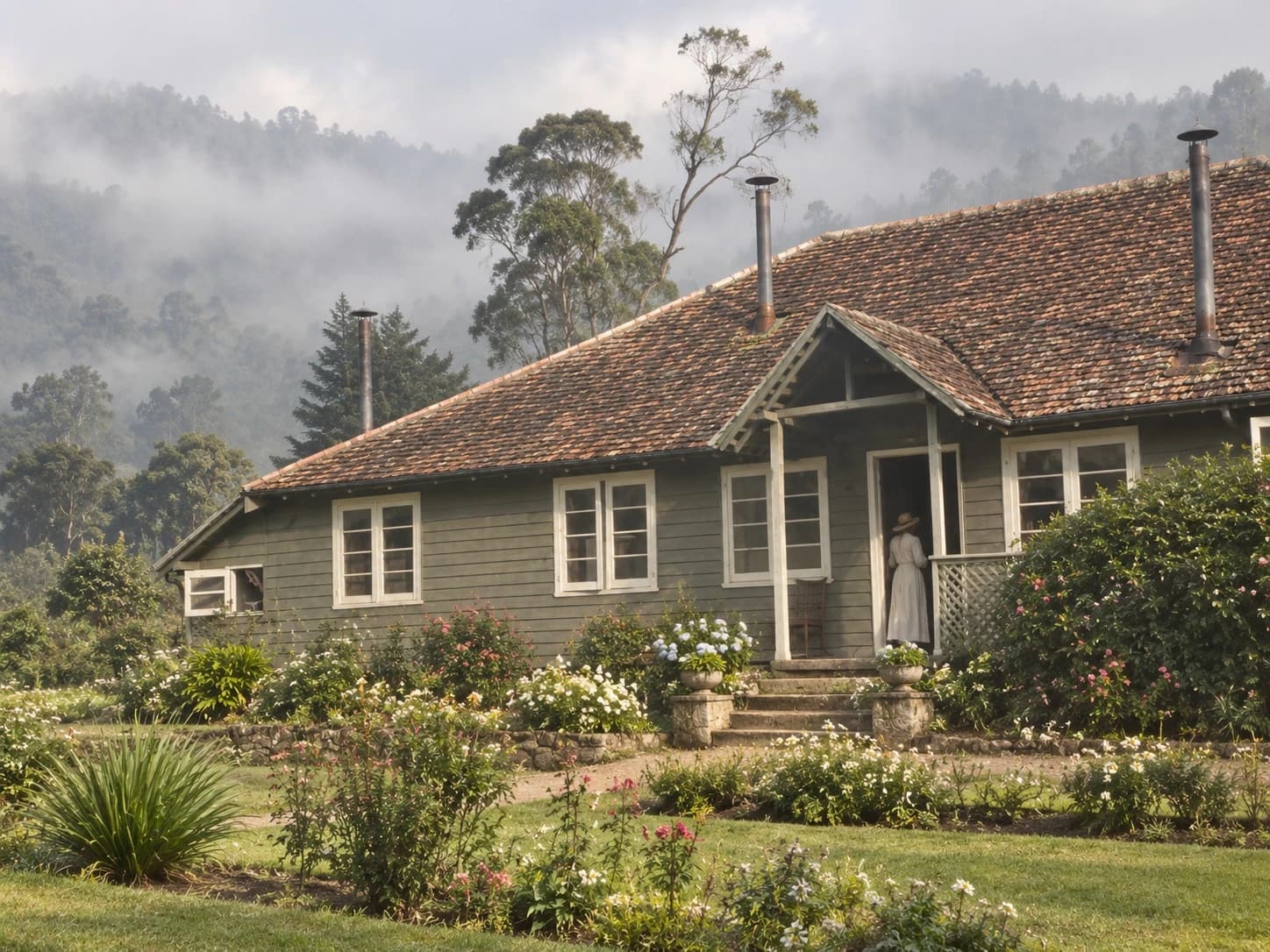
Ceylon planter life| The old photograph shows the sort of house we still associate with Ceylon’s planting districts: a long bungalow, tiled roof, several chimneys, a garden beginning to take shape around it, and a small group standing outside.What the photograph does not show is how little of the planter’s working day was actually spent inside that house.By the late nineteenth and early twentieth centuries, the working planter was part agriculturist, part factory manager, part accountant and part administrator. His day was organised around the estate, and it usually began much earlier than the comfortable bungalow might suggest.
Contemporary accounts are surprisingly detailed. A 1910 guide to the Ceylon Government Railway devoted several pages to the daily routine of a tea superintendent. An earlier memoir described a planter rising at 5.30 in the morning and finishing his estate books after returning home wet from the fields.The life differed from district to district and changed considerably over time. A coffee planter of the 1850s did not live exactly like a tea superintendent at Dimbula in 1910, nor did a rubber planter in Kalutara in the 1920s. But by piecing together their accounts, it is possible to reconstruct an ordinary working day remarkably well.
Read our previous article: https://trippingsrilanka.com/stories/ceylon-planter-ancestor
The Day Began at Muster
There was little chance of sleeping late.On a tea estate around the turn of the twentieth century, the superintendent could be at the morning muster by six o’clock.Workers assembled near the factory or another central point before dispersing across the property. The superintendent met the estate’s field staff there, including the kangani and the conductor, the latter being an important intermediary in the day-to-day supervision of cultivation.The superintendent counted the workforce and allocated gangs to different jobs.Some went plucking. Others might be pruning, weeding, clearing drains or carrying out maintenance.Numbers were entered in the estate records because the same workforce would have to be checked again later.This was not ceremonial supervision. The planter needed to know what was happening in every division of his estate.The 1910 railway guide describes him leaving muster, having what was known as “early tea”, checking the factory and then going straight into the fields.
Most of the Morning Was Spent Outside
For all the later imagery of planters sitting on bungalow verandahs, much of the job was done on foot.Tea had to be examined continuously.The superintendent checked whether plucking was being done correctly, whether pruning had been properly carried out and whether weeds or drainage were becoming a problem. An estate might cover hundreds of acres of steep country, divided into separate fields that were at different stages of cultivation.Quality could be lost through careless work.
Tea plucking in particular required supervision because taking too much of the shoot affected the quality of the manufactured tea, while damaging the growing point could affect the next round of leaf.The superintendent therefore moved between gangs, inspected the bushes and returned to weigh or record leaf during the day.By about ten in the morning, according to the 1910 account, the first heavily filled plucking baskets were being dealt with.And the planter was still outside.
Breakfast Could Be at Eleven
One of the stranger details for a modern reader is the timing of meals.What we would call breakfast was often taken only after several hours of work.After spending much of the morning going through the fields, the superintendent returned to his bungalow at around eleven o’clock for breakfast.By then he had already attended muster, checked the factory and walked through several sections of the estate.This late breakfast appears repeatedly in descriptions of plantation life. An account of nineteenth-century coffee planting similarly describes men returning to the bungalow for their midday meal after hours of work outside.
The bungalow therefore functioned less as the centre of the planter’s working life than as the place to which he repeatedly returned from it.He ate there, kept personal belongings there, entertained visitors there and, in many cases, maintained part of his correspondence and accounts there.But the estate itself was his real workplace.
The Planter Was Also Running a Business
After breakfast the day changed character.There were letters to answer, estate records to update and instructions to send.A superintendent might be responsible not only for growing tea but also for expenditure, labour records, roads, buildings, supplies and production. He dealt with the agency or owners responsible for the property and had to account for what was happening on the estate.Young men entering planting were expected to learn far more than agriculture.An 1893 account of opportunities in Ceylon recommended that a newcomer spend several years under an experienced planter learning estate management, cultivation and the working language used on estates.
The first position was commonly that of assistant superintendent , the sinna dorai in estate usage ,working beneath the senior superintendent or periya dorai.For a young man newly arrived from Britain, the difference between the life imagined at home and the one he encountered in Ceylon could have been considerable.There was no short course followed by an office job.He learned the estate by walking it.
Ceylon planter life | At Four, Everyone Came Back
The working day in the fields commonly ended around four.Workers returned with their leaf and assembled again. The day’s plucking was weighed, attendance checked and the work recorded.The superintendent was there again.A historical account describes the check-roll being marked according to the work completed during the day. The system was closely tied to wages and was also one of the mechanisms through which estate discipline was enforced.This is an important part of planter life that the bungalow photographs cannot show.
The superintendent occupied a position of considerable authority within a deeply unequal colonial plantation system. Decisions about work and wages could have immediate consequences for labourers and their families.The planter’s independence was real, but so was his power.
The Factory Did Not Keep Bungalow Hours
Field work ending did not mean tea making ended.Fresh leaf had to be processed.Withering, rolling, fermentation, firing, sorting and packing followed a production timetable dictated by the leaf rather than by dinner.The tea-maker had direct responsibility for the factory, but the superintendent ultimately had to know what was being produced under his name. The quality leaving the estate affected prices and the estate’s reputation with brokers and buyers.This was one reason the relationship between bungalow, fields and factory was so close.A planter could eat dinner while machinery was still operating somewhere below the house.The quiet estate seen after dark from a bungalow verandah was not necessarily asleep.
Life Inside the Bungalow Was Less Grand Than It Looks Today
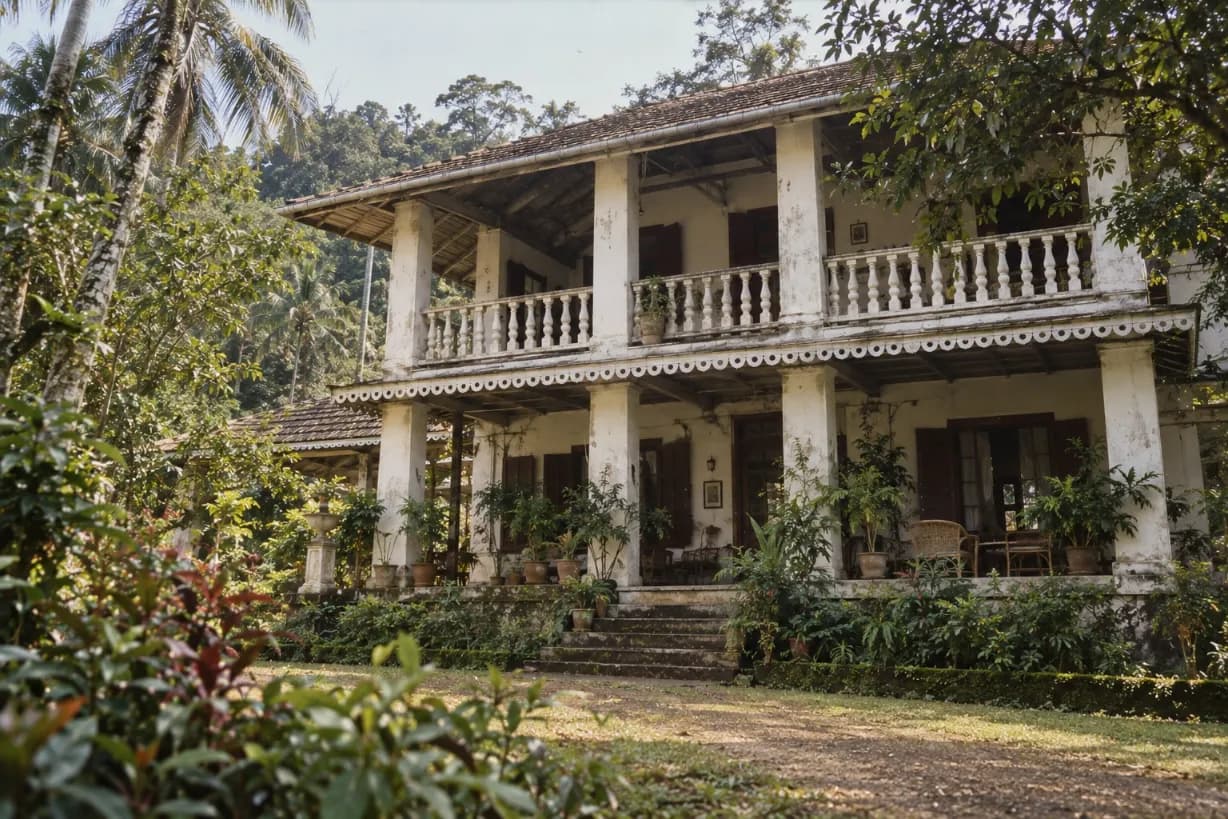
Many surviving planter bungalows have acquired a grandeur that can distort how they were originally lived in.Some certainly became substantial houses, with large gardens, dining rooms, polished furniture and several bedrooms.But comfort varied enormously according to period, estate and rank.An account of an estate household describes a bungalow staff divided between cooking, cleaning, waiting at table and looking after a horse. Such domestic labour made the planter’s lifestyle possible even when his salary was relatively modest.Electricity was not something every planter could assume.In early twentieth-century rubber districts, some bungalows still relied on paraffin lamps. Where an estate factory had its own generator, the superintendent’s bungalow might be connected to it.
Bathing could involve water being carried and heated.Food and household supplies had to come from somewhere.Repairs could not always wait for a tradesman from town.And insects, rats, damp and heavy rain were ordinary inconveniences rather than material for picturesque travel writing.One planter’s recollection of estate life records finishing administrative work in the evening before going to bed at about 9.30, only to contend with mosquitoes, fleas and rats.That is a rather different picture from afternoon tea on the verandah.
Isolation Was Part of the Job
Perhaps the most underestimated feature of planter life was distance.In the early coffee era some bungalows were many miles apart and connected by difficult roads. A visitor writing about Ceylon in the 1850s remarked on the extraordinary informality of planter hospitality: travellers arriving at an estate could expect food, drink and shelter partly because distances and weather made such hospitality necessary.By the tea era, railways and better roads had reduced that isolation considerably.In 1893 it was already possible to describe many important estates as lying within a day’s journey of Colombo by rail and cart road.
But being connected was not the same as being close.A planter still spent most days among the same small group of people.The mail mattered.Newspapers mattered.A visitor mattered.And the club mattered more than its recreational facilities alone would suggest.
Why the Planters’ Club Mattered
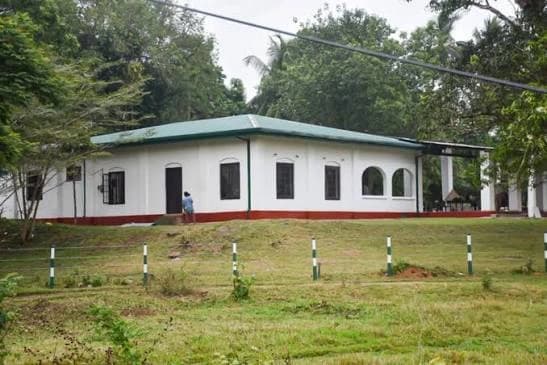
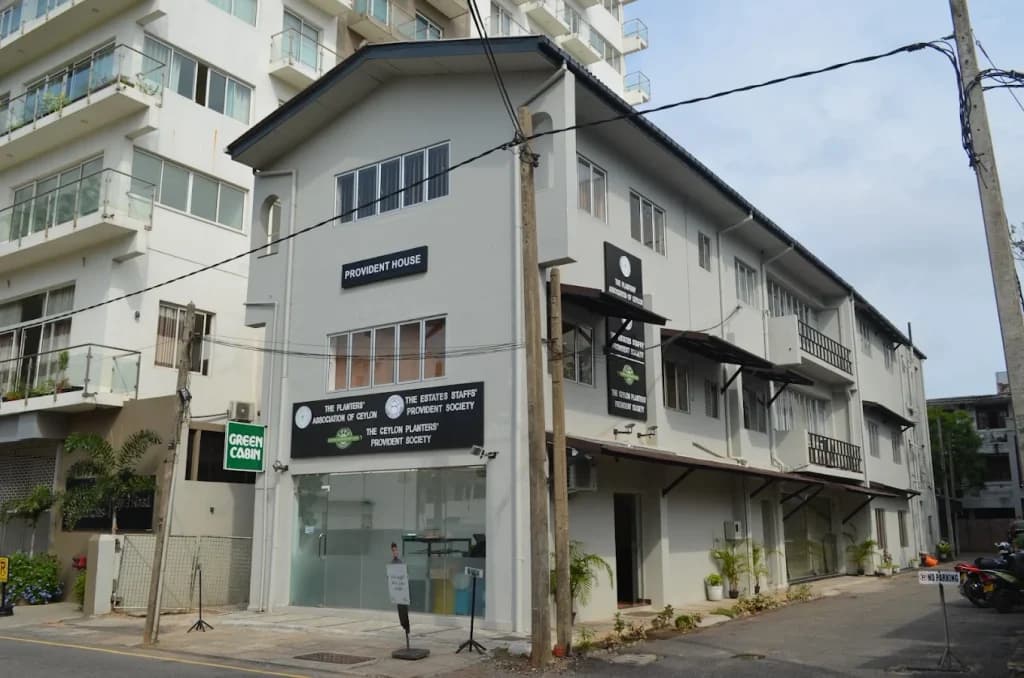
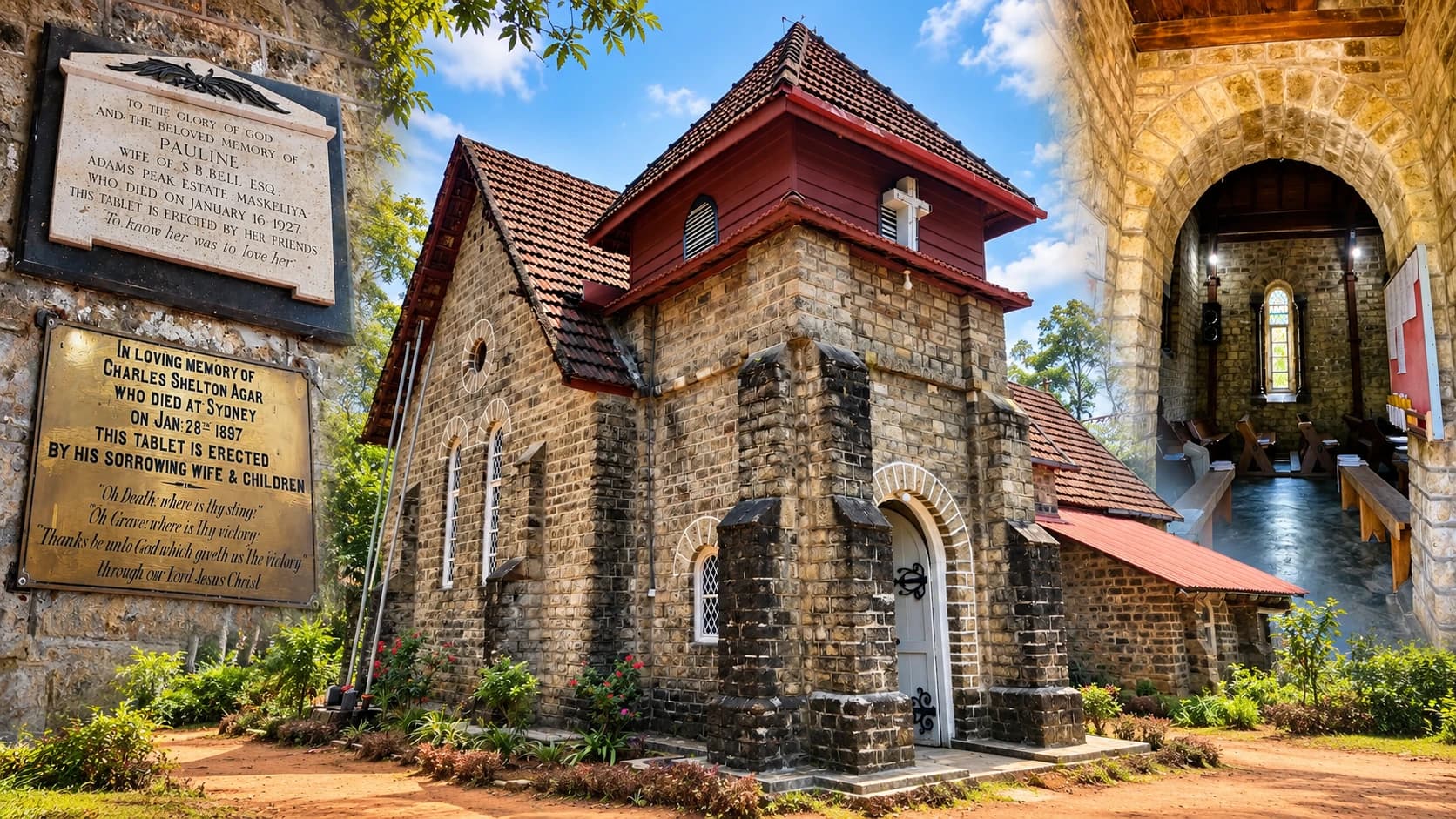
The same kind of planter society could be seen in places such as the Thebuwana Planters’ Club, connected with the rubber-planting districts of the low country. Clubs like this were not only places for sport or evening conversation. They were meeting points for estate owners, superintendents and assistants who otherwise spent much of their time on scattered properties. In districts where estates were separated by distance, rain, poor roads and long working days, the planter’s club became one of the few regular social spaces available to them. It helped turn a working district into a community.
District clubs developed wherever sufficient numbers of planters lived within travelling distance of one another.There was cricket, tennis, golf, drinks and dinners, but the club also solved a practical problem: it provided company.The Planters’ Association itself dated back to 1854, while district organisations later developed across the planting areas. The Dimbulla District Planters’ Association, for example, was founded in 1873.By the early twentieth century, contemporary descriptions could say that planting no longer meant the social exile experienced by some of the earliest coffee pioneers. Sporting and social clubs existed throughout the important districts.A planter might work alone for much of the week and then ride or drive several miles for an evening with neighbours.In some districts that was the social calendar.
Then There Were the Accounts
The romantic version of plantation life usually leaves out the ledger.The real one cannot.Historical recollections describe evenings set aside specifically for estate accounts and correspondence because there had simply been no time to complete them during the working day.Leaf weights, wages, work completed, expenditure, supplies and production all had to become numbers.The planter could spend the morning ankle-deep in wet ground and the evening doing arithmetic.That combination probably comes closer than anything else to explaining the occupation.He was neither simply a farmer nor simply a colonial gentleman.He was managing an agricultural business in difficult country.
And Tomorrow Began at Six Again
There were certainly privileges attached to being a planter in colonial Ceylon.There were bungalows, household staff, horses, clubs and a social position far removed from the lives of the workers whose labour sustained the estates.There was also hard physical routine, professional responsibility and, on remote properties, considerable isolation.Both belong in the picture.Look again at an old photograph of a planter standing outside his bungalow and the house begins to look slightly different.The chimney and verandah tell us where he lived.
They do not tell us where he spent most of his day.At first light he would have been elsewhere , down by the factory or at the morning muster, notebook in hand, with another long round of the estate ahead of him.And by the time he finally returned to the bungalow for breakfast, much of Ceylon had only just begun its working day.
Visit us: https://trippingsrilanka.com/stories