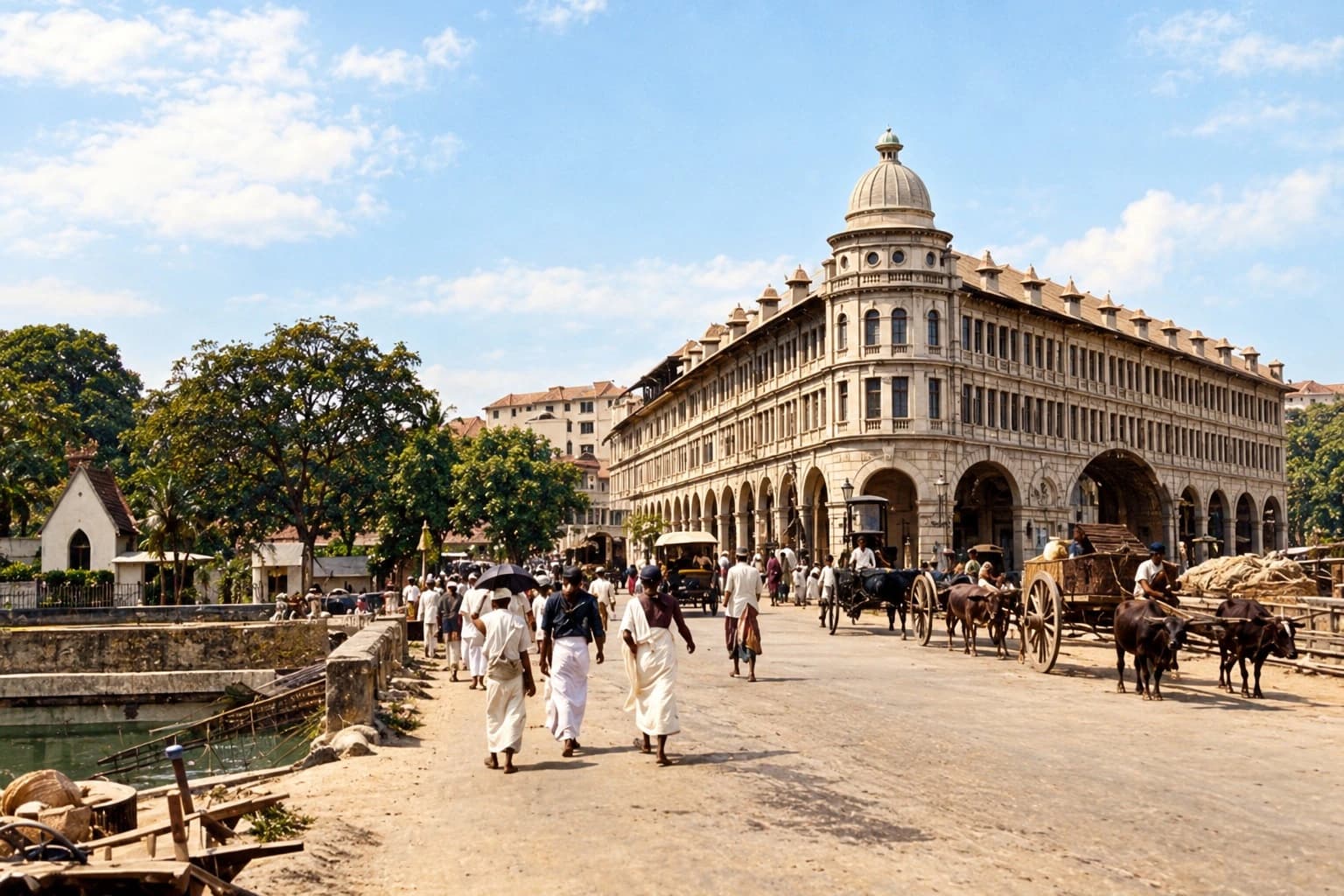
Before bridges and motor vehicles changed the way people travelled, the humble Paruwa carried people, bullock carts and goods across the rivers of Old Ceylon. It was a slower world, where every river crossing had its own rhythm and every journey required a little patience.
An Old Photograph of a River Crossing
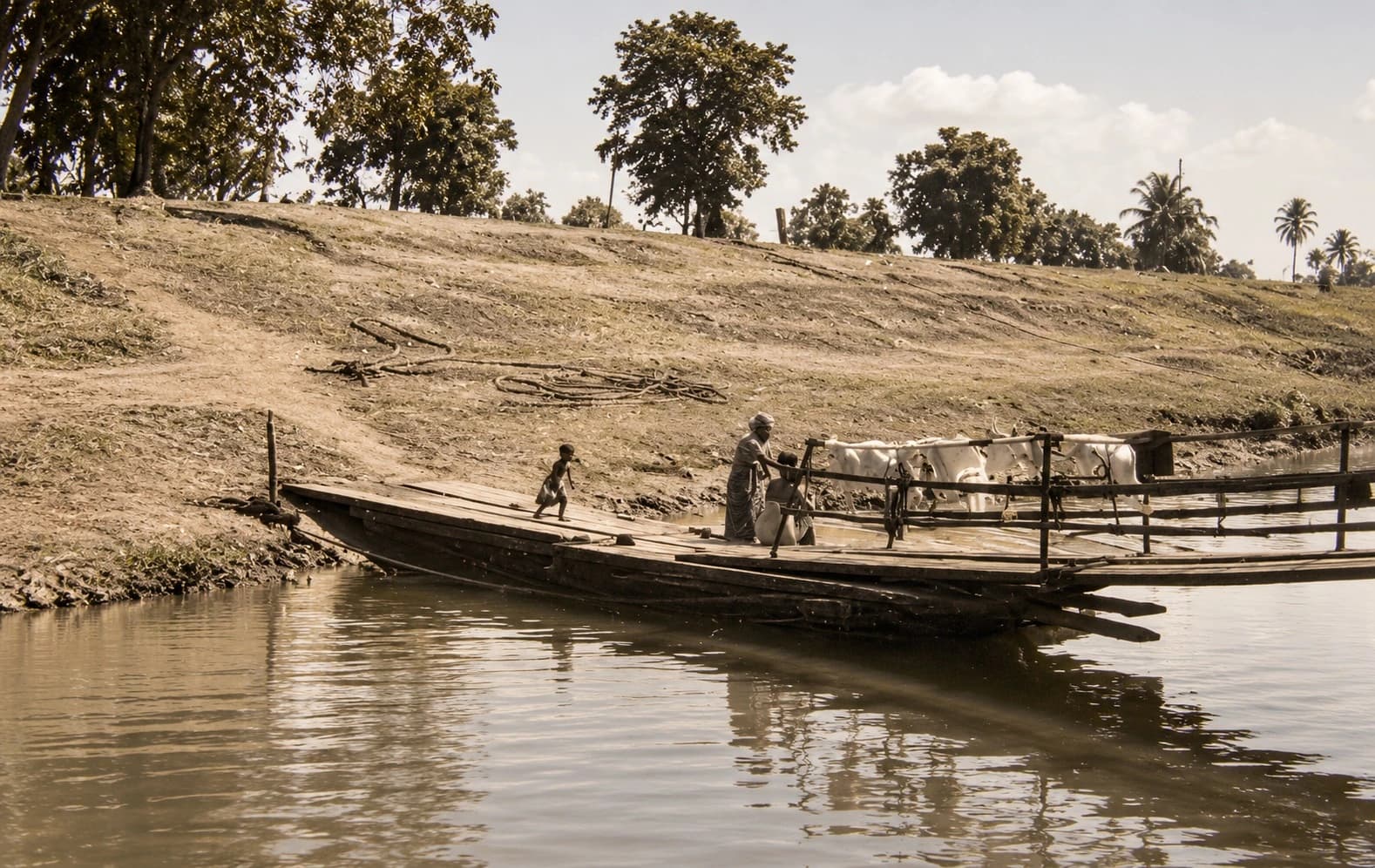
There is something about this old photograph, believed to date from around 1920, that takes us back to a Ceylon we can barely imagine today. A large wooden ferry rests beside a quiet riverbank, with two bullocks standing patiently on its wooden platform while a man attends to them. A child appears to be walking across the deck. Beyond the riverbank, the land stretches out beneath the trees, looking almost empty by today’s standards.
Nothing in the picture suggests that anything extraordinary is happening. There are no crowds, no great ceremony and no important-looking officials. It is simply a moment in the everyday life of Old Ceylon, when a wooden boat could mean the difference between continuing a journey and being stranded on the wrong side of a river.
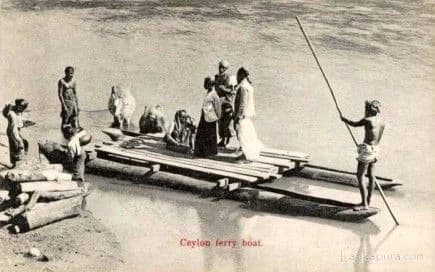
The boat was known as a Paruwa, a traditional vessel that once played an important role in the island’s transport system. Larger flat-bottomed craft were also known as Padda boats, although different types served different purposes. Some carried goods along rivers and canals, while others were adapted to ferry people, animals and carts across waterways.
Today, when we drive across a bridge without even noticing the river beneath us, it is easy to forget how important these humble boats once were.
Read our previous article : https://trippingsrilanka.com/stories/wellawatte-canal
When Crossing a River Was Part of the Journey
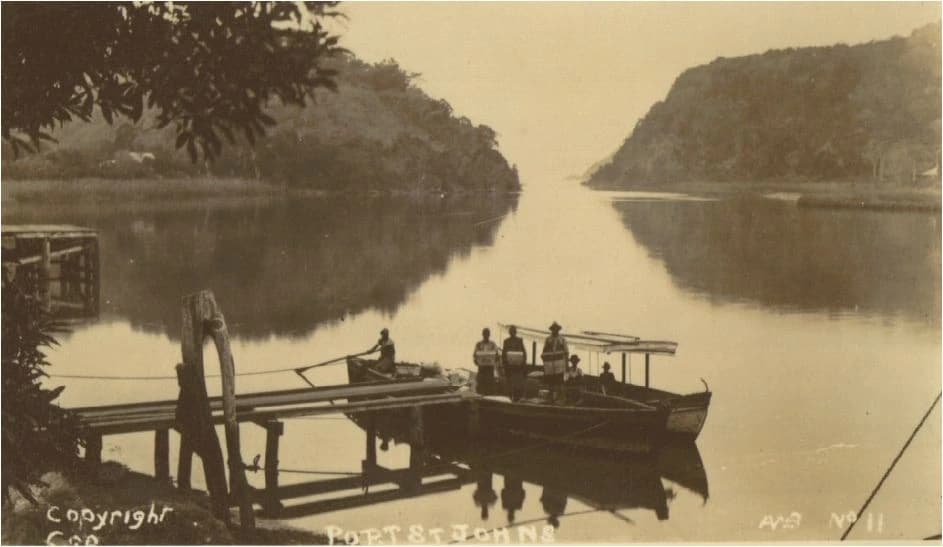
Life in Old Ceylon moved at a very different pace. Roads were fewer, journeys were longer and much of the countryside remained connected by narrow cart tracks and waterways. Although the British had developed roads and railways across parts of the island, many rural communities still depended on older forms of transport well into the twentieth century.
A farmer taking his produce to market might begin his journey before sunrise. His bullock cart would move slowly along dusty roads, passing coconut estates, paddy fields and small villages. The sound of wooden wheels and the steady footsteps of the animals would accompany him for miles. Eventually, he might reach a river where the road simply ended.
There was no bridge waiting for him. Instead, there would be a ferry landing, perhaps with a few other travellers already gathered beside the water. He would have to wait for the Paruwa to arrive, guide his animals towards it and make the crossing before continuing his journey.
It was all part of travelling in those days. Nobody expected to reach every destination quickly. Delays were accepted, and journeys were planned around the conditions of the road, the weather and the availability of transport.
Looking at this photograph, one can almost imagine the quiet conversation between the ferryman and the traveller as they prepared the bullocks for the crossing. Perhaps they had made this journey many times before. Perhaps it was a familiar morning routine that neither thought worth remembering. Yet more than a century later, that ordinary moment tells us something valuable about the way people lived and travelled.
The Wooden Boats That Kept Ceylon Moving
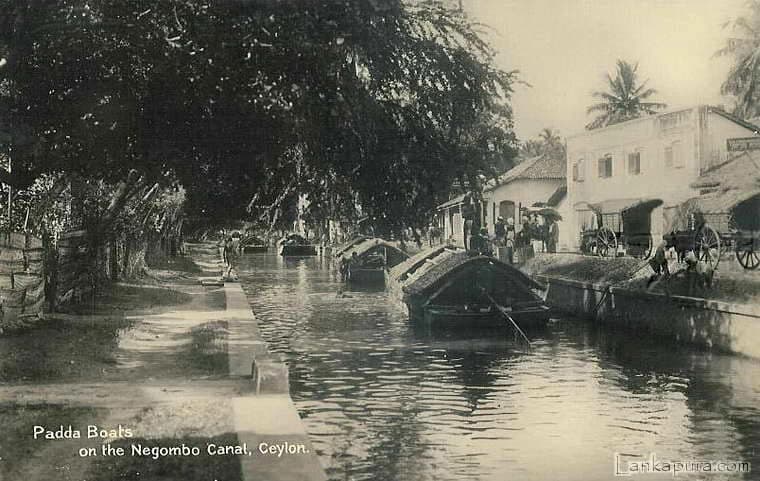
The Paruwa was a practical answer to the difficulties of travelling across water. Unlike a small canoe, a broad ferry could carry heavier loads, provided it was properly constructed and balanced. Its relatively flat form made it useful for transporting goods and, in some cases, animals and carts.
These boats were part of a much older tradition of river transport in Sri Lanka. Long before colonial rule, waterways had helped connect settlements and trading communities. During the Portuguese, Dutch and British periods, rivers and canals continued to serve as important routes for moving agricultural produce and commercial goods.
In the western and southwestern parts of Ceylon, waterways were particularly useful. Boats travelled through canals, lagoons and rivers, carrying coconuts, timber, cinnamon and other products towards markets and trading centres. The canal networks around Colombo and Negombo were once busy commercial routes, long before motor lorries took over much of this work.
Some of the larger Padda boats were fitted with simple coverings made from woven coconut leaves, providing shelter for goods and passengers. They could be moved with poles in shallow water or propelled using other traditional methods, depending on the river and the type of vessel.
It was not glamorous work. Loading and unloading cargo demanded strength, and moving a heavy wooden boat through water could be exhausting. Nevertheless, these vessels supported countless livelihoods.
The photograph reminds us that Ceylon’s transport system was not built entirely around grand railway stations, steam locomotives and colonial roads. Much of the ordinary work of keeping communities connected fell to simple wooden boats and the people who operated them.
The Ferryman and His River
Every Paruwa needed someone who knew the river. The ferryman’s work may have looked simple from the bank, but it required experience that could not be learnt in a day. He had to understand the current, recognise changes in the river’s depth and know where the boat could safely approach the shore.
During periods of heavy rain, a familiar crossing could become dangerous. In dry weather, shallow stretches and exposed riverbeds presented different difficulties. The ferryman needed to judge the conditions before moving passengers, animals or cargo across the water.
Carrying bullocks added another challenge. Animals had to be guided carefully onto the ferry and kept calm during the crossing. A sudden movement could disturb the balance of the vessel, especially when it was heavily loaded. Handling such crossings required patience from both the ferryman and the traveller.
The ferryman would also have known many of the people who used his crossing. Regular traders, farmers and villagers would have become familiar faces. There must have been conversations about the harvest, market prices, village happenings and the changing weather.
For people living near these crossings, the ferryman was an important figure. He helped them reach markets, visit relatives and carry out the many small tasks of daily life. His work was an ordinary but essential part of the community.
We know very little about the individuals in this particular photograph. The man standing beside the bullocks could have been a traveller, a handler or someone helping with the ferry. The photographer did not leave us their names or their stories. They were ordinary people carrying on with their lives, never imagining that someone would still be looking at them a hundred years later.
Where the Riverbank Became a Meeting Place
The old ferry landing, or thotupola, was more than a place where boats arrived and departed. It was part of village life, bringing people together as they waited to continue their journeys. Some arrived with baskets of vegetables or bundles of goods, while others travelled with animals or accompanied family members on visits to neighbouring villages.
There might have been children watching the boats, traders exchanging news and travellers asking about the condition of the roads ahead. In a world without mobile phones or instant messages, news travelled with people. A man returning from town could bring information about prices, an upcoming event or something that had happened in a nearby village.
A few minutes spent waiting beside the river could therefore become an opportunity to catch up on the affairs of the surrounding countryside. People who might otherwise have passed one another without speaking found themselves gathered at the same landing, waiting for the same boat.
One can imagine the sounds that filled these places. The movement of water against the wooden hull, the calls of men handling cargo, the footsteps of bullocks and the occasional conversation drifting across the landing. There would also have been long, quiet intervals when nothing much happened. The river would continue flowing, the boat would make its crossing and life would carry on.
Today, we might call such a place peaceful. For those who depended on it, however, the thotupola was a necessary part of everyday life.
The Songs of the Old Boatmen
The story of the Paruwa is also connected with one of Sri Lanka’s memorable folk traditions, the Paaru Kavi, or boatmen’s verses. Travelling along waterways was often a slow and tiring business. Boatmen might spend hours guiding heavily laden vessels through canals and rivers, sometimes working against the current or pushing their boats through shallow stretches.
Singing helped break the monotony of their work. Their verses drew upon everyday experiences, the difficulties of travel, the places they passed and the people they had left behind. The rhythm of the songs belonged to the world of river journeys, long hours of labour and companionship among boatmen.
Like many forms of traditional folk poetry, Paaru Kavi preserved something of the feelings and experiences of working people whose lives rarely found a place in formal historical accounts. Their words reflected a world in which the river was not merely a feature of the landscape but a place of work, travel and everyday experience.
It is difficult to look at an old Paruwa without thinking of those voices that once travelled across the waterways of Ceylon. The boats may have disappeared from many of their old routes, but the folk verses remain an important reminder of the people who worked on them.
When Bridges Changed the Landscape
As Ceylon’s road network expanded, the old ferries gradually began to lose their importance. Bridges were built across rivers, motor vehicles became more common and goods that had once travelled slowly by water could increasingly be transported by road. The changes made journeys faster and helped connect towns and villages that had previously depended on more difficult crossings.
The transition was not immediate. In some rural areas, ferry crossings continued to operate long after bridges had appeared elsewhere. Even today, traditional boats remain in use in certain waterways, although their role is much smaller than it once was.
For people who had spent years depending on ferries, a new bridge must have been a welcome development. It meant greater convenience, shorter journeys and less uncertainty during bad weather. Travellers no longer needed to wait for a boat or worry about whether a river crossing would be possible.
Yet something of the old riverbank life disappeared along with the ferries. The little gathering places where people waited for boats became less important. The familiar calls of ferrymen faded, bullock carts slowly gave way to motor transport, and the wooden vessels that once carried entire communities across rivers were increasingly left behind.
Progress made travelling easier, but it also changed the character of the places through which people travelled. A river crossing that once required conversation, patience and human effort became a matter of a few seconds behind the steering wheel.
A Photograph of a World That Has Passed
We do not know exactly where this photograph was taken. The river is unidentified, and the people in it remain anonymous. The estimated date of around 1920 gives us a glimpse of the period, but the finer details of the scene have been lost.
Perhaps the bullocks were being taken across to continue a journey along a country road. Perhaps they belonged to a trader transporting goods between villages. The photograph cannot tell us, and it would be misleading to give the scene a more specific history than the available information supports.
What it does preserve is a small piece of ordinary Ceylonese life. The open riverbank, the wooden ferry, the patiently waiting animals and the people going about their work belong to a world that changed enormously during the following century.
Much of the history we read concerns governors, kings, wars, railways and impressive buildings. Yet the story of a country is also found in such modest scenes. It is found in the farmer who left home before dawn, the ferryman who worked through the changing seasons and the child who watched the great wooden boat moving across the river.
The Paruwa may never have been considered a symbol of progress or prestige. It was built to perform a simple task, and it performed that task for generations. Without such boats, countless ordinary journeys would have been far more difficult.
When Ceylon’s Rivers Were Roads
Perhaps that is why this photograph deserves another look. It reminds us of a time when a journey was not measured only by the distance travelled, when people knew the river as well as they knew the road, and when a wooden ferry quietly connected one part of Ceylon with another.
The rivers are still there, and many of the roads now pass above them. People cross bridges without stopping to think about the boats, ferrymen and travellers who once depended on the water below. The crossings that were once important gathering places have gradually disappeared from everyday memory.
But the old Paruwa, with its bullocks, boatmen and patiently waiting travellers, belongs to a Ceylon that survives in photographs, memories and the stories we continue to tell. What was once an ordinary way of crossing a river has become a small but revealing chapter in the history of how the island travelled.
Visit Us: https://trippingsrilanka.com/stories
More from Old Ceylon
When Colonial Fashion Changed the Ceylonese Bride: From Lace Veils to Victorian Gowns
Armour Street: The Colombo Road That Still Carries an Old Name