The Fading Charm of Sri Lanka’s Colourful Letter Boxes
A Familiar Sight Slowly Disappearing
There are certain things from the past that disappear quietly. They do not vanish in a single day. Instead, they slowly move out of our daily lives until one morning we suddenly realise that we have not seen them in years. Sri Lanka’s old letter boxes are one such memory.
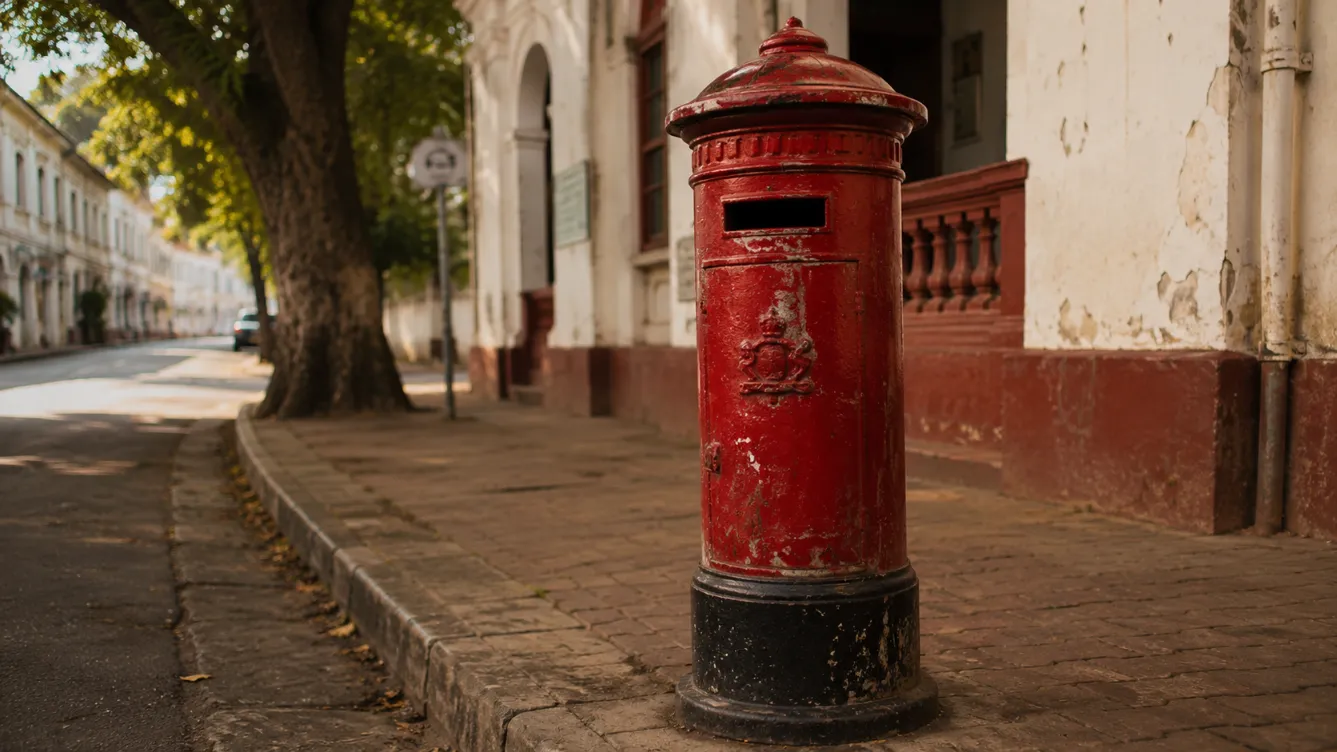
Once, almost every busy junction, town centre, post office entrance and roadside corner had a familiar red letter box standing patiently. It was not just a metal box. It was a small public promise. If you dropped a letter into it, that message would travel across villages, towns, districts and even oceans. Today, those old letter boxes are becoming rare sights. Most people pass them without noticing. Some younger people may not even know how important they once were.
Sri Lanka’s postal service has a history of more than 200 years, with its origins going back to the late 18th century during colonial rule. The Department of Posts records that postal activity began in 1798, when the Dutch established five post offices in the maritime districts. Later, under British administration, the service expanded and became a vital part of public life.
Before Messages Became Instant
Today, communication is instant. A birthday wish, business update, bank notice, love message or family photograph can be sent within seconds through WhatsApp, email or social media. But before mobile phones and the internet, letters carried emotions that could not be rushed.
People waited for letters. They looked forward to the postman’s arrival. In villages, the sound of the postman’s bicycle bell was enough to make someone step outside. A letter from a son working in Colombo, a daughter studying abroad, a relative in another district or a loved one far away could change the mood of an entire household.
The letter box was the beginning of that journey. It stood there silently, receiving everyone’s stories.
The Letter Box and Old Romance
There was a time when love often travelled by post. Young men and women wrote carefully folded letters, sometimes in beautiful handwriting, sometimes with pressed flowers, poetry or secret words only the receiver would understand. Posting a love letter was not a casual act. It carried nervousness, hope and excitement.
For many young people, the morning began with one question: “Has the postman come?” The postman was not just a government employee. He was the messenger of emotion. In some villages, he knew who was waiting anxiously, who received letters often, and whose face would light up when an envelope arrived.
There are even stories of young postmen marrying women from the villages they served. Whether every story is true or not, they show how deeply the postal system was woven into everyday life.
A Box for Every Kind of Message
The old letter box was useful to almost everyone. People used it to send personal letters, postcards, official forms, greeting cards and money order-related documents. Schoolchildren wrote to pen friends. Radio listeners sent postcards requesting songs. Newspaper readers sent letters to publish their details in friendship columns. Fans wrote to actors, actresses and singers. Families sent Vesak cards, New Year greetings and wedding invitations.
Before online forms and digital applications, the post was a lifeline. It connected the city to the village, the migrant worker to the family, the student to the institution, and the lover to the beloved.
Even a simple postcard had meaning. It did not need many words. A few lines were enough: “I am well. Hope you are well too.” That was how people maintained relationships across distance.
The Colours People Remember
Most people today remember the red letter box. Red became the strongest visual symbol of the postal system. But older generations still remember that there were once letter boxes in different colours. Red, green and blue boxes could be seen in certain places, especially in Colombo.
According to the memory preserved in the original Sinhala account, green letter boxes were used for letters within Colombo, red boxes for local letters going outside Colombo, and blue boxes for foreign mail. The Sunday Times has also noted that although Sri Lankan post boxes are mostly red, green and blue ones still exist, and that some of the oldest post boxes are displayed at the Postal Department’s head office in Colombo.
These colours made the postal system feel organised and almost ritualistic. A person had to know where the letter was going before choosing the correct box. It added a small but memorable action to the process of sending a message.
The General Post Office and Colombo’s Postal Memory
One of the most significant places connected with Sri Lanka’s postal heritage is the old General Post Office building in Colombo Fort. Located on Janadhipathi Mawatha, opposite the President’s House, the building became one of the great landmarks of colonial Colombo.
The Department of Posts records that the General Post Office acquired its own building in 1895 on King’s Street, now known as Janadhipathi Mawatha. The former GPO was not just a post office. It was once the centre of Sri Lanka’s communication network, linked to postal work, telegraphy and later telephone services. Roar Media notes that the building opened for operations in July 1895 and remained central to the postal service for more than a century.
Near the entrance of this historic building, old letter boxes still stand as reminders of another age. Their presence is powerful because they are not merely decorative objects. They are witnesses to thousands of private stories that once passed through Colombo’s postal system.
From Public Necessity to Heritage Object
The reason these letter boxes feel nostalgic today is simple: their purpose has changed. In the past, they were essential. Now, they are mostly heritage objects. Personal letters have nearly disappeared. Bank statements, government notices and official documents still arrive by post, but even those are gradually moving online.
A letter box that once received love letters, job applications, radio postcards and family news may now stand unused for long hours. Its silence says something about how much society has changed.
But that does not make it irrelevant. In fact, it becomes more meaningful. It reminds us of a slower world where people took time to write, wait and respond. It reminds us that communication once required patience.
Why These Letter Boxes Matter
Old letter boxes should not be seen only as roadside metal boxes. They are part of Sri Lanka’s public memory. They belong to the history of communication, romance, administration, migration, education and family life.
They also carry design value. Their shapes, royal insignia, cast-iron details, colours and placement tell us about the periods in which they were made. Some were installed during colonial rule. Some came later. Some still carry marks of older administrative systems.
When we preserve them, we are not only preserving postal equipment. We are preserving the everyday history of ordinary people.
A Quiet Goodbye to a Slower World
The colourful letter boxes of Sri Lanka tell a story of change. They remind us of the days when people chose paper, folded it carefully, sealed it, wrote an address by hand and walked to a letter box with hope.
Today, messages move faster. But they often feel lighter. The old letter had weight. It had handwriting, scent, delay and anticipation. It could be kept in a drawer for years. It could be read again and again.
So the next time you see an old red, green or blue letter box, pause for a moment. It may look silent, but it has carried more stories than most of us can imagine. It is not just a forgotten object on the roadside. It is a small monument to a time when communication had patience, emotion and a little more soul.