The Strange Machine That Once Followed Tractors Through Ceylon’s Tea Estates
Ceylon tea estate machinery | There are plenty of things from the old tea estates that have disappeared without much notice.
This rather ungainly machine is one of them.
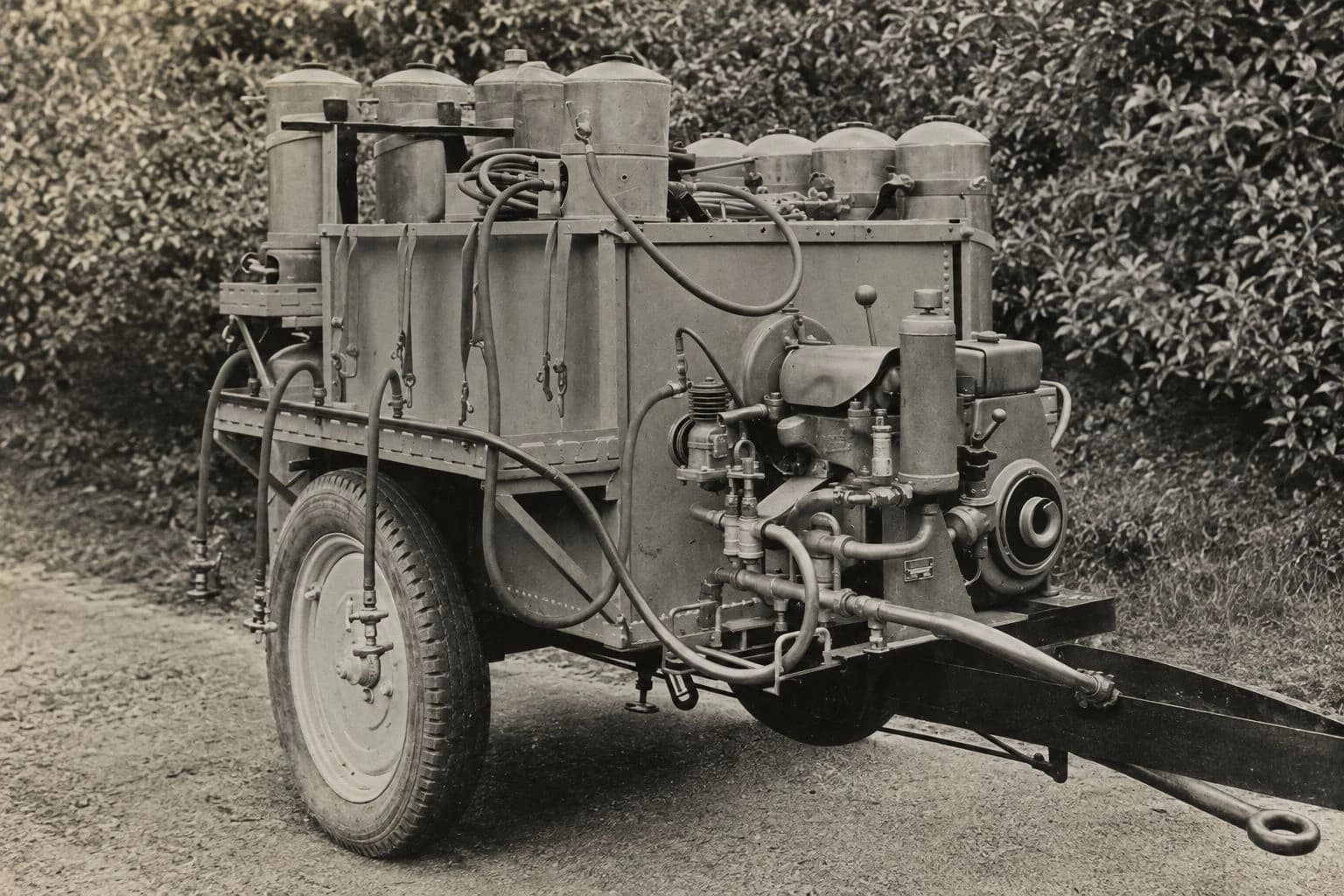
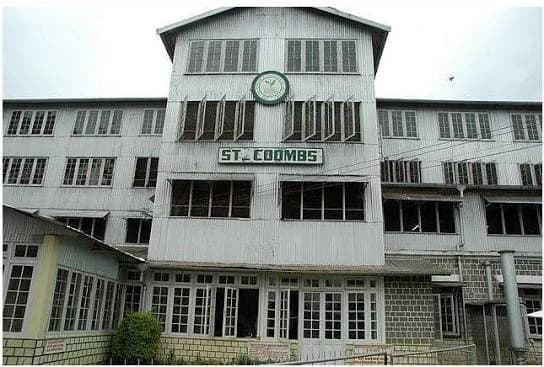
It was photographed at St. Coombs, and at first glance it is difficult to work out exactly what you are looking at. There is a tank, an engine, a collection of hoses and valves, all mounted on wheels so that the whole contraption could be pulled behind a tractor.
Its job was to charge the knapsack sprayers used on the estate.
And those sprayers have a story of their own.
Read our previous article: https://trippingsrilanka.com/stories/johnsons-note-book-for-tea-planters
Before the Plastic Knapsack
The familiar agricultural sprayer today is a fairly simple affair.
Older Ceylon estates had something considerably heavier.
Brass knapsack sprayers were carried by workers through the tea fields for spraying. Instead of repeatedly working a hand pump, sprayers could be brought to a power-operated charging unit such as this one, pressurised and then taken out into the field.
The old photograph describes this as the new power charging unit at St. Coombs, suggesting that, when the picture was taken, this was itself a modern improvement.
It is an interesting thought.
What looks thoroughly antiquated to us was once the new piece of equipment on the estate.
A Machine Made for Estate Work
The machine was not elegant.
It was not meant to be.
It belonged to the practical world of the estate yard, where usefulness mattered more than appearance. The tank, engine, hoses, valves and wheels were all there for one reason: to keep work moving in the fields.
On a tea estate, spraying was not a small matter. Fields had to be covered, workers had to move across slopes, and equipment had to be ready when needed.
A machine like this helped speed up the process.
The sprayers could be charged, taken into the field, used, and brought back again.
It was a simple idea, but on a large estate it would have made a difference.
A Different Side of the Tea Country
Old photographs of Ceylon’s tea districts tend to show us the attractive parts.
A bungalow above a valley.
Tea stretching across a hillside.
A factory beside a winding estate road.
Perhaps a planter standing beside a motorcar.
There was another side to estate life that was far less photographed.
Workshops smelled of oil and grease. Tractors hauled machinery over rough estate roads. Pumps had to be repaired. Engines refused to start. Pipes leaked. Parts wore out.
On an isolated estate, things also had to last.
Equipment was repaired and repaired again because replacing it was not always simple. Estate workshops became remarkably good at keeping old machinery alive, sometimes long after its expected working life.
This charging unit belongs to that world.
The Estate Workshop World
Every old estate had its working corners.
Places where tools were kept, engines were opened up, tyres were changed, pipes were patched and machinery waited for attention.
These spaces rarely appear in the romantic memory of Ceylon tea.
Yet they were essential.
A tea estate could not run only on green hills and beautiful views. It needed people who knew how to repair things. It needed mechanics, drivers, field staff, labourers and workshop hands who could keep equipment moving in difficult country.
A machine like this would have been part of that daily background.
Not famous.
Not beautiful.
But necessary.
It would have followed a tractor along estate roads, been parked near the fields, used when needed and then brought back again to wait for the next round of work.
Then Someone Put Flowers in It
The nicest part of the story comes much later.
The brass knapsack sprayers eventually became obsolete. Some apparently spent years lying forgotten in estate junk rooms.
But brass is brass, and somebody evidently decided they were too good to throw away.
A number of the old tanks were cut open and turned into flower vases.
Some, according to the recollection accompanying this photograph, could still be found in estate bungalows.
It is easy to imagine one without knowing what it was: an unusually heavy brass container standing on a verandah, perhaps polished occasionally, with flowers coming out of the top.
Few people seeing it would think of a worker once carrying it through rows of tea.
When Working Objects Become Household Objects
This is one of the strange ways old estate life survives.
Something that began as a working tool ends up inside a bungalow.
Its original use is forgotten, or half-remembered. It becomes decorative. Someone puts flowers in it. Someone else asks where it came from. A vague answer follows.
“Old estate thing.”
That is often how memory works.
Not everything is preserved in museums. Not everything is labelled. Sometimes an object survives because it was strong, useful, unusual or simply too good to throw away.
The brass knapsack sprayer became one of those objects.
It moved from the field to the storeroom, from the storeroom to the verandah, and from work into memory.
The Things That Survive by Accident
There must still be objects like this scattered around Sri Lanka.
Old estate bells.
Tea chests.
Measuring equipment.
Lamps.
Factory tools.
Account books.
Planters’ manuals.
Bits of machinery whose original purpose nobody in the house can quite explain.
They survived not because anyone decided they were historically important, but because they remained useful, attractive or simply too well made to discard.
Sometimes that is how the past manages to hang around.
Quietly.
Without a plaque.
Without anyone making a great fuss over it.
Ceylon Tea Estate Machinery| Why This Machine Matters
The great factories and famous estates naturally found their way into histories of Ceylon tea.
A machine used to charge brass knapsack sprayers did not.
But that is exactly why it is interesting.
It reminds us that estate history was not only made in boardrooms, bungalows and auction rooms. It was also made in sheds, workshops, fields and rough estate roads.
For somebody who once worked on an estate, the sight of one of these machines might bring back something much more immediate.
The tractor on the estate road.
The noise of the little engine.
The smell of fuel.
The hoses being handled.
The brass sprayers waiting to be charged.
Another day’s work among the tea beginning.
Final Thoughts
Old Ceylon is easy to romanticise from a distance.
Tea hills, mist, bungalows and factories all lend themselves to nostalgia.
But sometimes the more honest memory sits in a strange machine like this one.
Awkward, practical, slightly ugly and built for work.
It followed tractors through estate roads, helped charge heavy brass sprayers and belonged to a working world that rarely paused to explain itself.
Now, if we are lucky, a photograph survives.
A few old sprayer tanks may survive too, perhaps standing somewhere as flower vases, their original purpose mostly forgotten.
And from those fragments, another small piece of Ceylon’s tea estate life comes back into view.
Visit us: https://trippingsrilanka.com/stories