Johnson’s Note Book for Tea Planters: The Handbook That Ran an Estate
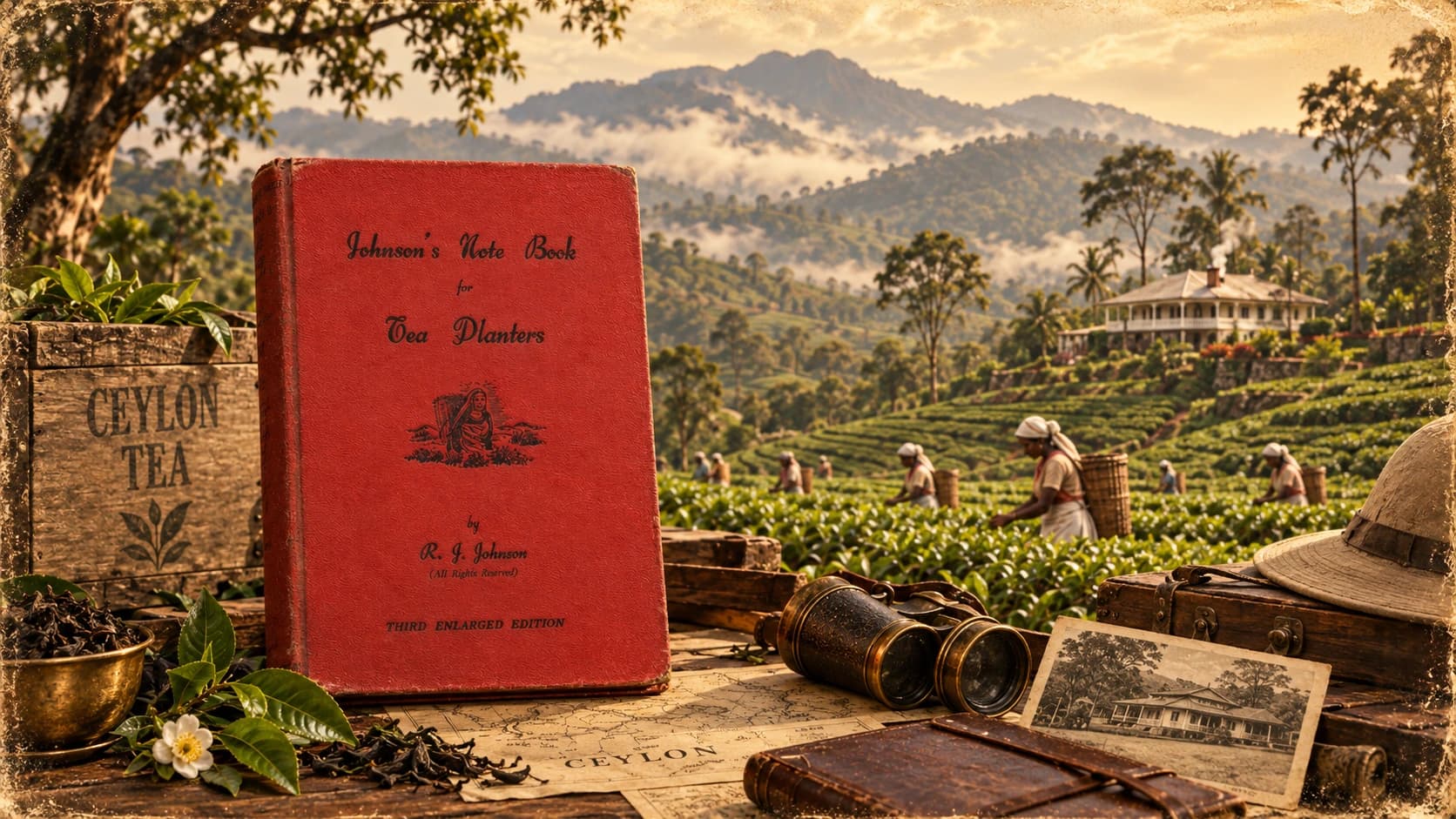
Johnsons Note Book for Tea Planters| Long before estate managers carried smartphones, opened spreadsheets or received weather reports by email, much of the knowledge needed to run a tea estate could be found inside a sturdy clothbound book.
Its title was simple: Johnson’s Note Book for Tea Planters.
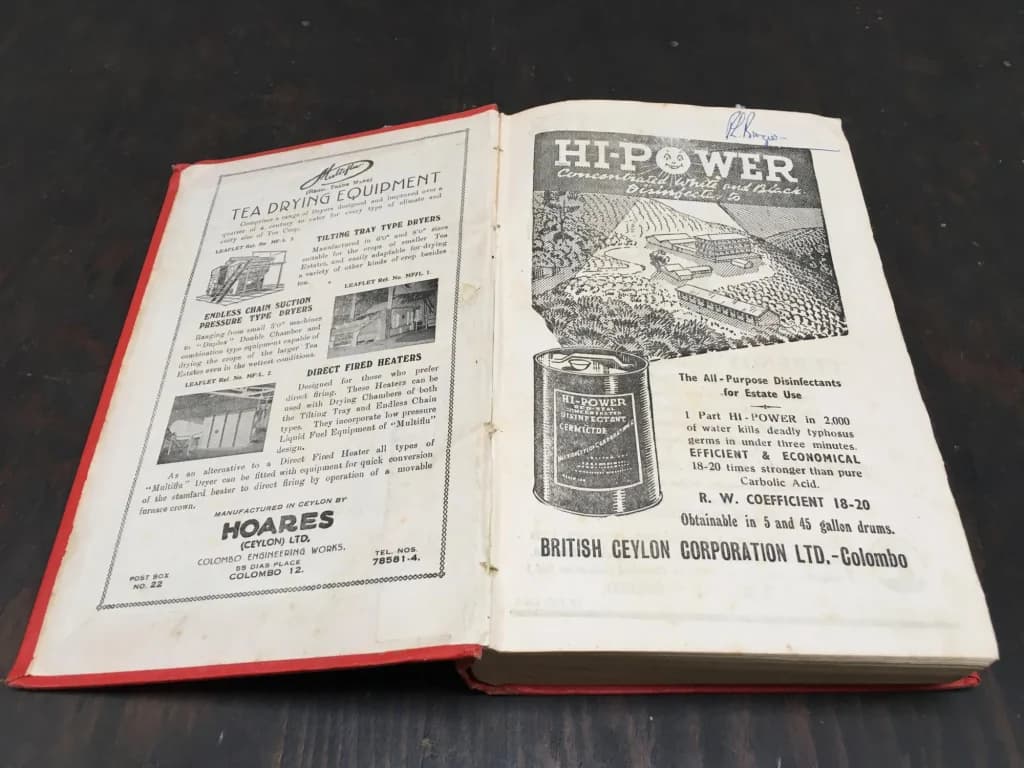
The faded red cover may appear unremarkable today. Yet this was no ordinary notebook. It was a working manual designed for men responsible for keeping a tea estate alive, productive and profitable.
It covered the planter’s world from the soil beneath the tea bushes to the figures entered in the estate accounts. For a generation working in remote plantation districts, it was the sort of book that remained close at hand not displayed neatly on a shelf, but opened, consulted and carried back into the field.
Read our previous article- https://trippingsrilanka.com/stories/oonankande-estate-ceylon
A Working Book, Not a Romantic Memoir
Much of the surviving literature about plantation-era Ceylon recalls bungalow verandahs, misty hills, evening drinks and long journeys along winding estate roads.
Johnson’s book belonged to the less romantic side of that world.
It dealt with the actual work.
Tea planting was never simply a matter of placing bushes across a hillside and waiting for the harvest. An estate manager needed to understand soil, drainage, shade, pruning, plucking, pests, labour, factory production, tasting, record-keeping and finance.
A mistake in any one of these areas could affect the quality of the tea or the survival of the estate itself.
The fuller description of the third enlarged edition presented the book as a guide to tea planting, manufacture, tasting, estate bookkeeping and accountancy. At nearly 500 pages, it attempted to place an entire profession between two covers.
R. J. Johnson and the World Behind the Book
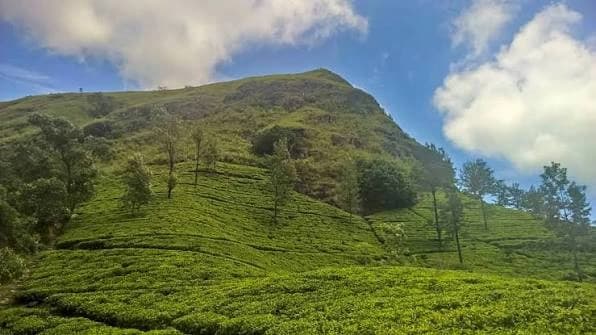
The handbook was written by R. J. Johnson, a planter associated in accounts of the book with the Monerakande Group in Koslanda.
Koslanda lies within one of Sri Lanka’s most dramatic plantation landscapes. The country here descends from the highlands towards the plains, creating steep slopes, deep valleys and sudden changes in climate. Managing an estate in such country demanded close observation and practical judgement.
Johnson appears to have written for people who understood this reality.
His readers did not need a decorative account of plantation life. They needed answers they could apply when rain damaged a road, a field showed signs of disease, factory results declined or the estate books failed to balance.
The handbook translated knowledge acquired through years of plantation work into a form that another manager, assistant or trainee could use.
The Planter as Agriculturalist
The old estate manager had to read the landscape.
He watched the colour and condition of the leaves. He examined the soil after heavy rain. He judged whether drains were carrying water safely away or allowing it to cut into the hillside. He considered the age of each field, the pruning cycle and the growth expected during different periods of the year.
Tea demanded constant attention.
Bushes had to be maintained at a workable height. Fields had to be divided and monitored. Shade trees needed management. Weeds, pests and plant diseases could not be ignored. Rainfall helped the crop, but too much water could bring erosion and disrupt estate work.
A handbook such as Johnson’s offered a shared body of practical knowledge. It helped turn experience often passed verbally from one planter to another — into written instruction.
From Green Leaf to Finished Tea
The planter’s responsibility did not end when the leaves reached the factory.
Freshly plucked leaf began changing from the moment it was removed from the bush. Delays, rough handling or poor factory control could reduce its value. The manager therefore needed to understand every stage through which it passed.
Withering reduced moisture. Rolling disrupted the leaf and prepared it for oxidation. Careful control of time, temperature and humidity helped create the desired character. Drying stopped the process, after which the tea was sorted and graded.
Tea tasting then revealed what the machinery and the eye could not fully explain.
A cup might expose uneven manufacture, excessive heat, poor leaf, contamination or incorrect timing. Tasting was therefore not merely a refined ritual performed in Colombo. It was part of production control.
Johnson’s inclusion of both manufacture and tasting suggests how broad the planter’s role had become by the middle of the twentieth century. The manager had to understand the field, factory and cup as parts of one continuous process.
The Estate Office After Sunset
The working day did not necessarily finish when the last field round ended.
There were wages to examine, crop figures to record, supplies to monitor and correspondence to answer. Factory output had to be compared with the quantity of green leaf received. Expenditure had to be controlled. Labour, transport and maintenance all generated records.
Estate bookkeeping was essential because a plantation was both an agricultural property and a business.
The account books revealed whether the apparent success seen in the fields was producing a sound financial result. A healthy crop could still be undermined by poor management, excessive costs or wasteful factory practices.
This is what makes Johnson’s handbook especially interesting. It did not separate the romance of planting from the arithmetic behind it. Tea was a crop, a manufactured product and an export commodity. The person in charge had to understand all three.
A Book Passed Between Generations
The existence of enlarged editions tells its own story.
Technical handbooks are expanded when readers continue to find them useful and when a changing industry demands new information. A third enlarged edition was published in 1955, while a fourth enlarged edition followed in 1961.
The pictured volume is marked “Third Enlarged Edition”. Its worn lower edge and softened cloth cover give it the appearance of a book that may have served its purpose well.
Copies could move between planters, remain in bungalow libraries or pass to younger assistants beginning their careers. Marginal notes, stains and folded corners — when they survive — can be as revealing as the printed text. They show where general instruction met the conditions of a particular estate.
Such books became unofficial repositories of professional memory.
The Knowledge Beyond the Bungalow
Although the title addresses tea planters, the knowledge that sustained an estate was never produced by one person alone.
Field officers understood the condition of individual divisions. Factory workers recognised changes in leaf and machinery. Clerks maintained the records upon which management depended. Tea pluckers knew the bushes through daily contact and could often identify subtle changes in growth.
Mechanics, drivers, carpenters, drain cutters and road workers kept the estate functioning.
A printed handbook may have formalised the manager’s responsibilities, but the estate itself depended on accumulated knowledge held across its workforce. The history of plantation expertise must therefore extend beyond the author’s desk and the manager’s bungalow.
That wider human story gives the book greater meaning. It represents a system of management, but it also points towards the many people whose skill made that system work.
A Glimpse of Koslanda’s Forgotten Plantation World
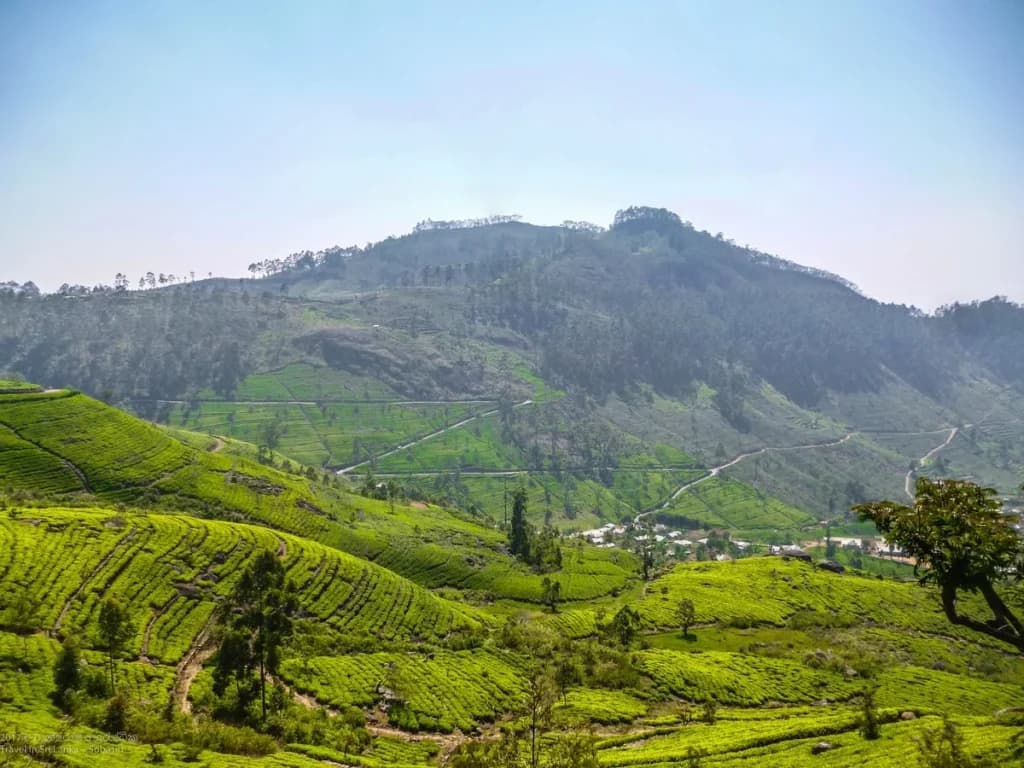
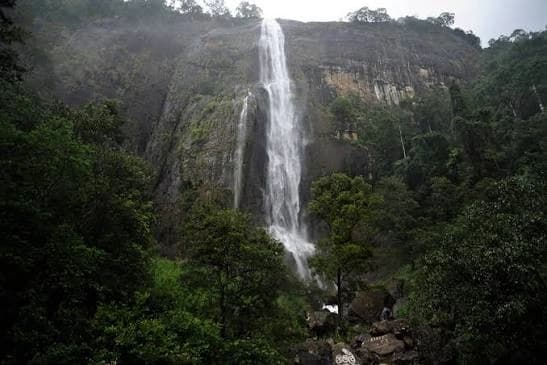
The reported connection between Johnson and Monerakande gives the book a geographical atmosphere of its own.
Koslanda is not the polished “Little England” landscape often associated with Nuwara Eliya. It feels wilder and more transitional. Mountain roads move through forest, estate country and open views towards the lowlands. Mist can settle over the slopes before suddenly lifting to reveal enormous distances.
To imagine Johnson working there is to imagine a desk inside an estate office, perhaps crowded with field reports, rainfall figures, wage records and production sheets. Outside lay the practical problems that filled his book.
The handbook may have travelled far beyond Koslanda, but a landscape like this helps explain why it was written. Isolation made self-reliance important. A planter could not always wait for expert help to arrive. The estate required decisions every day.
Johnsons Note Book for Tea Planters| Why This Old Handbook Still Matters
Today, plantation management uses scientific research, digital records, laboratory analysis, modern forecasting and more advanced machinery. A single mid-century manual can no longer serve as a complete guide to the industry.
Its historical value, however, has grown.
Johnson’s Note Book for Tea Planters shows us how knowledge was organised and circulated across South Asian tea country. It reveals the range of skills expected from an estate manager and the extraordinary complexity hidden behind an everyday cup of tea.
It also preserves something that buildings cannot: the working mind of the plantation era.
Old factories reveal how tea was processed. Bungalows reveal how managers lived. Estate roads reveal how people and produce moved across the hills. A manual like Johnson’s reveals what a planter was expected to know.
More Than a Faded Red Cover
The worn book in the photograph is easy to overlook.
It lacks the grandeur of an old planter’s bungalow or the visual beauty of a mist-covered estate. Yet it carries a more intimate kind of history. Its pages belong to early mornings in the fields, long hours inside factories and quiet evenings spent checking figures in an estate office.
It recalls a time when running a tea plantation required observation, memory, discipline and a remarkable breadth of practical knowledge.
Johnson’s Note Book for Tea Planters was created to answer the everyday questions of that demanding world. Decades later, it allows us to see beyond the scenery of Ceylon’s tea country and into the careful, complicated work that kept it running.
Visit Us: https://trippingsrilanka.com/
More from Old Ceylon
When the King’s Birthday Was Celebrated on Galle Face Green: A Glimpse of Colombo in 1933
Holyrood Estate, Talawakelle: An Old Ceylon Bungalow and a Name That Echoes Scotland