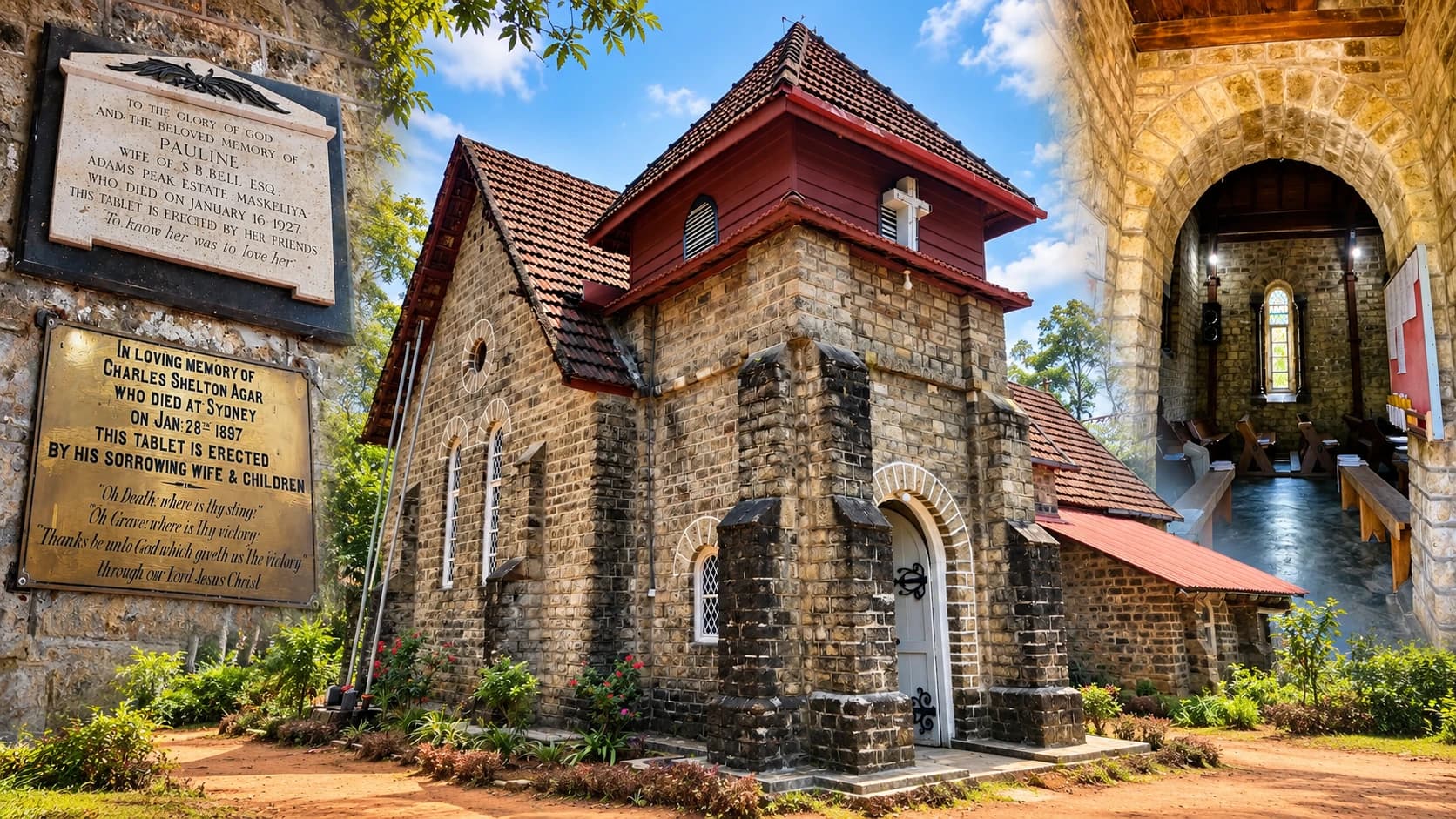
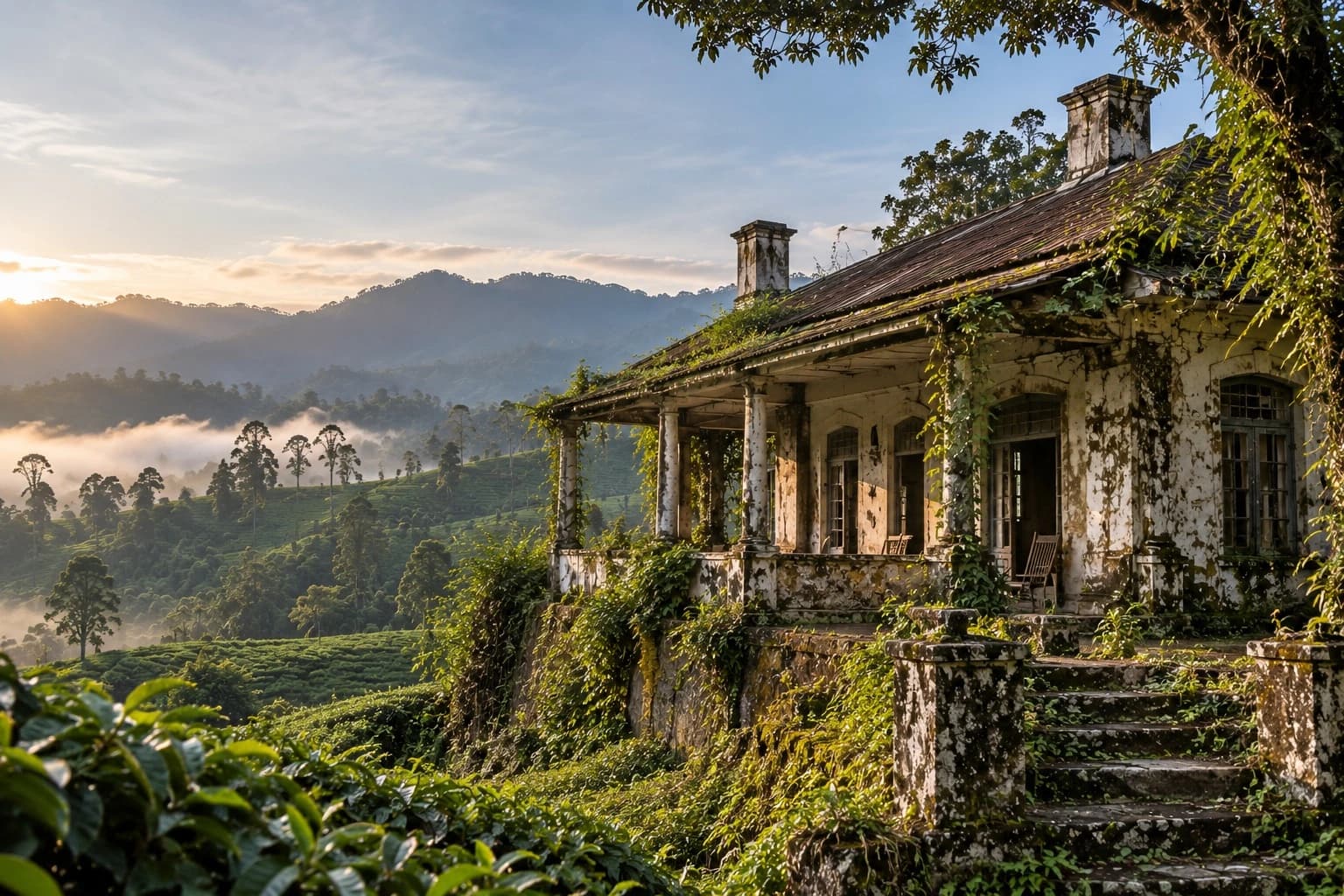
Forgotten tea estate bungalows | Beyond the railway stations, viewpoints and neatly clipped tea fields of Sri Lanka’s hill country, another landscape survives almost unnoticed.Old estate roads disappear into the vegetation. Factory buildings stand silent.
Stone walls emerge through ferns and lantana. And, on isolated hillsides, the remains of planter’s bungalows can still be foundSome have survived remarkably well. Others have lost roofs, verandas and entire wings.
A few are little more than foundations hidden beneath the undergrowth.
These forgotten houses tell a different story of Sri Lanka’s tea country , one that goes beyond the familiar postcard image of green plantations and mist-covered mountains.
When the Hill Country Was Coffee Country
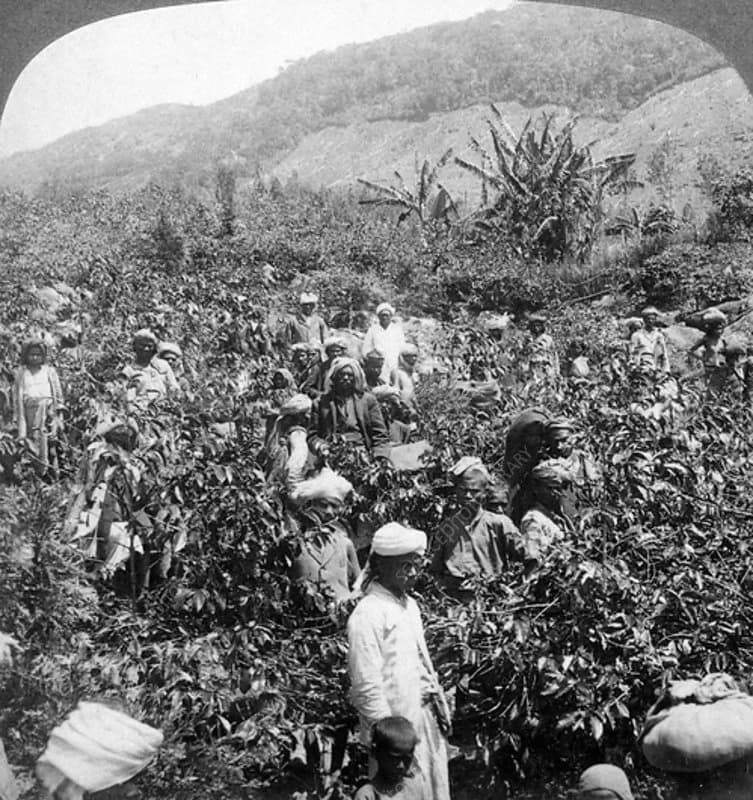
Long before tea became synonymous with Ceylon, coffee dominated much of the plantation economy.
Commercial coffee cultivation expanded rapidly during the nineteenth century, transforming large areas of the central highlands. Roads were opened, estates established and an entire plantation economy developed around the export crop.
Then came disaster.
Beginning in the late 1860s, coffee leaf disease caused by Hemileia vastatrix spread through Ceylon’s plantations. The industry declined dramatically over the following years, forcing estate owners to look for alternatives.
Tea proved to be the answer.
By the closing decades of the nineteenth century, tea cultivation was spreading through the highlands. Estates required factories, labour quarters, offices, roads and accommodation for their managers. The planter’s bungalow became one of the most recognisable buildings within this landscape.
Read our previous article: https://trippingsrilanka.com/stories/coffee-blight-of-ceylon
A House at the Centre of an Estate
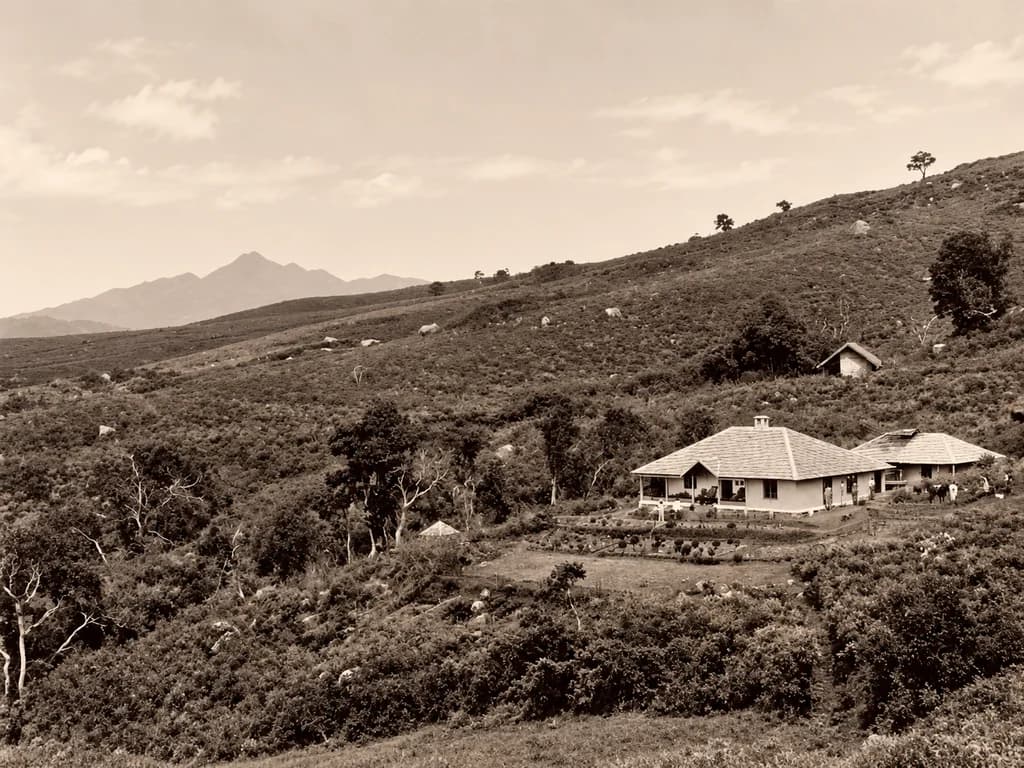
The bungalow was more than simply a residence.
It usually occupied a prominent position overlooking the plantation, separated from the factory and workers’ housing. Its location reflected the social structure of the estate itself.
Although no two properties were identical, many shared architectural features suited to life in the cooler highlands: broad verandas, fireplaces, high ceilings, substantial masonry walls and large gardens.
Some were relatively modest houses. Successful estates could have considerably grander residences, complete with formal dining rooms, guest bedrooms, servants’ quarters and extensive grounds.
Today, restored examples survive as private homes, hotels and heritage properties.
The abandoned ones are different.
They show what happens when the economic purpose that sustained a building disappears.
Why Were Some Bungalows Abandoned?
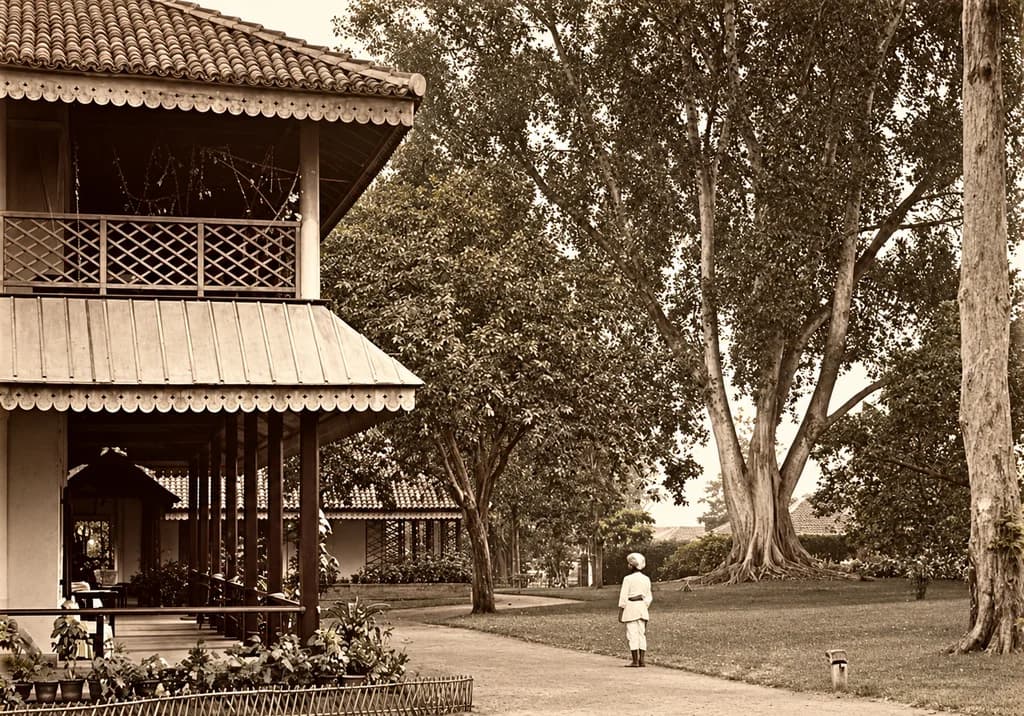
There is no single explanation.
Sri Lanka’s plantation sector passed through enormous changes during the twentieth century. Ownership changed. Estates were consolidated or divided. Management structures evolved. Plantation companies disappeared or were absorbed into larger organisations.
Land reform and nationalisation during the 1970s represented another major transformation in the ownership and administration of plantation land.
Individual estates also faced their own problems.
A property that had once justified a resident manager and a substantial bungalow might later have been incorporated into another estate. Buildings became expensive to maintain. Roads deteriorated. Some structures simply ceased to have a practical purpose.
Once a bungalow was no longer occupied, the hill-country climate could do the rest.
Rain entered through damaged roofs. Timber deteriorated. Roots forced their way into masonry. Gardens became forest.
Within a few decades, a house built to dominate its surroundings could almost disappear into them.
The Strange Beauty of a Ruined Estate
Walking towards an abandoned estate bungalow can be an unusual experience.
The first sign may be a line of stone steps beneath the vegetation. Then a retaining wall appears. Beyond it, perhaps a veranda or chimney remains standing.
Inside, the original arrangement of the house can sometimes still be understood.
A fireplace indicates what was once a sitting room. Sections of patterned floor survive beneath leaves. An old doorway opens onto a room without a roof. Through a broken window there may still be the same mountain view that somebody looked across a century ago.
There is a temptation to romanticise places like these.
But their real history is considerably more complicated.
The Other Side of the Plantation Story
The planter’s bungalow represented only one part of estate life.
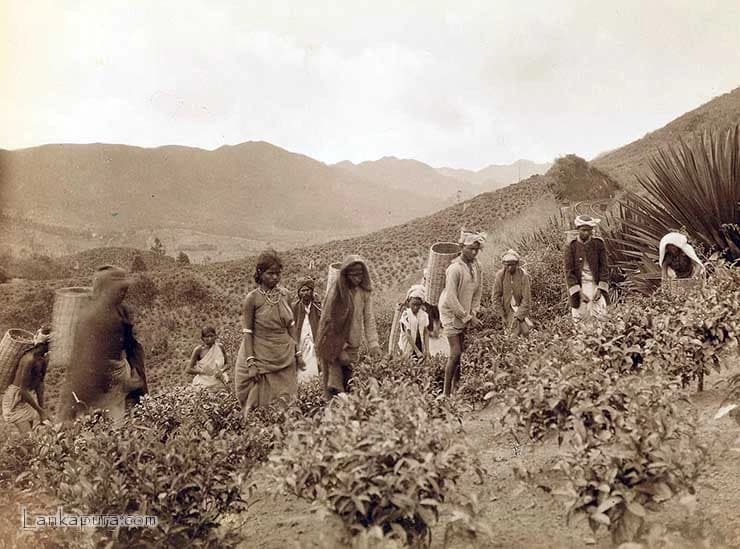
The tea industry depended overwhelmingly on the labour of workers brought from southern India during the British colonial period and their descendants. Generations of plantation workers lived and worked in conditions very different from those enjoyed by estate managers.
Their communities became inseparable from Sri Lanka’s plantation economy and from the development of Ceylon tea itself.
That history matters when looking at an abandoned bungalow.
The veranda, fireplace and garden tell us about the lives of the people who occupied the house. The surrounding estate tells a much larger story about labour, migration, land, commerce and colonial power.
Understanding both produces a far more interesting picture than nostalgia alone.
Where the Stories Survive
The most valuable information about forgotten estates is not always found in guidebooks.
It may survive in old planting directories, maps, company records, newspapers, photographs and family papers. Former estate employees and neighbouring communities can also preserve memories of properties whose names have largely disappeared from public knowledge.
Sometimes even the spelling of an estate changes over the decades.
A bungalow known by one name during the colonial period may have another name locally today. Estates were amalgamated, subdivided or renamed, making their histories surprisingly difficult to reconstruct.
That detective work is part of what makes these places fascinating.
An apparently anonymous ruin can turn out to have connections stretching across several generations and thousands of kilometres.
Not Every Ruin Should Become a Hotel
Sri Lanka has successfully restored a number of historic plantation properties, and adaptive reuse can give old buildings a viable future.
But preservation does not necessarily mean turning every surviving bungalow into luxury accommodation.
Some buildings may be worth conserving simply as historic sites. Others could become small museums, interpretation centres or stopping points on carefully managed heritage trails.
And some ruins may be better documented and stabilised rather than extensively reconstructed.
What matters is recording their history before it disappears.
A collapsed roof can be rebuilt. Lost information is much harder to recover.
Forgotten tea estate bungalows | Exploring Them Responsibly
Many old estate buildings are not public attractions. They may stand on working plantations, government-managed land or private property.
Permission matters.
So does safety. A bungalow that appears solid from outside may contain rotten floors, unstable roofs or weakened masonry. Remote estate roads can also become difficult during heavy rain.
Where possible, exploring with someone who knows the estate is far more valuable than simply arriving with a camera. Local knowledge can turn an unidentified ruin into a place with names, dates and stories.
It also ensures that the communities who actually live within these landscapes are treated as part of the history rather than scenery around it.
A Different Way to See Sri Lanka’s Tea Country
Sri Lanka’s hill country is usually presented through what has survived beautifully: functioning tea factories, restored bungalows, railway journeys and immaculate plantations.
The abandoned estates reveal something else.
They show that the plantation landscape has never been static.
Industries expanded and contracted. Companies changed. Families arrived and departed. Political and economic systems were transformed. Buildings that once represented permanence eventually became redundant.
That is precisely why these forgotten bungalows deserve attention.
They are not merely picturesque ruins hidden among tea bushes.
They are fragments of a much larger history , of Ceylon’s plantation economy, colonial society, migration, labour and the transformation of the highlands.
And as vegetation slowly closes over another veranda and another estate name disappears from memory, there is an increasingly strong reason to document these places while they can still tell their stories.
Visit Us: https://trippingsrilanka.com/stories
More from Old Ceylon
When the King’s Birthday Was Celebrated on Galle Face Green: A Glimpse of Colombo in 1933
Holyrood Estate, Talawakelle: An Old Ceylon Bungalow and a Name That Echoes Scotland