A Fort City Where the Past Still Feels Close
Galle Fort Sri Lanka| There are few places in Sri Lanka where the past feels as close as it does in Galle.
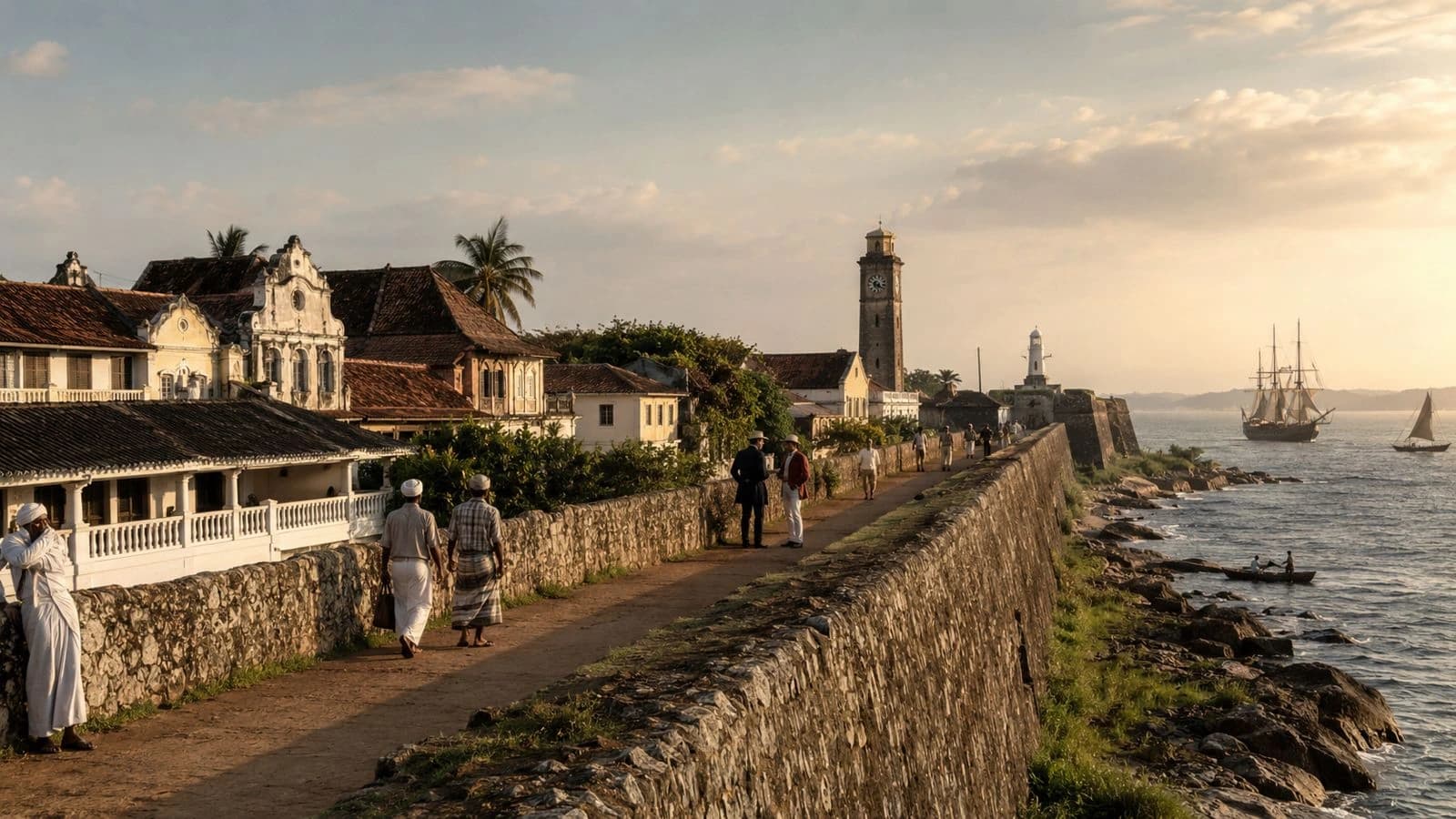
Walk through the old gateway of Galle Fort and the modern city seems to fall quietly behind you. Traffic gives way to narrow streets. Thick stone walls rise beside the sea. Wooden shutters, shaded verandahs and weathered gables recall another age.
The air carries salt from the Indian Ocean, the fragrance of food drifting from old houses and, sometimes, the distant sound of church bells or the call to prayer.
Galle does not feel like a monument preserved behind glass.
It feels lived in.
Behind its ramparts are homes, churches, mosques, courtyards, cafés, small hotels and shops. Children return from school along streets once used by colonial officers and merchants. Families sit outside houses that have watched generations come and go.
This is what makes Galle so special.
It is not merely a remnant of colonial Ceylon. It is an ancient port shaped by centuries of encounters between Sri Lanka and the wider world.
Check our previous article- https://trippingsrilanka.com/stories/galle-fort-sri-lanka-ramparts
Before the Europeans Arrived
Long before Portuguese, Dutch or British flags appeared above its walls, Galle was connected to the great maritime routes of the Indian Ocean.
Its natural harbour offered shelter to ships travelling between East and West. Traders from Arabia, Persia, India and China moved through the region, carrying spices, precious stones, textiles, ceramics and other valuable goods.
Different languages would have been heard near the waterfront. Sailors brought news from distant kingdoms. Merchants negotiated prices while ships were repaired and prepared for their next voyage.
One of the most fascinating reminders of this international past is the Galle Trilingual Inscription, associated with the voyages of Chinese admiral Zheng He.
Written in Chinese, Tamil and Persian, it reflects the varied communities and religious traditions connected through Indian Ocean trade.
Galle was, in that sense, an early cosmopolitan centre — one of the ports where cultures met long before international travel became ordinary.
Its history did not begin with Europe.
The Europeans merely added new layers to a place that was already looking outward towards the world.
The Dutch Character of Galle
The Portuguese established a fortified settlement at Galle during the 16th century. However, it was under Dutch rule, following their capture of the town in 1640, that the Fort took much of the form we recognise today.
The Dutch strengthened the defences and transformed the rocky peninsula into an organised fortified town. Massive ramparts enclosed a carefully planned network of streets, administrative buildings, warehouses, residences and places of worship.
Bastions bearing names such as Sun, Moon, Star, Triton and Utrecht guarded the settlement.
Houses were built with high ceilings, internal courtyards, deep verandahs and large windows suited to the tropical climate.
This was European planning adapted to life in South Asia.
Even today, the Dutch presence remains visible in the Fort’s architecture. Look beyond the restored façades and boutique displays, and you will notice thick walls intended to soften the heat, clay-tiled roofs darkened by monsoon rain and courtyards designed to catch the breeze.
The Groote Kerk and Dutch-Era Survivors
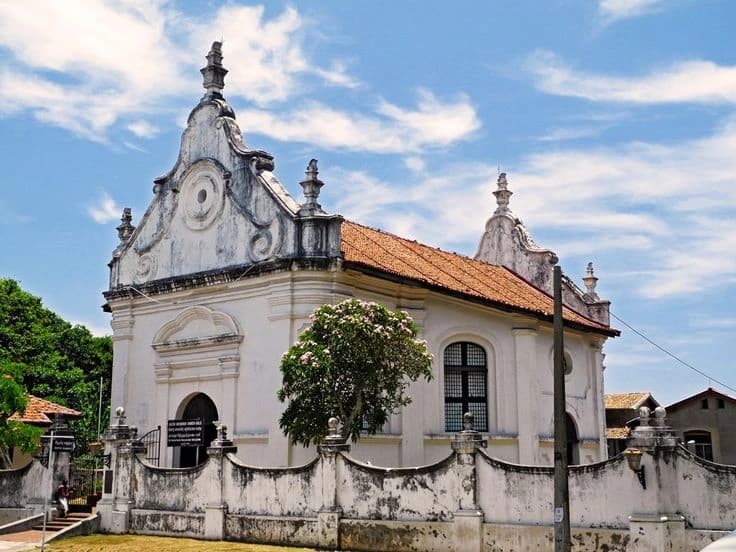
The Groote Kerk, or Dutch Reformed Church, is among the most evocative survivors of the Dutch period.
Its quiet interior, old memorial tablets and simple colonial character recall the families, officials and merchants who once lived within the walls.
Elsewhere, the old Dutch warehouse and hospital offer glimpses of a town built around trade, administration, defence and the daily realities of life beside a busy harbour.
According to UNESCO, Galle reached the height of its development during the 18th century under Dutch rule. Its remarkable fusion of European urban planning and South Asian traditions helped earn the old town and its fortifications World Heritage status in 1988.
When Galle Became British
The British took control of Galle in 1796, adding another layer to the town’s identity.
Unlike the Dutch, they did not need to reconstruct the entire fortified settlement. Instead, they adapted it to suit a new colonial administration.
Buildings were altered, new entrances opened and distinctly British landmarks appeared within the older Dutch town.
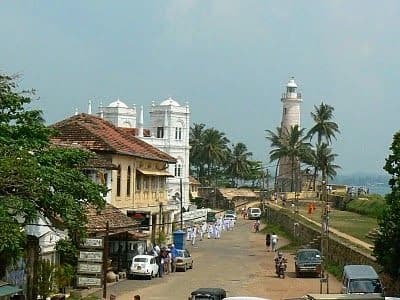
All Saints’ Church brought the character of Victorian Anglicanism to Church Street. The clock tower became a familiar feature above the ramparts, while the lighthouse eventually became one of Galle’s most recognisable symbols.
Under British Ceylon, Galle remained an important southern centre. Government officers, soldiers, merchants and travellers passed through its streets. Inns, offices and residences occupied buildings constructed during earlier periods.
One can imagine a late-19th-century afternoon inside the Fort: horse-drawn carriages moving through the gateway, clerks carrying papers between government offices and travellers resting beneath wide verandahs while waiting for ships.
Galle Harbour and the Shift to Colombo
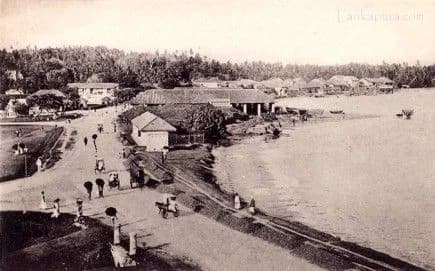
For a time, Galle Harbour remained one of Ceylon’s principal maritime gateways.
Ships called at the southern port. Travellers arrived from across the sea. Merchants, sailors and colonial officials gave the town a busy maritime life.
Its importance declined as the British expanded Colombo into the island’s leading commercial port.
But Galle retained an atmosphere that Colombo gradually lost.
Colombo became larger, busier and more modern.
Galle remained intimate, enclosed and close to the sea.
This is one reason Galle still feels so powerful today. Its old harbour world did not vanish completely. It settled into the stones, streets and sea walls.
A Town Where Many Worlds Met
Galle’s identity cannot be explained through Dutch walls and British buildings alone.
Its true character comes from the people who lived within and around them.
Sinhalese, Muslim, Tamil, Burgher and European communities contributed to the life of the town. Merchants, artisans, sailors, religious leaders, civil servants and labourers all left their imprint upon it.
The proximity of churches, mosques and other places of worship reveals a history more complex than any single colonial narrative.
Street names recall traders, craftsmen and communities who once worked there. Food, language, architecture and family traditions absorbed influences from across the Indian Ocean and Europe.
Galle was cosmopolitan not because it was detached from Sri Lanka, but because it was one of the places through which Sri Lanka encountered the world.
The Fort as a Meeting Point of Cultures
The Fort became a meeting point between foreign forms and local ways of living.
European houses acquired tropical courtyards. Imported recipes met Ceylon spices. Colonial institutions existed beside longstanding communities and traditions.
The result was not entirely European or wholly Asian.
It was unmistakably Galle.
This is why Galle still feels different from other colonial towns. It was shaped by empire, but not swallowed by it. It absorbed influences, adapted them and made them local.
That layered quality is the real spirit of Galle.
Walking Through Old Ceylon
The best way to experience Galle is without haste.
Begin near the old gateway and allow the streets to lead you. Walk past weathered walls, arched doorways and houses painted in soft shades of white, ochre and blue.
Notice the old name plaques, tiled roofs and heavy wooden doors.
Some buildings have been carefully restored. Others still carry cracks, faded plaster and the gentle imperfections of age.
Continue towards the ramparts as the afternoon begins to cool.
The sea appears beyond the walls, restless and blue. Waves strike the rocks below while fishing boats and distant ships move across the horizon.
Galle rewards slow walking.
Its beauty is not only in its famous landmarks, but in the ordinary details between them.
The Ramparts at Sunset
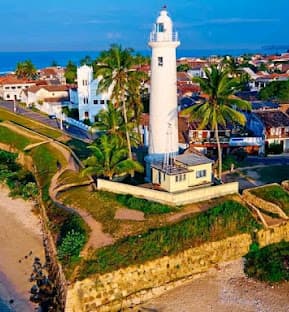
Near the lighthouse, the white tower rises above palms and red-tiled roofs.
Around sunset, families, couples and travellers gather along the walls. Vendors appear with snacks. Children run across the grass. The sky turns gold, then pink, before fading into the deeper colours of evening.
It is a simple ritual, yet it connects today’s Galle with every generation that has stood on those walls and watched the sea.
The ramparts once guarded the town against approaching fleets.
Today, they provide one of Sri Lanka’s most beautiful evening walks.
This is where Galle feels most alive — not as a frozen heritage site, but as a town still using its old spaces in new ways.
Beyond the Picture-Postcard Fort
It is easy to see Galle only as a romantic collection of colonial buildings.
Its cafés, villas and boutiques certainly add to its modern appeal, but the Fort is most meaningful when understood as a living historic town.
People still worship in its churches and mosques. Families still occupy houses passed through generations. Schools, courts and public offices continue to function beside heritage hotels and galleries.
Galle’s charm comes from this coexistence.
The past has not disappeared, and the present has not been kept outside the gates.
They inhabit the same streets.
A Living Town, Not a Museum
A Dutch gable may stand above a contemporary restaurant.
An old warehouse may house a museum.
A British-era residence may welcome modern travellers.
Beneath these visible layers lie older memories of merchants and mariners who knew Galle before its ramparts existed.
This is why Galle must be treated carefully.
It is not merely a tourist backdrop. It is a living town with residents, businesses, schools, religious communities and everyday routines.
The challenge is to preserve its beauty without turning it into something artificial.
Galle matters most because it is still lived in.
The Enduring Appeal of Galle
Galle inspires nostalgia even in those who never knew colonial Ceylon.
Perhaps it is the softness of the evening light on old walls. Perhaps it is the sound of footsteps along a quiet street after rain. Or perhaps it is the awareness that countless travellers have arrived here from across the sea, each seeing the same rocky coastline for the first time.
The city carries memories of Dutch commanders, British administrators, Arab merchants, Chinese navigators, local traders and generations of Galle families.
Yet it belongs fully to none of them alone.
Galle belongs to the meeting of worlds.
Why Galle Matters to Old Ceylon
Galle matters because it holds several histories at once.
It is:
- An ancient Indian Ocean trading port
- A Portuguese, Dutch and British colonial town
- A UNESCO World Heritage site
- A maritime gateway shaped by global exchange
- A living community behind old ramparts
- A place where Sri Lankan, European and Indian Ocean cultures met
- One of the most atmospheric heritage towns in the island
Its ramparts remind us of empire, but its streets tell a richer story — one of adaptation, exchange and continuity.
The Fort survives not simply because its walls were strong, but because people continued to live within them and give them meaning.
Final Thoughts: Where Old Ceylon Still Walks Beside the Sea
To visit Galle is to do more than admire colonial architecture.
It is to walk through the remains of an old maritime crossroads. It is to recall a Ceylon connected to distant shores by wooden ships, seasonal winds and the promise of trade.
It is to discover a town where Dutch heritage, British influence and Sri Lankan life have settled together like layers of history beneath tropical sunlight.
And as evening falls over the ramparts, with the lighthouse behind you and the Indian Ocean stretching endlessly ahead, Galle feels exactly as it should — timeless, worldly and still touched by the romance of Old Ceylon.
Heritage places mentioned
Galle
More from Old Ceylon
When Prince Philip Visited Pedro Estate: The Royal Visit That Became Part of Ceylon Tea History in 1954
When Five Cents Mattered: The Forgotten Small Change of Old Ceylon