Long before the hill country became a landscape admired by tourists, its narrow footpaths were the everyday roads of plantation life. An old Ceylon postcard offers a glimpse of a world that has quietly changed.
An Old Postcard and a Forgotten Path
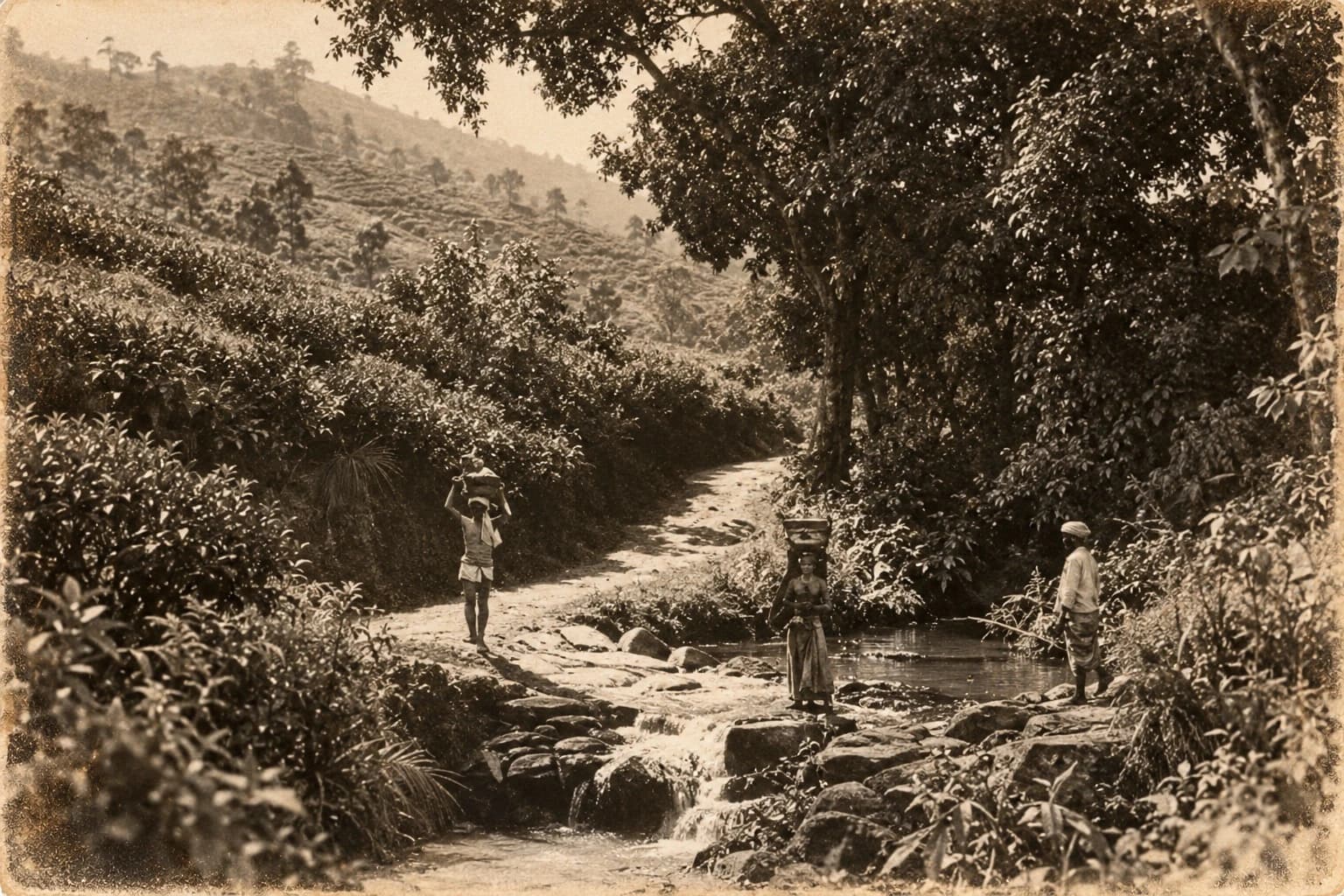
Tea Estate Footpaths in Old Ceylon | There is a little footpath winding through a tea estate in an old photograph of Ceylon. It is not a particularly remarkable scene. There are no grand planter’s bungalows, no railway engines crossing magnificent bridges, and no sweeping views of mountains disappearing into the mist. Just a narrow path, a few trees, a small crossing over a stream, and two figures who happened to be there when the photographer arrived.
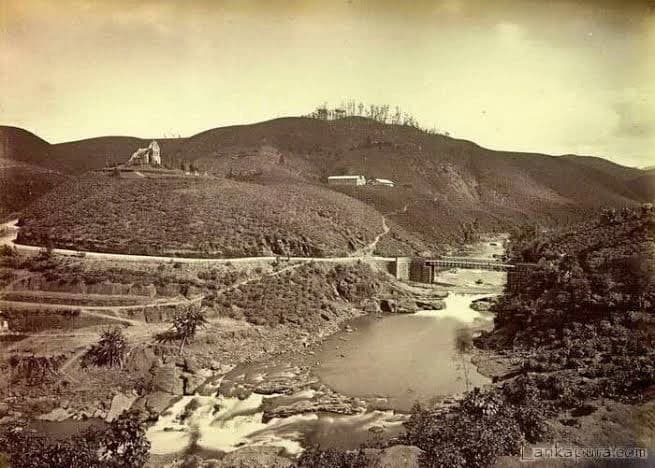
Yet there is something about this photograph that makes one look at it twice. The postcard, published under the name of Plâté & Co., carries the simple caption, A Tea Estate Foot Path, Ceylon. The estate is not identified, nor are the people in the picture. We cannot say exactly when or where the photograph was taken. But the scene belongs unmistakably to the plantation country of Old Ceylon, where paths like these connected the everyday lives of thousands of people.
Today, when we think of the tea estates of Sri Lanka, we usually picture beautifully trimmed tea bushes stretching over the hills, green valleys and the occasional colonial bungalow standing on a distant ridge. The older photographs often present the same romantic picture. Tea country was one of the great subjects of colonial photography, and postcards of its scenery travelled across the world. But the footpaths tell another story.
Before Estate Roads Reached the Hills
Before motorable estate roads reached every section of a plantation, much of the ordinary movement within an estate took place on foot. Narrow tracks connected the workers’ homes to the tea fields, the factory, the estate dispensary, the little provision shops and neighbouring settlements. Some paths were cut into steep hillsides, while others followed streams or passed beneath the shade of trees that had survived the clearing of the surrounding land.
A person who lived on an estate would know these paths intimately. There was the quicker route to the factory, the crossing that became slippery during the rains, and the steep climb that seemed considerably longer after a hard day’s work. Children used the same tracks on their way to school, while women and men walked them to reach their assigned sections of the plantation.
The estate footpath was not something created for pleasure. It was a necessity, connecting different parts of a working landscape long before visitors began coming to the hills to admire their scenery. What appears picturesque in an old photograph was, for those who lived there, simply part of the journey to work or home.
When Coffee Country Became Tea Country
The landscape itself had undergone an extraordinary transformation during the nineteenth century. Much of the central hill country had once been covered in forest, but the expansion of British colonial plantations changed it dramatically. Coffee came first, spreading across the highlands before the devastating coffee leaf disease of the late nineteenth century forced planters to look for another crop.
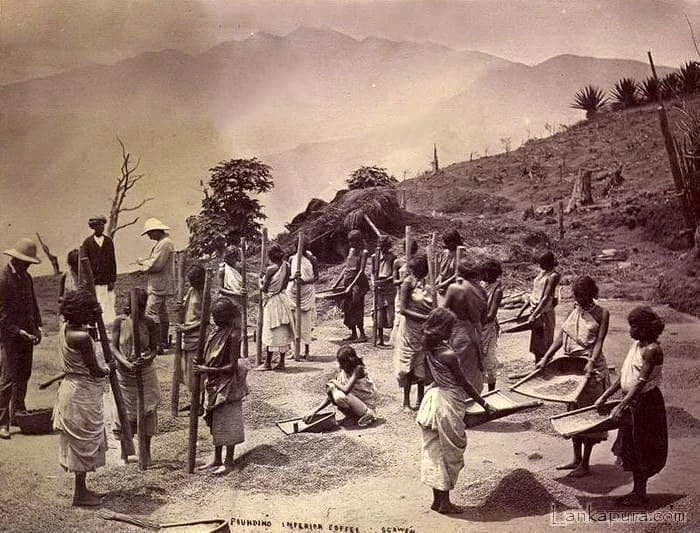
Tea, commercially cultivated by James Taylor at Loolecondera near Kandy in 1867, eventually took coffee’s place. By the turn of the twentieth century, tea estates had spread extensively across the hill country, bringing factories, roads, labour settlements and an entirely different way of life to the mountains.
With the plantations came the communities whose labour sustained them. Many estate workers were brought from South India under the colonial labour system. Their descendants established enduring communities in the hills, developing social, cultural and family lives closely associated with the plantations. The transition from seasonal coffee cultivation to tea, which required year-round labour, helped make these settlements permanent.
Read our previous article: https://trippingsrilanka.com/stories/coffee-blight-of-ceylon
The People Who Walked These Paths
It is easy to forget that the familiar green scenery of the hill country was also a place of considerable hardship. Behind the neatly maintained tea bushes were workers living in line rooms, often with limited facilities and few opportunities beyond the estate. Their working lives were demanding, and the distances they travelled on foot formed part of their daily routine.
The romantic image of Ceylon’s plantations, so popular in photographs and travel writing, rarely conveyed the full reality of the people who maintained them. The tea bushes, factory buildings and estate roads were the visible results of an industry supported by generations of labour. The paths between them were used every morning and evening by people whose names seldom entered official histories.
For the residents of these estates, walking was not an occasional pastime. It was an ordinary requirement of life. The distance between the workers’ settlements, fields, schools and shops shaped each day’s movements, and the same routes were used over many years by successive generations.
The Two Figures in the Photograph
Perhaps that is what makes this particular postcard rather different. The photographer has not chosen to show a tea factory or an impressive estate bungalow. Instead, the camera looks down a modest path, and the human figures are part of the scene rather than its grand subjects. One appears to be standing near the crossing while another is positioned further along the path. Their identities and purpose are lost to time.
Were they on their way home? Had they stopped out of curiosity when they noticed the camera? Or were they simply passing through when the photograph was taken? We will probably never know, and there is no inscription on the postcard to help us identify them.
There is an old-fashioned intimacy about these small details. The uneven ground, the crossing over the water, the trees growing close to the path and the vegetation beside it make the scene feel less arranged than many colonial photographs. One can almost imagine the sound of water below the crossing and the rustle of leaves overhead. These were the places where the ordinary business of estate life unfolded.
Morning and Evening on the Estate
In the early mornings, workers made their way through the plantation country before the heat of the day. During the monsoon, the paths could become muddy and difficult, with streams rising after heavy rain. In the evenings, people returned along familiar routes towards their homes, where cooking fires, conversations and the demands of family life awaited them.
For children growing up on the estates, the footpaths were also places of exploration. A small stream might be somewhere to pause on the way home. A bend in the path could hide a neighbour approaching from another part of the estate. Familiar trees, little bridges and patches of uneven ground became landmarks that needed no signboards.
The surrounding hills were not simply scenery. They were home. What a visitor might describe as a beautiful walk through tea country could be an everyday journey that an estate resident had made hundreds of times. The same path could carry children to school in the morning and their parents home from the fields later in the day.
The Footpaths That Survived Into Modern Sri Lanka
Much of this world survived well into the twentieth century, even as Ceylon became independent and the plantations passed through successive changes in ownership and management. Roads improved and vehicles became more common, but walking remained an important part of estate life.
Those who travelled through the hill country several decades ago may still remember estate footpaths that seemed to disappear between walls of tea, only to reappear beside a stream or a row of old line rooms. Some led through groves of trees and across narrow bridges. Others climbed so steeply that an unfamiliar visitor soon discovered why estate residents were accustomed to walking considerable distances.
Even today, away from the more popular tourist routes of Nuwara Eliya, Hatton, Talawakelle and the surrounding districts, traces of that older network remain. Some paths have been widened into roads, others have been surfaced with concrete, and a few have disappeared beneath new development or changing patterns of cultivation. Yet many continue to serve the communities that live and work among the tea fields.
What the Postcard Photographer Did Not See
Old postcards have a curious way of preserving things that nobody at the time thought particularly important. The photographer may have considered this little footpath nothing more than a pleasing rural scene, suitable for a postcard sent from Ceylon to a friend or relative overseas.
To the recipient, it might have represented the beauty and exotic charm of a distant British colony. To someone who lived there, however, it was simply a path. It led somewhere familiar, perhaps towards home, work or a neighbouring settlement. Its importance came from daily use rather than appearance.
That difference is worth remembering. Colonial postcards often turned working landscapes into scenery, presenting tea country through its hills, fields and picturesque buildings. The people who lived and worked there were not always given the same attention. Yet in this particular photograph, the little footpath has preserved something of their world.
The Forgotten Journeys Behind Ceylon Tea
For generations, the story of Ceylon tea was told through its planters, its factories, its export figures and the reputation it earned in markets overseas. Far less attention was paid to the countless journeys made on foot by the people whose work made that industry possible.
The little path in this photograph was part of that larger history. It may have connected only a few sections of an estate, but it belonged to a network of everyday routes through which entire plantation communities lived their lives. Workers travelled along them to reach the fields. Children used them to attend school. Families followed them when visiting neighbours or moving between settlements.
These paths were as much a part of the plantation system as the factory or the estate road. They did not appear in celebrated engineering photographs, and few travellers thought to record them individually. But for those who depended on them, they were essential.
Where Old Ceylon Still Survives Beneath the Tea
More than a century may have passed since scenes of this kind were recorded on postcards. The people in the photograph have long since disappeared, and the landscape itself may be unrecognisable today. The little crossing may have been replaced, the path widened or the surrounding estate altered beyond recognition.
But somewhere in the hills of Sri Lanka, there are still narrow paths winding between tea bushes, crossing little streams and disappearing beneath old trees. People still use them to reach their homes, schools and places of work, often without giving much thought to how long those routes have existed.
Perhaps that is what makes this forgotten postcard worth looking at again. It reminds us that the history of Ceylon was not made only along its great roads and railway lines. Some of it was lived, day after day, along little footpaths through the tea.
Visit us: https://trippingsrilanka.com/